

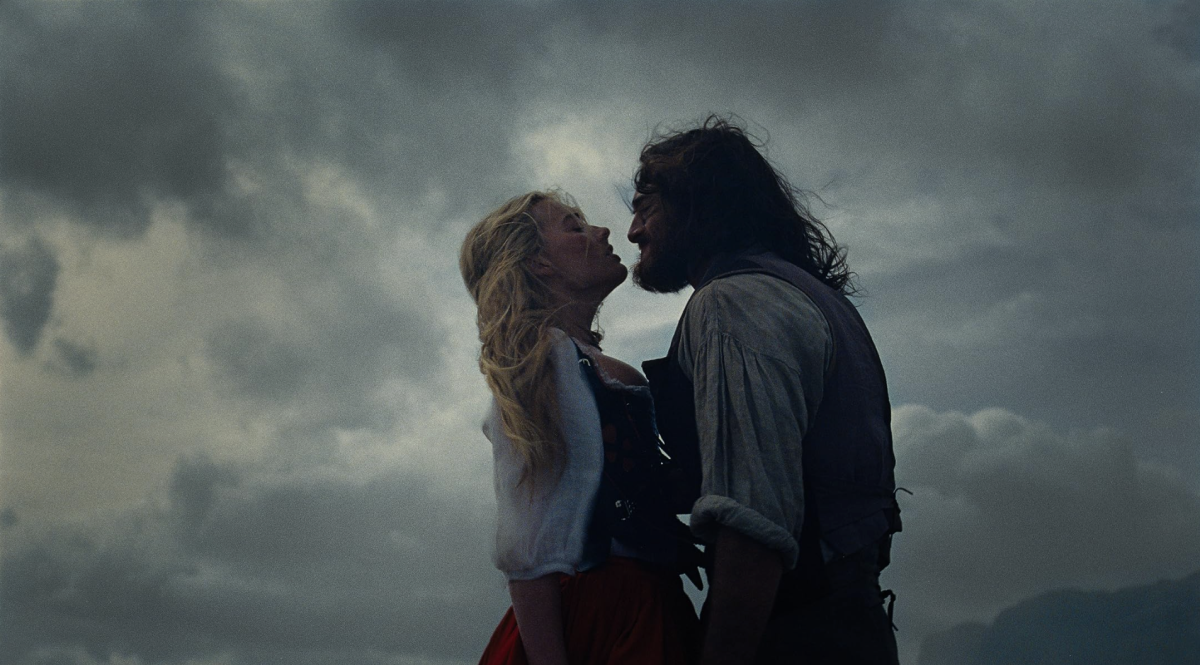

Emerald Fennell’s “Wuthering Heights” takes a shovel to Emily Brontë’s novel of the same name, excavating the novel from its 18th-century roots. The film draws out the toxic byproducts that lie latent in the original manuscript: lewdness and depravity, the macabre and the grotesque and lots and lots of fluid.
Fennell keeps “Wuthering Heights” in quotation marks, editing the book down to the tragedy of Heathcliff (Jacob Elordi) and Catherine Earnshaw (Margot Robbie) and infusing the story with an explicitly carnal, sexual overtone that 18th century audiences — already flustered by the book’s amorality — couldn’t have swallowed. It works delectably.
Following the original plot, the film traces the fate of two families on the Yorkshire moors, the Lintons and the Earnshaws. During the ambiguous but discernible late 18th century, Earnshaw (Martin Clunes) brings Heathcliff, a grimy abandoned child, into his gothic and infernal Wuthering Heights estate. Heathcliff is to be a “pet” for Earnshaw’s daughter, Catherine, and they grow up in mutual moral depravity and physical filth, becoming inseparable complements. As they reach adulthood, the garishly wealthy Linton family settles nearby, erecting a palatial estate just across the moors.
Edgar Linton (Shazad Latif) grows quickly infatuated with Catherine, as his sister Isabella (Alison Oliver) becomes equally engrossed by the scintillating Earnshaw daughter, her obvious foil. Catherine rashly accepts Edgar’s marriage proposal, despite being invariably and secretly in love with Heathcliff, prompting him to flee Yorkshire. He returns some years later a clean-shaven gentleman and the new owner of the Wuthering Heights estate, drained of his physical, but not moral, filth. He and the uncomfortably-married Catherine, now settled at the Lintons’ Thrushcross Grange estate, begin an impassioned affair, which they sustain through games of violent, jealousy-filled brinksmanship.
“Wuthering Heights” makes a series of structural amendments to Brontë’s world. Aside from condensing Mr. Earnshaw and his son, Hindley Earnshaw, into one, the movie also changes the point of view of the narrator. In Brontë’s novel, Heathcliff and Catherine’s love epic is told retrospectively, by Catherine’s lady servant, Nelly. Fennell tells the story directly, giving the film an objective frame that feels more intimate and immediate than the book.
Fennell also willfully ignores that the original Heathcliff is not white. In casting Elordi in the role, she loses the racial complexities that would inflect both Heathcliff’s domestication, identification as a “pet” and the impossibility of him marrying Catherine. This leaves the film with less conceptual dimension and more predictability.
Despite these consequential shifts, Fennell redeems herself through the conviction and vigor of her world. The film, and I mean this quite literally, is disgusting. Base. Vile.
Fennell’s gothic Yorkshire is rife with imagery of distorted ragdolls, rooms littered with rotten food, sweating, flushed skin, splattered blood, sebaceous egg yolks and suffocating reds everywhere. The camerawork alters between sweeping shots of the hazy moors, brooding images of the vampiric and dilapidated Earnshaw estate and tight, wet close-ups of Elordi’s scarred back or Robbie’s tightening corset strings. The textural richness is delightful, and masterfully complemented by a swooning and evocative sound design.
Even as we leave the grime of Wuthering Heights and follow Catherine to Thrushcross Grange, we find nothing pretty. Scenes from the Lintons’ near-absurdist estate feature flesh-toned, veiny walls, blood-red marble floors and a towering mantelpiece made of chalk-white human hand replicas. Catherine feels trapped in a violently colorful fever dream. We are stuck with her in this sickening lollipop world, left yearning alongside her for the derelict Heights.
The massive scale and totality of this world completely justify the musical accompaniment of pop phenom Charli XCX. Hers is a colossal sound that melds heartbreak with tempestuous rage, jealousy, insecurity and eternal love. Her lead singles from the eponymous soundtrack album are as alarming, gratifying and earsplitting as the film itself. Within the screenplay, a mix of strings and isolated synths dutifully complement the plot as it moves from tender to violent and back again.
Fennell’s most interesting choice was her command of animalistic motifs. At both estates, we are spoon-fed close-cut images of dead and bleeding livestock, slithering leeches and slugs, broken egg remains and jellied fish. In one scene, after Heathcliff has revenge-married Isabella Linton, we see her chained to the fireplace in Wuthering Heights, yelping and crawling as Heathcliff’s dog. This repeated choice both works to show the dehumanizing effects of the Heights and adds carnal, corporeal textures to its already rich textural lexicon. It also drives the thesis of the film’s aesthetic styling: Even the grossest, basest and most violent human creations can somehow transcend into passion and pleasure.
I anticipated the two leads, acclaimed for moderns like “Saltburn” and “I, Tonya,” to conflict with the setting and sensitivities of Brontë’s story. In Fennell’s adaptation, though, they fit right in. Though Elordi’s performance was impressive, it felt commonplace for him as a tall, beautiful man and alumnus of twisted cinema. Robbie, however, again proved her versatility. She played Catherine’s lifelong tempestuousness, melodrama and capacity for cruelty exceptionally well. Her Catherine was animated with a larger-than-life hyperbole that still felt genuine.
Overall, the film was a touch too swollen. A favorite moment in this film was Heathcliff reminiscing on his childhood with Catherine, a last act of pleading as he clings to her dead body. The movie sadly overshadows these tender moments by giving the audience too many motifs and horrific images to leech onto. Fennell tells us that the lovers’ souls are just as intertwined as their bodies, but her busy film doesn’t allow her to prove it to us. This crowding-out effect causes the film to feel monotone, stuck more on hot, rushed passion than deeply felt yearning. Even so, that passion is insatiable.
“Wuthering Heights,” quotation marks emphasized, will not please everyone. The Brontë purists, the casual watchers looking for an Austenian lightness and the easily disturbed will find this lewd movie off-putting. But for those of us who are ravenous, wildly bored with the mundane and thoroughly incensed by aesthetic grandeur, a transcendent world of pleasure, horror and tragedy awaits.