


Chloé Zhao’s “Hamnet” is a visually stunning breath of fresh air. Released in Nov. 2025, the historical drama showcases breathtaking cinematography, a devastating score and an acting masterclass from Jessie Buckley as Agnes Shakespeare. Its ferocious intensity and poignant nature make it one of the year’s most memorable films.
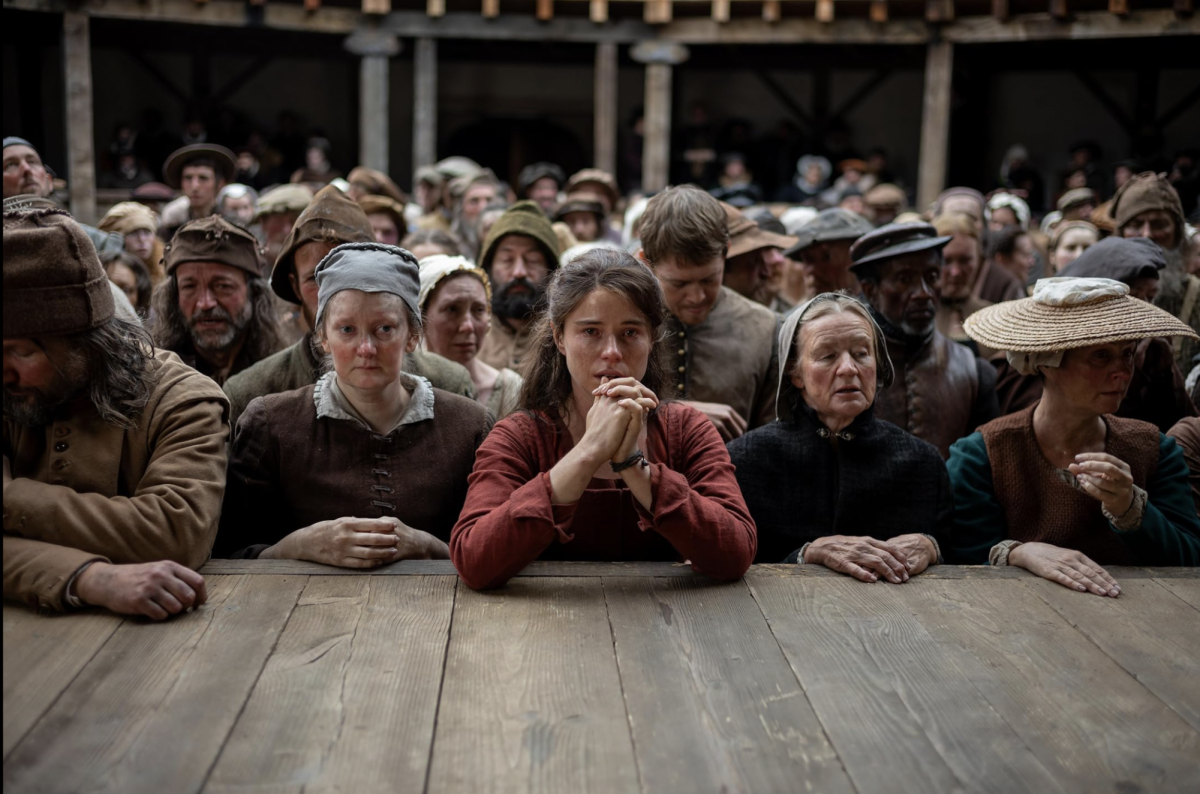
Based on real events, “Hamnet” follows the lives of Agnes and William Shakespeare (Paul Mescal) in the 1500s as they raise their children and ultimately wrestle with the death of their son Hamnet (Jacobi Jupe). The film primarily centers on Agnes as she meets William and starts a family with him. Raised in close proximity to nature, Agnes raises her children, Susanna (Bodhi Rae Breathnach) and twins Hamnet and Judith (Olivia Lynes), to be surrounded by nature as well. At age 11, Hamnet dies of the plague, and Agnes and William must cope with the grief and loss of their son. Hamnet’s death inspires William’s play “Hamlet,” and its initial staging at the Globe Theatre displays the extraordinary healing powers of art as Agnes smiles again for the first time since Hamnet’s death. The film is less focused on being an accurate biography and more on the impact of loss and the journey to healing.
The film’s cinematography strikes a deep chord through its lush landscapes and soft lighting, conveying the story’s beauty and emotional intensity. From the beginning, there is a strong emphasis on Agnes’s connection to nature and her surroundings. Cinematographer Łukasz Żal emphasizes this connection through wide shots of the forests where Agnes spends her time, highlighting the light filtering through the trees and the freedom nature brings her. The interior shots are filled with darker colors and soft, moody lighting, a stark contrast to the vibrant open spaces of the English countryside. Both settings, however, feel fluid and connected as Żal’s camerawork shifts evenly and openly between shots. The home feels comforting, while nature provides balance through its wild, unknown tangles. There seems to be a close, almost symbiotic connection between the characters and the environment they live in — every setting is tied to a specific character, and each is framed to seem most natural in that setting.
Max Richter’s minimalist score provides texture and cohesion to the film while capitalizing on its emotional nature. Richter uses a blend of orchestral and vocal elements that offers nuance and resonates with each of the characters’ emotional states, particularly Agnes’s. During moments of turmoil, a women’s choir can be heard, emphasizing the themes of women’s love and loss throughout the film. Overall, the score’s tonal quality is subtle and ethereal, yet full of emotion. The piece that stood out to me the most, however, was Richter’s “On the Nature of Daylight,” used during the film’s climax. The piece was originally part of a separate 2004 Richter album, “The Blue Notebooks,” but was ultimately included in the final score of “Hamnet.” The song’s quiet, building harmonies perfectly complement Agnes’s turmoil and final revelations as she watches the performance of “Hamlet” in the film’s finale.
While the film had a multitude of praiseworthy technical and directorial aspects, what ultimately stood out to me most was Buckley’s outstanding performance as Agnes. The film revolves almost entirely around her, allowing her to display a wide range of emotions and tremendous acting capabilities. Buckley’s raw, emotional performance stands out for its intensity, especially in its portrayal of the complexities of grief after familial loss. Her unfiltered physicality felt almost uncomfortable for its intensity. Buckley made Agnes feel real and alive, not just a historical figure, but a mother and wife dealing with separation and trauma. Her grounded fervor helped convey Agnes’s connection to the natural world she grew up in, and her anguish felt gritty and powerful. Buckley’s memorable performance is the heart of “Hamnet,” and her presence constitutes the final element the film needed to feel fully cohesive.
“Hamnet” struck me as a particularly beautiful effort to highlight the importance of performance and cohesion in cinema. Zhao’s stunning film had me in tears by the final moments, and while the depth of emotion a film induces should not be the defining factor of how good it is, its overall impact still left me stunned. I highly recommend it for its remarkable cinematography, soundtrack and performances. This is undoubtedly a film everyone should see at least once in their lives.


