


For anyone familiar with Mitski’s work, her trademark melancholy has pulled at many listeners’ heartstrings, including my own. While the singer-songwriter’s themes do not define her — she proved her range as an artist with her synth-pop record “Laurel Hell” — her art is at its finest when working with the somber colors and tones she’s gracefully and meticulously made her own.
On her newest record, “Nothing’s About To Happen to Me,” her feelings of denial are not merely titular, but they pierce every song on the tracklist. She grapples with the feelings of losing control over one’s life and agency and being so tied down that to move would certainly mean uprooting all one’s ever known.
As an avid Mitski fan, the cover instantly caught my eye. The streaming cover depicts a painted portrait of a white cat staring directly at the listener, and the vinyl cover reveals another perspective, showing the white cat sitting calmly as an orange, sharp-toothed feline is suspended mid-pounce, chaos surely imminent. This feeling of impending and inevitable doom is characterized throughout the album, such as in the track “Dead Women,” which explores how a woman’s reputation molds and shifts to a sanguine narrative after her death, replacing her nuanced and perhaps painful life. There’s no care given to the dead woman, nor is her presence in life at all important to the role that she now plays. As Mitski states plainly, “She gave her life so we could fuck her as we please.” The album’s white cat also breaks tradition, leaving Mitski absent from the cover. To the viewer, she is removed from the narrative.
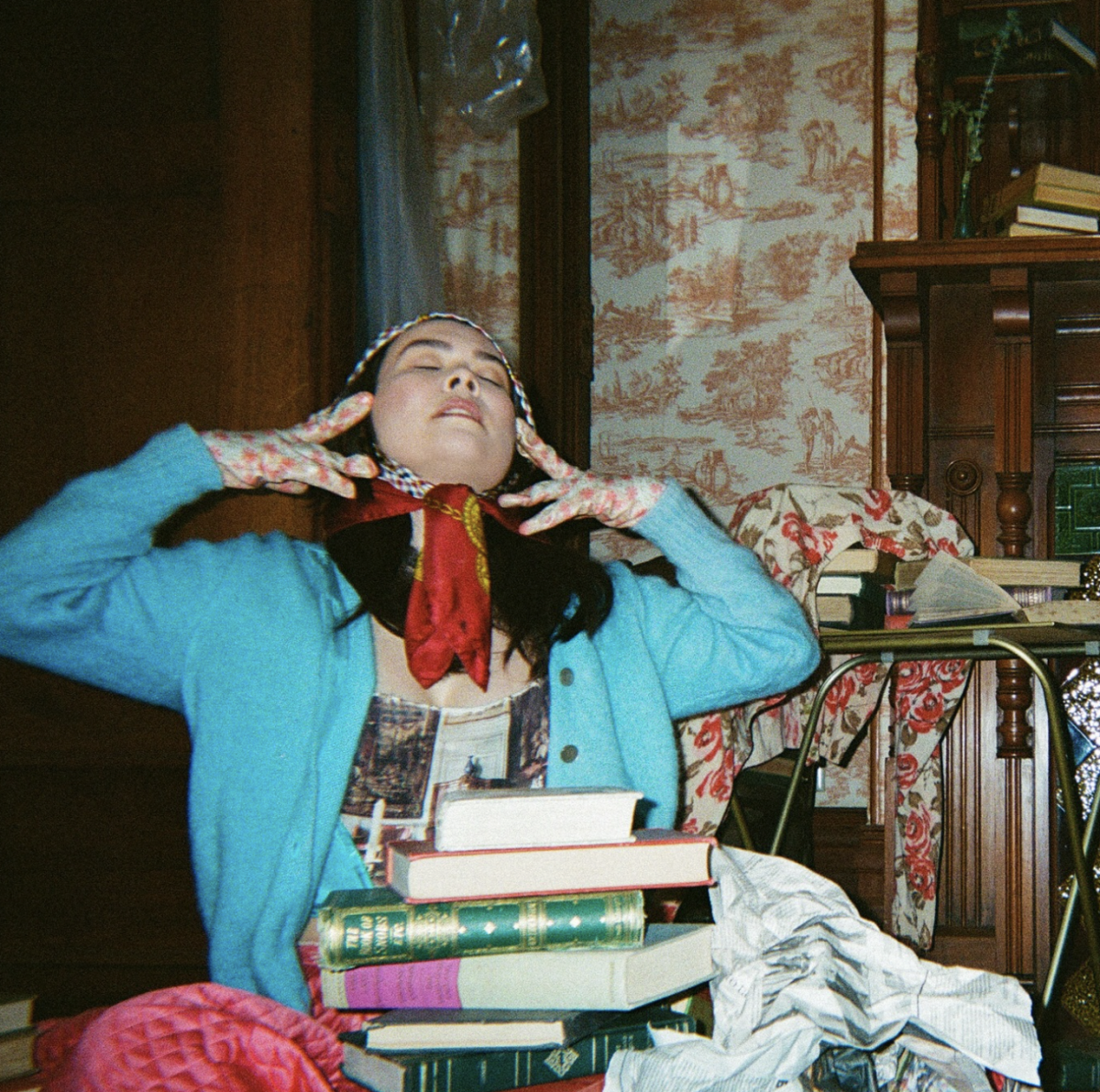
And yet, it seems the album’s concept puts her more in the spotlight than any other album has. Tourgoers at Mitski’s residency at the NYC venue The Shed had the opportunity to explore “The Tansy House,” a house inhabited by an eccentric female character featured in Mitski’s music video for “Where’s My Phone?”. In both the video and the exhibit, “The Tansy House” is eccentric and wild, with sticky notes abound (a motif that is also visible on the vinyl’s inner cover) and shelves stuffed with knick-knacks across disconnected decades. Mitski herself is hard to miss in her new visuals, as she is opulently dressed in a red bowler hat with a green and red coat that features a unique tartan plaid pattern and donning bright blue eyeshadow. She feels completely in control, even while the album explores a lack of control.
Despite the control Mitski seems to have, the album’s sentiments feel clear — “I’ll Change For You” is a somber song about relinquishing one’s self for the validation of another, and “If I Leave” sees the narrator losing control to their partner in their over-dependency. “Rules” even features lyrics listing literal rules that put the narrator in a horrible position within their relationship, which ultimately destroys them from the inside. The writing seems to repeatedly emphasize a lack of control, while the aesthetics represent eccentricness, individuality and a house that is so clearly that of the narrator, creating an ambiance that implies control within the mess. We see both lack of agency and autonomy — but which is it?
The bridge between these two seemingly warring implications lies in the psychological inferences gleaned from a person’s home, as laid out by Mitski’s creative director, Mary Banas. Banas mentioned author Shirley Jackson’s distinct brand of domestic horror as an inspiration, which related the house’s state to the narrator’s internal mentality, a link I initially missed. Now, I’ve established that I am quite the Mitski fan, so when I went back to my deluxe autographed vinyl that I preordered for this project (not-so-subtle brag), the lyric sheets caught my eye. They had been designed to be in-universe scribbles on note sheets with the Tansy House emblem.
In Sydney Gore’s interview with her, Banas explores the idea that houses are almost reflections of those who inhabit them, and I believe the same is the case for both the Tansy House and the songs on the album. Though the songs themselves are melancholic and woefully dark, they serve as reflections of the narrator (and likely of Mitski herself) in the same way that the house does. The narrator’s mind, left in isolation in the Tansy House, creates a trap for itself through its lack of agency. Having to express itself somehow, it frees itself artistically; her ideas, thoughts and emotions explode across the house and onto her songs in an eccentric blast.
What is left, then, is the story of a woman who, through forced isolation — be it due to trauma, fear or other factors — found autonomy only in her home and her songs. Oxymoronically, an album which overwhelmingly discusses a lack of control over the anarchy of living displays the vast control and security that the narrator has within her home, but even that might be getting away from her. As she hears thunder nearby her home on “Lightning,” she sings, “I can hear the song of my death / Singing for the lightning to come.” The lyric is phrased in such a way that it conveys that death is not something she wishes for but, rather, something she accepts as a brutal inevitability. It’s a tear-jerking ending that lives up to her reputation for evoking emotions in the listener… Mitski doesn’t have me crying, you’re crying!


