


The best part of “Mercy” is the clock on the screen counting down to its end. The movie goes downhill from there.
“Mercy” relies entirely on sci-fi cliches, stilted action sequences and hopelessly uninteresting performances from its two leads, registering as nothing more than a complete dud.
But before reaching a verdict, let’s present an opening statement. “Mercy” follows Los Angeles detective Chris Raven (a perfectly generic Chris Pratt) after he awakens in the Mercy Court, accused of the murder of his wife. The Mercy Court was established, a helpful exposition dump reveals, after a wave of violence in a near-future, dystopian Los Angeles led to soaring crime rates. With the traditional legal system overrun and failing to hold criminals accountable, Los Angeles turned to an option free from the “emotion” which supposedly clouds jury verdicts — artificial intelligence (AI).
Mercy Court is led by an AI judge, Maddox (Rebecca Ferguson), who gives defendants a conveniently movie-length 90 minutes to prove their innocence or face execution. Helpfully for the easily-distracted viewer, the court displays both a “guilt meter,” which Raven must lower to 92% to be acquitted, and a clock, which counts down towards his execution if he fails.
As the movie’s opening sequence says without a hint of irony, Mercy Court acts as “judge, jury and executioner” and defendants are “guilty until proven innocent.” Throughout the movie, Maddox offers additional, boring exposition of her role and the setting. To portray Maddox’s artificiality and lack of emotion, Ferguson uses just one expression throughout the movie — quizzical.
However, the audience also learns that Raven played a key role in the establishment of the Mercy Court, which makes Maddox’s lines neither meaningful within the movie’s own framework nor beneficial to the audience’s experience. If, as the backstory reveals, Raven was intimately familiar with the Mercy Court’s operations, these lines, which occupy a significant portion of the runtime, are completely unnecessary for him. Further, the premise is already explained to the audience in the opening 90 seconds. At some point, Maddox’s diatribes on the court’s operation start to feel a lot more like blunt blows with a hammer than meaningful dialogue.
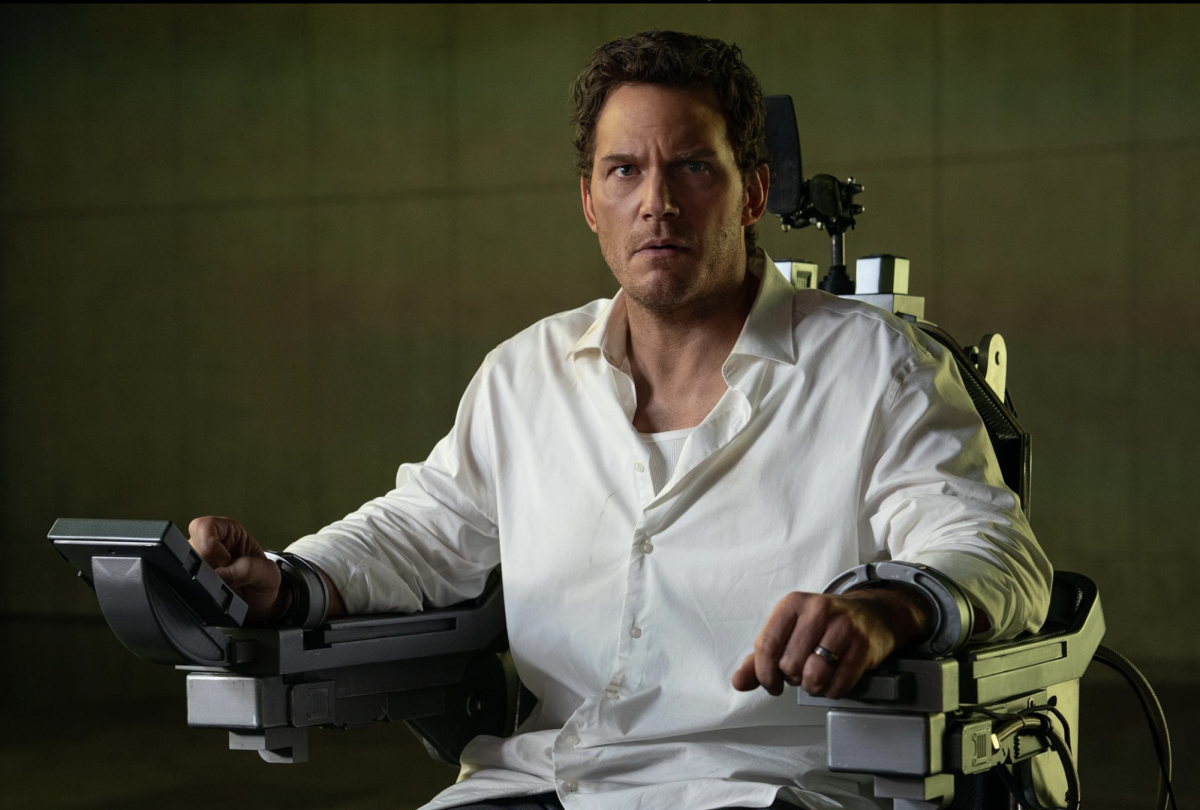
Raven, tied to a chair in a blank concrete room, has access to an alarming amount of data on the citizens of Los Angeles and can use that information to attempt to prove his innocence. His interlocutor, Maddox, is — by her artificial nature — emotionless, but this fails to coax much in response out of Pratt’s acting, which is as wooden as his machine counterpart. While Raven has his emotional moments, they are so stock and lifeless that it is hard for the audience to get much out of them. Despite his character’s humanity and personal woes, Pratt’s acting renders Raven about as lively as his artificial counterpart.
If this sounds like the basic premise of “Minority Report,” poorly adjusted for the modern age, that’s because it is. “Mercy” steals many of its notions of what justice might look like in the near future from Steven Spielberg, but fails to do much with them. The twists in “Mercy” range from predictable to unearned and, while the solution to the movie’s central mystery is shocking in terms of the reversal of certain supporting characters, it is not particularly interesting nor does it merit the emotional response it was seeking.
In fact, the movie’s third act works to undermine much of its initial messaging about artificial intelligence. By the final minutes, AI becomes a force for good that, just like humans, makes mistakes but learns from them; nevermind the fact that those mistakes are the execution of innocents. There is little emotional satisfaction in the movie’s climax, which aims to resolve both the mystery and Raven’s personal problems, but leaves untouched what exactly happens to Mercy, Maddox and the city.
Perhaps the case will start to unravel with a little more detail. “Mercy” is the newest directorial effort from Timur Bekmambetov, the pioneer of “screen-life” filmmaking, which sets a movie on a computer screen. Much like the terrible 2025 adaptation of “War of the Worlds” (also produced by Bekmambetov), the format of “Mercy” is intriguing in theory but disappointing in practice. Though the movie is shot for IMAX and 3D, it is set almost wholly within a confined room with projected video calls to equally lifeless supporting characters.
Around the midway point, the viewer may notice that almost every shot of a vapid Pratt or stone-faced Ferguson is center-framed. While “Mercy” is officially for premium formats, it feels like Bekmambetov intended the film to be watched in 60-second increments on a phone screen above Subway Surfers gameplay. This might explain the plot’s genericness far better than anything else.
The video call setting robs much of the visceral feeling of the movie’s action sequences, despite a couple of nifty computer-generated imagery (CGI) tricks during a particular latter-half scene. For the most part, the cinematography and directing are just as generic as the story and acting.
The only reason to see “Mercy” is for the “so bad, it’s good” effect, but it’s hard to say that the film even reaches that mark. Like its AI judge, “Mercy” is one thing for sure — generic and emotionless. The prosecution rests.


Nicholas Balabanoff • Feb 23, 2026 at 11:13 pm
Said what I was thinking