


What happens when a franchise built on the subversion of horror cliches finally succumbs to them? With “Scream 7,” a series once defined by its satirism of slasher formulas is forced to face whether “Scream” has become exactly what it was created to mock.
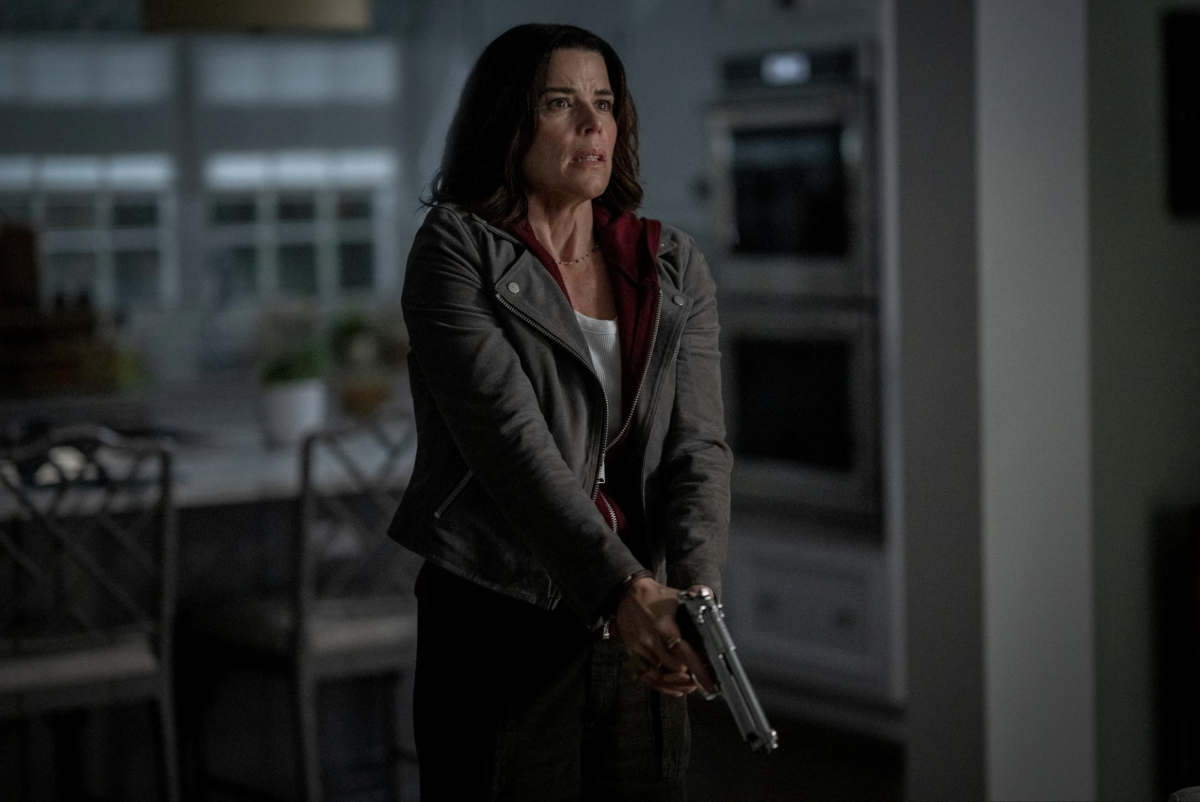
Since the release of the original “Scream” in 1996, the series has purposefully toed the line between slasher-style horror and self-aware satire, examining common tropes of the genre while simultaneously employing them. At the center of this formula is the protagonist and eternal final girl, Sidney Prescott (Neve Campbell). In “Scream 7,” Sidney returns as the main character for the first time since “Scream 4,” now settled into life in small-town Indiana with her husband, Mark (Joel McHale), and teenage daughter, Tatum (Isabel May). Naturally, Ghostface, the familiar mantle taken by all “Scream” villains, is back to target Tatum and her friends.
The film’s strongest suit is its set design creativity. In one sequence, Ghostface murders Tatum’s friend, Hannah (McKenna Grace), during a theater rehearsal while she hangs mid-scene from a harness, rendering her completely powerless as Ghostface attacks her. A similar vulnerability is exhibited by Tatum and Sidney in a scene where they hide inside the narrow walls of their home as Ghostface stabs through the drywall they are wedged behind, forcing Sidney to improvise an escape.
Unfortunately, these few exciting scenes are unable to overcome the lack of foundation that the movie suffers from, specifically in its absence of character depth. The majority of the cast consists of newcomers, making “Scream 7” lean heavily on the crutch of creative production design and shocking gore. However, the Ghostface attacks’ chilling violence still doesn’t thrill the audience, as viewers have no reason to care about the outcomes of these characters. As for the characters that long-time viewers should care about, even they fare poorly. Sidney and familiar newscaster Gale Weathers (Courteney Cox) return as insufficient caricatures of themselves — most glaringly, with Sidney making careless mistakes completely out of character for a girl so well-versed in survival. Meanwhile, the extremely publicized return of Matthew Lillard as Stu Macher from the original “Scream” was exceptionally disappointing. Rather than fully committing to the popular fan theory that Stu survived the events of “Scream,” the film plays it as safe as possible, with Lillard returning as an AI rendering of Stu, rather than the character reborn.
The film’s disjointed character roster is especially disappointing considering the groundwork laid by the two preceding “Scream” installments, which established the daughter of Billy Loomis (Skeet Ulrich) as the scream queen of the next generation, alongside her sister, Tara (Jenna Ortega). Their dynamic successfully held its own, even allowing for protagonist Sidney’s absence from “Scream 6” to feel natural; the “final girl” torch had been passed.
This momentum collapsed, though, following the 2023 firing of Barrera over several Israel social media posts decrying Israel’s violence in the Israel-Hamas war, prompting Ortega to depart from the project in solidarity. The result is this movie’s centering on Sidney being less triumphant and more like desperate damage control — the “final girl torch” was awkwardly thrust back into Neve Campbell’s arms, along with a lazy script and a $7 million salary to soften the blow.
The final act only compounds the film’s glaring issues. In “Scream” movies, the unmasking scene that reveals who has been executing the murders all along is generally the most satisfying scene of the whole film — it’s when all of the pieces finally fall into place. This Ghostface reveal, though, was easily the worst in the franchise, with the killer’s motivations seemingly retroactively formulated and especially unsatisfying considering the guilty party was selected from characters so inconsequential that it was hard to remember whether they’d even been seen before.
At its best, “Scream” is more than just a franchise of horror movies, but also a teasing tribute to the genre. Its characters weaponize trope awareness, with the formulaic nature of slasher movies serving as a punchline as well as a survival guide. Simultaneously, the films criticize Hollywood’s obsession with disrespecting the victims of true crimes and its insatiable appetite for cash-grab sequels. “Scream 7,” in contrast, has little room to criticize, as any criticism carried over from previous films would only be hypocrisy.
“Scream 7” is an embarrassing departure from the franchise’s roots, built upon recycling familiar, tired faces and begging audiences to applaud their return, because, apparently, in Hollywood, nostalgia sells. And “Scream 7,” indisputably, sold, as it is the highest-grossing of any previous movies in the franchise. What “Scream 7” delivers, though, is far from the self-aware satire viewers are nostalgic for in the first place, leaving nothing but a hollow, desperate imitation, as the movie becomes precisely the type of slasher flick that “Scream” (1996) once gleefully dissected.


