

The Georgetown University Pivot Program, which supports formerly incarcerated individuals, welcomed 15 new fellows to its eighth cohort for the 2025-26 academic year.
The Pivot Program, led by Georgetown’s Prisons and Justice Initiative (PJI) and the McDonough School of Business (MSB), provides career development to formerly incarcerated individuals through classes and hands-on internships with the goal of reentry into the workforce upon completion of the program. The program boasts an 80% completion rate and has graduated 92 fellows, 91% of whom are employed within three months of completion, according to the program webpage.
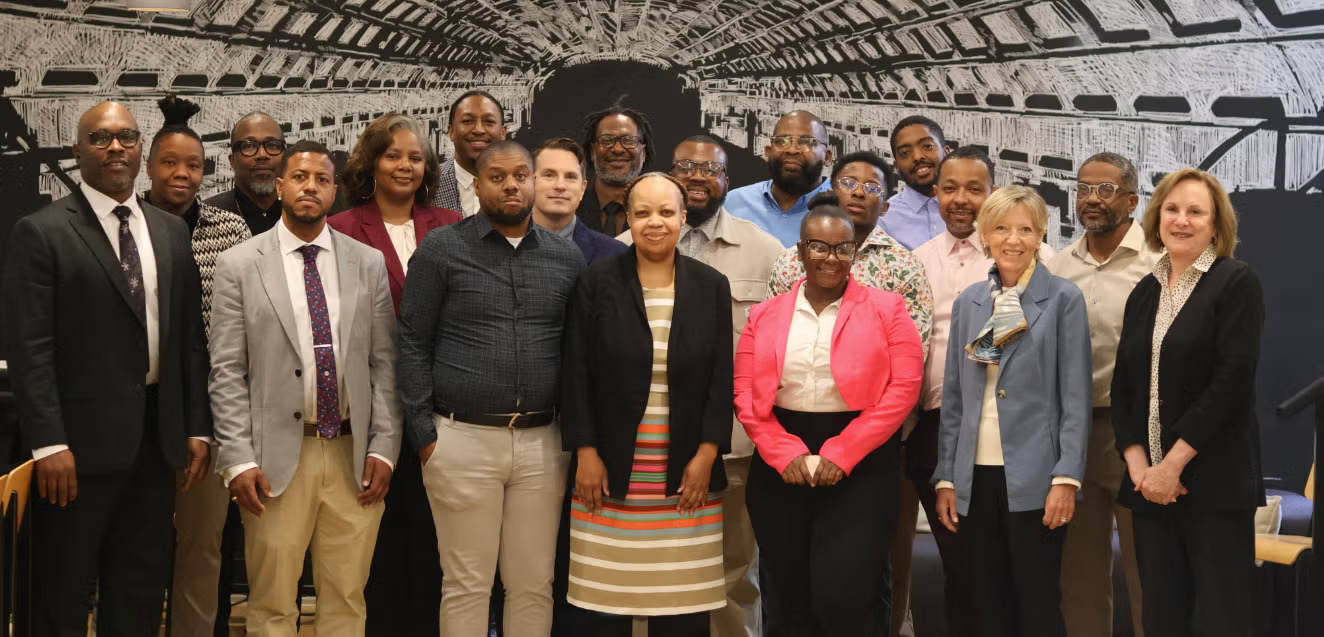
Loniece Hamilton, one of this year’s fellows, said the courses offered through the Pivot Program present fellows with a unique opportunity.
“The classes that I have been attending, I would not have had access to in my everyday life,” Hamilton told The Hoya. “I feel as though they’re helping me grow my brain and who I’m becoming as a person.”
The other fellows this year include Bryan Burwell, George Brown, DeAnthony Campbell, Diego Cunningham, Tre Edmundson, Jamal Francis, Earnest Hanible, Allister Kennedy, Melvin McClean, Justin Moore, Leon Richardson, Tevin Richardson, James Robinson and Celeste Santifer.
Moore said the program’s goal is to prepare the fellows for a working environment.
“The goal is basically to get us acclimated to working in a business environment with a focus on entrepreneurial skills,” Moore told The Hoya. “It’s teaching us how to function — whether we want to start our own business or get a job in the real world.”
Moore added that he hopes to use the skills he learns through the Pivot Program to maintain a business, building on his experience prior to incarceration.
“I had my own business, but I didn’t really know how to run a business,” Moore added. “I’m hoping that this program will help me if I want to start a business again with the skills I need to keep that business going.”
Tevin Richardson said his experience in the Pivot Program has changed his worldview.
“Not only am I really into Pivot, but I’m really into this transition that I’ve made,” Richardson told The Hoya. “The Pivot Program for me has been transcendent. We only know what we know, but when we allow ourselves to reach beyond that, we get the opportunity to see something different.”
Hamilton said she is optimistic about her future after her time as a Pivot Fellow.
“I cannot wait to see what the future holds for me with this new journey, so I’m definitely excited,” Hamilton said. “They’re preparing me for a lot of things I need within the working environment. After my incarceration, they taught me a lot of things I didn’t know.”
Previous fellows have opened their own businesses, become criminal justice reform advocates and worked for PJI.
Hamilton said she hopes the program will enhance the entrepreneurial skills she gained while managing a commercial vehicle prior to her incarceration.
“Before my incarceration, I had a box truck. I’m focusing back on that to see how I can get funding for it and how to better myself as an entrepreneur,” Hamilton said. “It’s for me to better my skills within the working class, and I want to see if I can further enhance those skills that I already have.”
Richardson said that after his time as a Pivot Fellow, he hopes to work as a reentry coordinator, a position within PJI that helps other formerly incarcerated people.
“I want to help individuals coming home from long times of incarceration to be able to find the help and the resources they need, because I understand how important it is to have that support,” Richardson said. “I want to be that person who is the go-to for individuals coming home and trying to better themselves.”
Moore said the Pivot Program is providing him with a second chance that he never expected to get.
“It means a second chance and a change from where my life was headed before this,” Moore said. “I really didn’t know what I was going to do when I got out. I don’t know what I would have done, where I would have worked, or how I would have even begun to find a job if it wasn’t for the program.”
Richardson said having Georgetown’s support is a dream fulfilled.
“As a native Washingtonian, being involved with Georgetown in any shape or form is a dream come true,” Richardson said. “Having Georgetown behind you, and its network and resources is priceless — it’s invaluable.”