
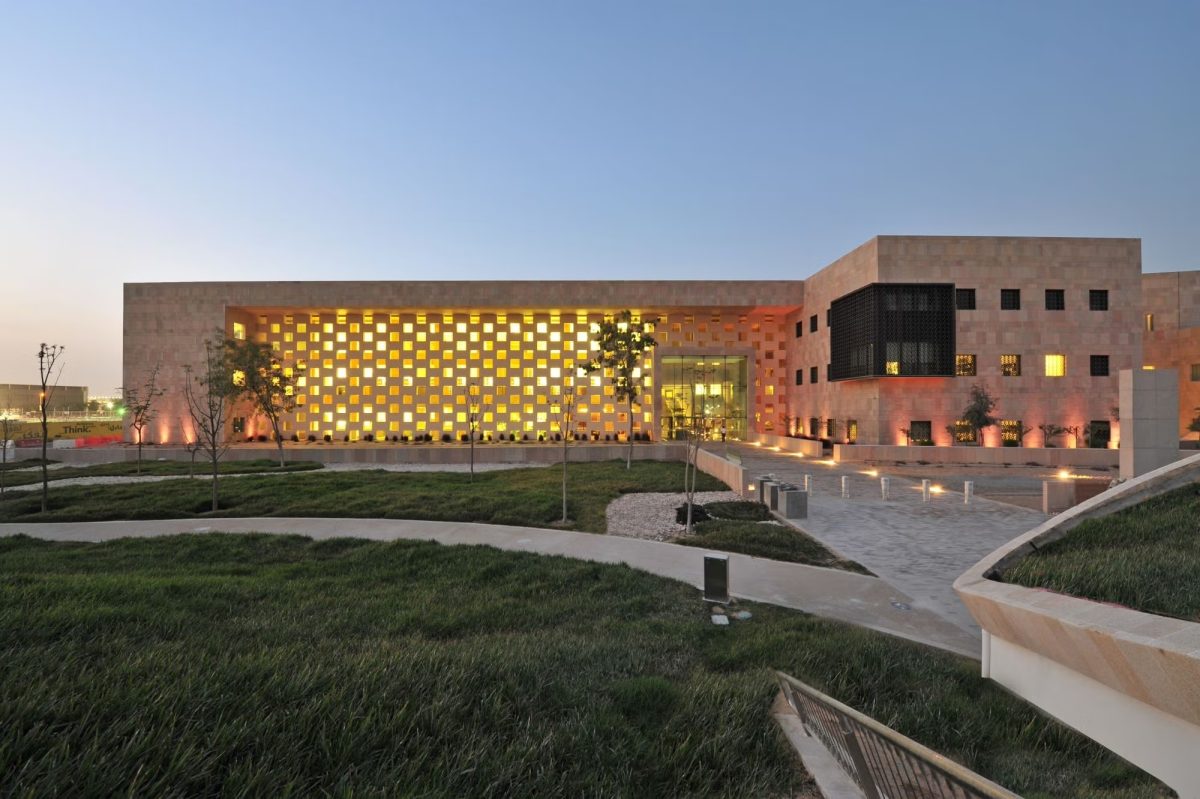
Georgetown University in Qatar (GU-Q) has facilitated the departure of international students from its campus and moved students to a virtual program with a pass/fail option following Iran’s retaliatory strikes on Qatar.
Following the United States and Israel’s joint attack on Iran that began Feb. 28, the country has repeatedly launched strikes targeting Qatar and several Gulf countries for their ties to the United States. GU-Q has operated remotely and helped non-resident students leave if they wish to do so, according to communications with students reviewed by The Hoya.
On March 2, U.S. Department of State officials began urging U.S. citizens to “depart now” from Gulf countries, including Qatar. Starting March 4, GU-Q chartered buses to drive students from campus through Qatar’s open land border to Riyadh, Saudi Arabia, where an airport was open; Qatar’s airspace remains mostly closed to commercial travel. The university offered to cover the costs of a Saudi Arabian visa and airfare from Riyadh to the student’s destination.
Adeena Hossain (SFS-Q ’27), a GU-Q student who lives on campus in Doha, said students in residential halls stayed together after the government and university warned students about the strikes.
“It was scary because, as students, we all live in the dorms, especially since I’m an international student, so we were all gathered together,” Hossain told The Hoya. “We were all watching the news and we heard the initial strikes — or the interceptions — and we were just kind of all watching them.”
Qatar has intercepted most incoming missiles with its defense system and has not reported any deaths, according to the country’s defense ministry.
Hossain said she took the university’s voluntary departure option because she lives in Saudi Arabia.
“My parents live in Saudi Arabia, which is relatively close by, so they wanted me back home, and I know a lot of my friends also decided to leave just because Qatar’s only way out was through land — through the Saudi border,” Hossain said. “So a lot of people wanted to get out just as a precautionary measure.”
Sama Alissa (SFS-Q ’27), who is a U.S. citizen living abroad, said she chose to seek help with evacuation from Georgetown administrators because she saw others’ negative experiences with U.S. officials.
“I decided to take the help of my university instead of even thinking about taking the help of the embassy because I knew from the stories that I had been seeing on social media, from people that have tried to get in touch with the embassy, everyone’s been saying that they’re very useless and they’re not very helpful,” Alissa told The Hoya. “So I didn’t even personally bother with the embassy.”
GU-Q classes are virtual indefinitely and the university will allow students to choose to take classes pass/fail for the Spring 2026 semester, according to an email from the GU-Q dean to community members.
Hossain said the university’s move to a pass/fail option recognizes the uncertainty students are facing.
“I’m really glad that they considered that because I know a lot of students who are worried about their classes,” Hossain said. “We basically had two weeks of limbo, and even as we transition into more normal, remote classes, it’s just hard to wrap your head around class material when there’s such geopolitical tension and literally war occurring around us.”
Clyde Wilcox, a government professor at GU-Q, said that while the transition to virtual classes has generally gone smoothly, students initially remained anxious.
“My U.S. political systems class had been going very well, attendance was high, there was a lively discussion,” Wilcox wrote to The Hoya. “But for this first class, only a couple of students spoke. I think the students are worried and afraid, and of course not all of them are here because the airport closed before all could return for spring break.”
Participants enrolled in abroad programs organized by the Council on International Education Exchange (CIEE) in Amman, Jordan, were given the option to transfer to the CIEE program in Rabat, Morocco, or return to the United States, several students confirmed to The Hoya.
Isabelle Mansour (SFS ’27), a student enrolled in the Amman program, said the normalcy in the city during the attacks shocked her.
“My initial thought was how it was impacting people actually on the ground, which was kind of scary to see how kind of normal the missile sirens were and the sound of missiles in the air,” Mansour told The Hoya. “So it’s kind of terrifying to see how a normal life proceeded in a place like Amman, a pretty metropolitan city, and how people were kind of unfazed by these awful things that were happening.”
Other U.S.-based students were stuck in the Middle East amid retaliatory strikes while attempting to travel internationally during spring break or return to Washington, D.C.
Valli Pendyala (SFS ’27), a Hilltop Campus student traveling to India, said they had a layover in Abu Dhabi, United Arab Emirates, when strikes forced an airspace closure, trapping them for nearly a week.
“The way that I was treated, and all of the Americans trapped were treated, including those that lived in these countries, not only those who were traveling, was just a testament to that fact that they did not care if we lived or died,” Pendyala told The Hoya.
Ethan Hill (SCS ’25, GRD ’27) — a graduate student traveling for the Armenia Nexus Program, an initiative that connects students with Armenian policymakers — said an overnight layover in Doha forced him to pursue evacuation plans following the airport’s closure.
“I was only supposed to be there for a three-hour layover,” Hill told The Hoya. “And had they not overbooked the flight, I would still be in Armenia. Armenia is completely fine right now.”
Hill said while the U.S Embassy did not provide meaningful assistance, GU-Q was pivotal to his evacuation, coordinating his shuttle from Doha to Riyadh.
“I talked to some of my friends that go to GU-Q, and they put me on with their emergency coordinator person, and he got us booked,” Hill added. “He got me and a few of the other students — there were some other students there that I didn’t know, that were also stranded there — got us all hotels right by the campus, paid for it, coordinated our evacuation. The main campus was coordinating stuff too, but they don’t have the contacts within the region that GU-Q does.”
“If it were not for Georgetown Qatar and Georgetown main campus, I would still be there,” Hill added.
Hossain said she is skeptical of returning to the Doha campus amid the uncertainty.
“It’s just really worrying hearing the bombs and the sounds of the missiles, even though they are the sounds of the interceptions,” Hossain. “It’s like — you’re sitting in an office, all of a sudden you hear a big shake and a big boom and the walls are shaking.”
“No one really knows what’s going to happen next,” Hossain added.
Pendyala said that while the experience was worrisome, it was only a fraction of what others in the Middle East and Iran have gone through.
“I experienced this once for a couple of days. This is some people’s lived experiences or their entire lives,” Pendyala said. “Decisions that we make here in Washington are a matter of life and death for people in countries that we deem unimportant or disposable in some way.”






EYK2002 • Apr 3, 2026 at 4:53 pm
The reason that the lives and wellbeing of these students is in danger is the Georgetown element.
GU-Q is a Qatari institution with American paint and . What more evidence can Georgetown need that GU-Q cannot and does not work?
Georgetown has already sullied its Jesuit values by indulging the wishes of autocrats of a gay-hating, human rights abusing rulers of Qatar. GU-Q is a vulnerability, and the sooner Georgetown cuts it off, the sooner it can start healing.