The U.S. Department of Homeland Security (DHS) cited Georgetown University postdoctoral researcher Badar Khan Suri’s social media posts, online articles and academic work when deciding to detain him in March 2025, according to internal government documents unsealed by a federal judge Jan. 22.
The documents were released as part of a 2025 lawsuit wherein the American Association of University Professors (AAUP), a faculty union that includes Georgetown, alleged that the federal government detained and threatened students and faculty for constitutionally protected speech. The judge in the case ruled in favor of the AAUP in September 2025, writing that federal officials unconstitutionally denied the plaintiffs’ free speech.
Among the documents is DHS’s profile of Khan Suri, called a “Report of Analysis” (ROA), that included the government’s evidence justifying detaining Khan Suri in March. The ROA lists posts about Khan Suri from conservative watchdog groups, his academic writing and faculty profiles on various Georgetown websites.
William G. Young, the federal judge in the AAUP case who unsealed the documents, said the government unjustly targeted Khan Suri and other students.
“This case — perhaps the most important ever to fall within the jurisdiction of this district court — squarely presents the issue whether non-citizens lawfully present here in United States actually have the same free speech rights as the rest of us,” Young wrote in his opinion. “The Court answers this Constitutional question unequivocally ‘yes, they do.’”’
In November, the plaintiffs filed a motion for remedies against the federal government, requesting additional protections against deportation and legal relief.
Young also ruled Thursday that any plaintiff involved in the AAUP case is protected from adverse changes to their immigration status, except in certain circumstances including a criminal conviction after September 2025 or an “appropriate reason under the governing immigration law” to alter their status.
It is unclear whether this ruling affects Khan Suri’s ongoing immigration case following an immigration court ruling that made him deportable in November. The November ruling is separate from the March 2025 deportation ruling.
Andre R. Watson, former assistant director of DHS’s National Security Division, said Homeland Security Investigations (HSI), DHS’s primary investigative branch, based its determination partially on Khan Suri’s familial ties to Hamas leadership.
“HSI is concerned that SURI’s direct connection to Hamas leadership and involvement in antisemitic activities may undermine U.S. foreign policy by creating a hostile environment for Jewish students and indicating support for a designated terrorist organization,” Watson wrote in a March 14 letter to the State Department’s top consular, John Armstrong, three days before Khan Suri was detained.
Khan Suri’s wife, Mapheze Saleh (GRD ’26), is a U.S. citizen whose father, Ahmed Yousef, served as an official in Gaza’s Hamas-run government before leaving his position over ten years ago. Yousef publicly criticized Hamas’ Oct. 7, 2023, attack on Israel, according to The New York Times, and told the Times that Khan Suri is not involved in any “political activism” for Hamas.
The federal government repeatedly cited Khan Suri’s father-in-law as grounds for deportation.
The Hoya previously reported that Khan Suri has not advocated breaking the law on social media, though he has opposed Israel’s military actions in Gaza and the West Bank. His academic work focuses on peacebuilding and democratic institutions in regions with deep sectarian conflict, and he teaches a course titled “Majoritarianism and Minority Rights in South Asia.”
In addition to Khan Suri, the unsealed documents represent DHS’s filings to defend their arrest of four other students and scholars — Rumeysa Ozturk, Mohsen Khader Mahdawi, Mahmoud Khalil and Yunseo Chung — whom DHS determined deportable in early 2025. The documents were key parts of the trial in July, but remained sealed at the federal government’s request until the presiding judge agreed to multiple media outlets’ appeals to release them in the public interest.
Of the five cases, investigators only claimed to have a substantive reason for deportation in Khan Suri’s.
The ROA and other materials from DHS reference “open source reporting,” including articles from the Middle East Forum (MEF), a conservative think tank, and posts on X by self-proclaimed independent journalists.
In a memo to U.S. Secretary of State Marco Rubio, Armstrong said DHS could not find separate evidence to substantiate the think tanks’ claims.
“We have not independently uncovered additional open-source information regarding Suri’s involvement in antisemitic conduct or intimidation of Jewish students,” Armstrong wrote in the March 15 memo.
The ROA did not include records of Khan Suri’s actual posts, but rather descriptions of those posts from third-party sources, including MEF, which described them as “propaganda” that was “legitimizing Hamas’s violent actions.”
Armstrong also recognized that the federal government’s reliance on Khan Suri’s academic history could pose legal difficulties, saying Khan Suri may challenge the determination on those grounds.
“Given the reliance on Suri’s public statements as an academic, and the potential that a court may consider his actions inextricably tied to speech protected under the First Amendment, it is likely that courts will closely scrutinize the basis for this determination,” Armstrong wrote.
The ROA also included screenshots of Khan Suri’s faculty profiles from Georgetown websites, information about his course on Coursicle, a scheduling tool, and descriptions of his research.
At a July hearing, AAUP lawyers questioned DHS officials about the ROA, alleging the deportation determination was based on Khan Suri’s constitutionally protected academic and political speech. During the trial, senior DHS official Peter Hatch testified that the ROA looked at his research, teaching and pro-Palestinian advocacy, but not his personal life.
While the unsealed documents are not necessarily the full extent of DHS’s findings on Khan Suri, they include what the federal government chose to present in court to justify the arrest.
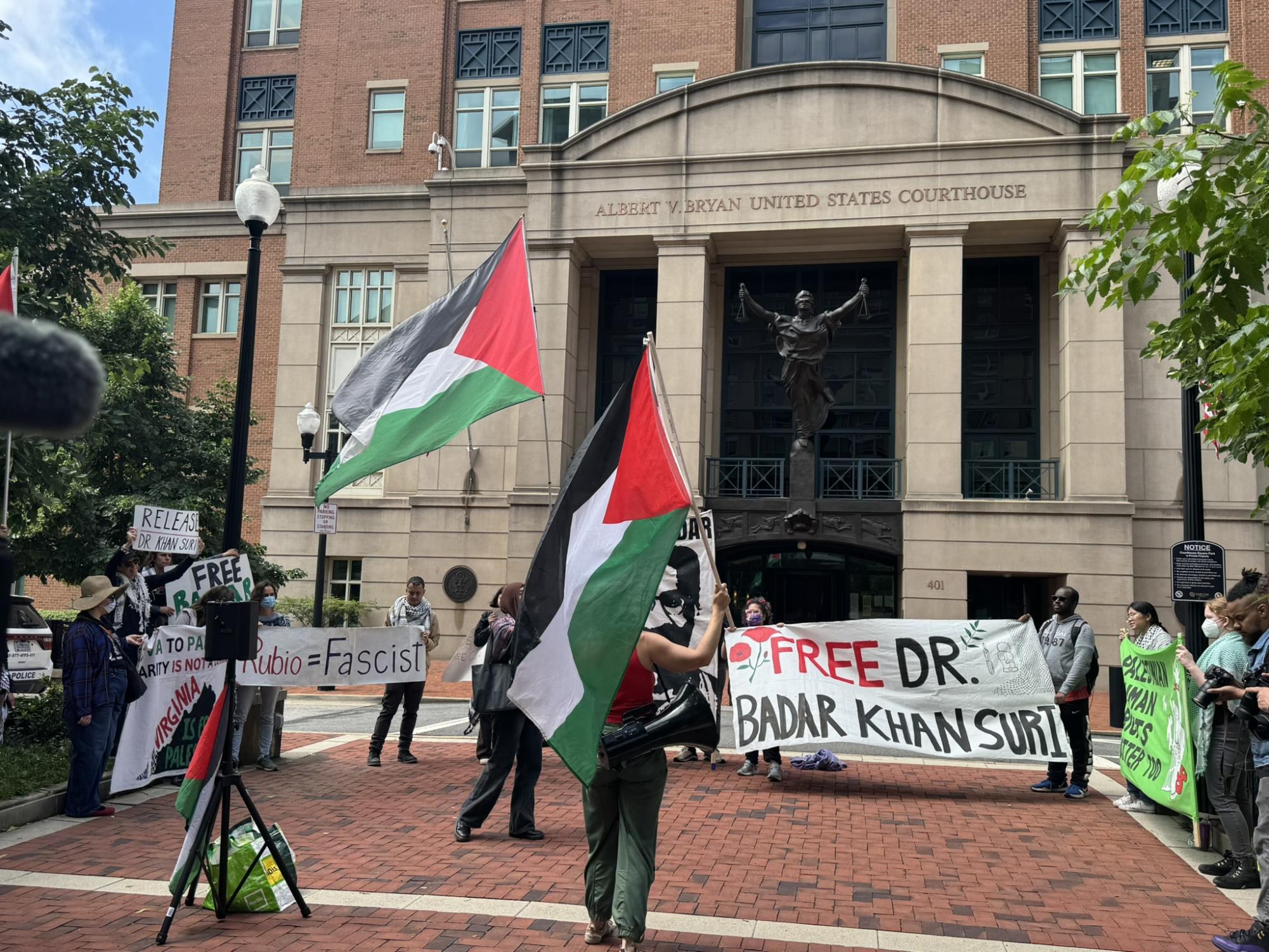
In Khan Suri’s personal case against the federal government, a judge ruled in May 2025 that his detainment unconstitutionally targeted him for protected speech and familial associations, violating the First Amendment. His legal team is also appealing the November immigration ruling, according to sources familiar with the case.
Sidra Mahfooz, a staff attorney with the legal nonprofit American Civil Liberties Union (ACLU)’s Immigrants’ Rights Project and one of Khan Suri’s attorneys, said the federal government is suppressing Khan Suri’s free speech.
“This is just the next step in the government’s effort to retaliate against Dr. Suri in violation of the First Amendment,” Mahfooz wrote to The Hoya in December, following the immigration court ruling. “It is far from the last word, and we will continue to fight for his rights in every available venue. Dr. Suri should be able to focus on teaching and spending time with his family instead of fighting the government’s attempts to detain and deport him in retaliation for his speech about Palestine.”