
A former U.S. chief data scientist praised diverse hiring within the artificial intelligence (AI) industry and warned students of data privacy threats at a Georgetown University event Nov. 4.
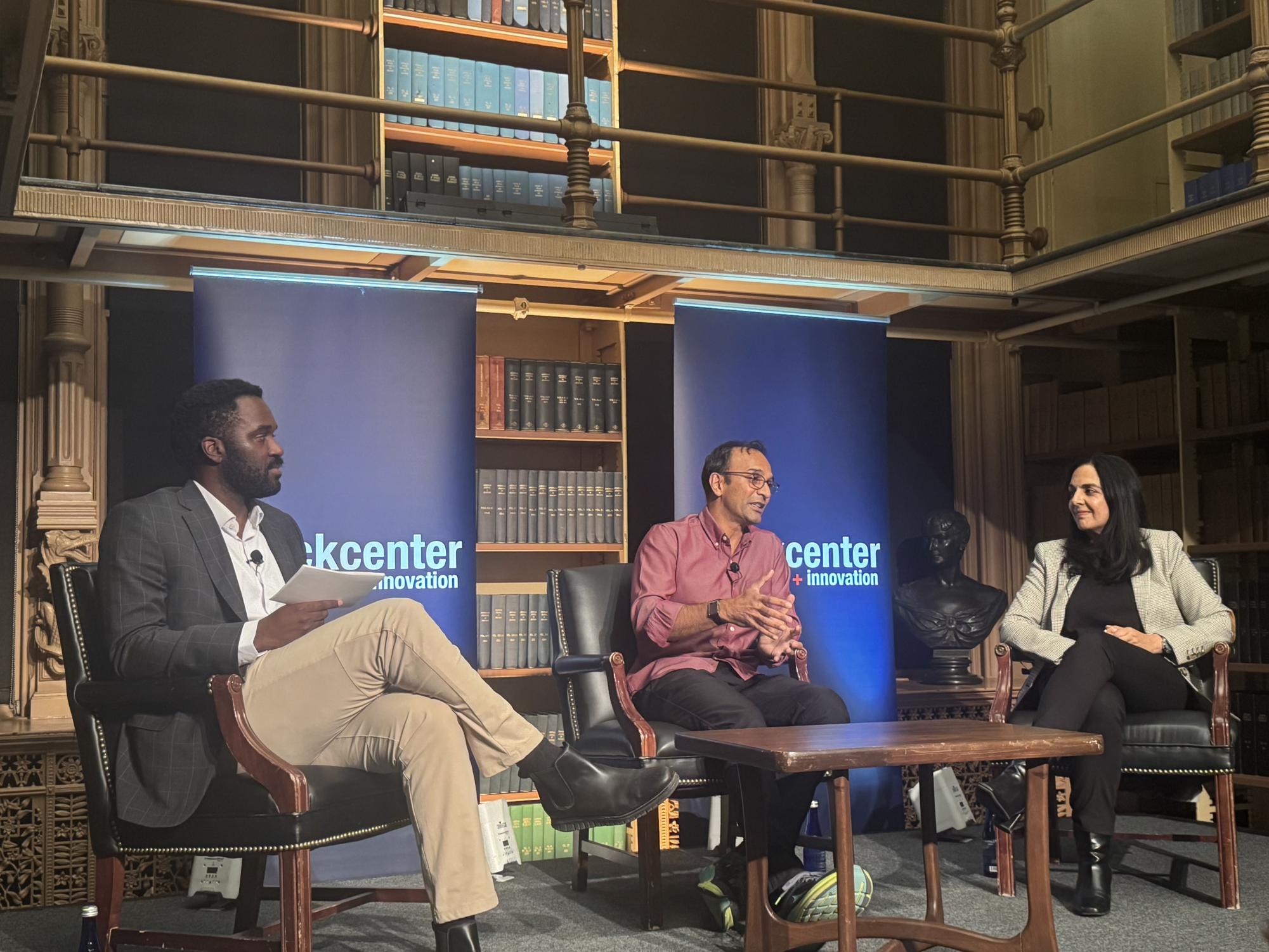
DJ Patil, who led data initiatives for federal criminal justice and health care reform from 2015 to 2017, argued that varied perspectives within the developing AI industry are important, advocated a hands-on approach to data science and warned against corporations’ unethical data usage at the event. The panel, hosted by Georgetown’s Beeck Center for Social Impact and Innovation, aimed to educate and provide networking opportunities for students in the data science field.
Patil said diversity within AI development teams is crucial for building successful systems.
“Unless you have a team that is diverse, that can look at the data, can ask very intellectually honest questions — you can call it whatever the heck you want — I call it ‘what good looks like,’” Patil said at the event. “Having representation means having a voice at the table who can call out things and say, ‘That’s a blind spot, that’s an issue, have you thought about this?’”
“When you intentionally are not going to do that, you’re going to miss something — you’re either going to harm somebody, or you’re going to end up building something that is going to fundamentally lose in the market,” Patil added.
Former President Barack Obama appointed Patil as the first U.S. chief data scientist in February 2015. Patil left the position in May 2017, shortly after the start of President Donald Trump’s first term. Patil previously worked as head of data products and chief scientist at LinkedIn and is now a general partner at GreatPoint Ventures, a venture capital firm that mainly focuses on the health care industry.
Lisa Singh, the chair of Georgetown’s computer science department who joined Patil on the panel, said consumers should be cautious when sharing data with corporations.
“I was genuinely shocked at the level of detail of information they had on people, on moving entities,” Singh said at the event. “So I think there’s a question that we just first fundamentally need to ask, which is: ‘What if the data does get into the wrong hands?’”
“We live in that world now,” Singh added. “A decade ago, we might have been able to get away with certain things, but there’s too much data out there now, and it’s too valuable.”
Privacy and technology advocates have raised concerns about data misuse and leaks amid an increasingly digital environment, including a 2024 breach from telecommunications provider AT&T that leaked thousands of customers’ financial information, and the political consulting firm Cambridge Analytica’s misuse of Facebook profiles to build political profiles on users for President Donald Trump’s 2016 campaign. A setting error in an internal system also caused a Georgetown data breach in 2024, exposing students’ and graduates’ sensitive information.
Patil said legislation has been largely ineffective in preventing data misuse and encouraged government partnerships with large businesses.
“You have to jump in, and you have to join these companies and try to make change from within,” Patil said. “You have to call out things when there are some areas where we should have whistleblower protections and other types of things to provide transparency.”
Singh said computer science programs should focus more on ethics to build a safer digital environment.
“I think we have to start integrating ethics, not just as a one class tacked on, but actually embedding it throughout our courses, so that we can, from the outset, get people to think about the inequities, the biases, the ethics of building certain types of tools,” Singh said.
“This is up to us — to care about the fact that our data is not being used in a way we should expect it to and build tools that enable all of you and enable us as a society to recapture and reclaim what is actually ours,” Singh added.
Patil said data science is ultimately about positively impacting lives.
“The best part of the job, the best part of building anything, is really sitting down with the people, the humans that are impacted,” Patil said. “What that does to you is it changes your mindset of not what product you can ship, but what are you doing today to make that person’s life different tomorrow. And I think if we approach that, that’s a different order of motivation, and it aligns the team up in a different pragmatic way.”
“Get out there and interact directly with the people that your technology is going to touch, and then ask, ‘What can we do more with the technology today, and what potentially we might be able to do with the technology tomorrow?’” Patil added.