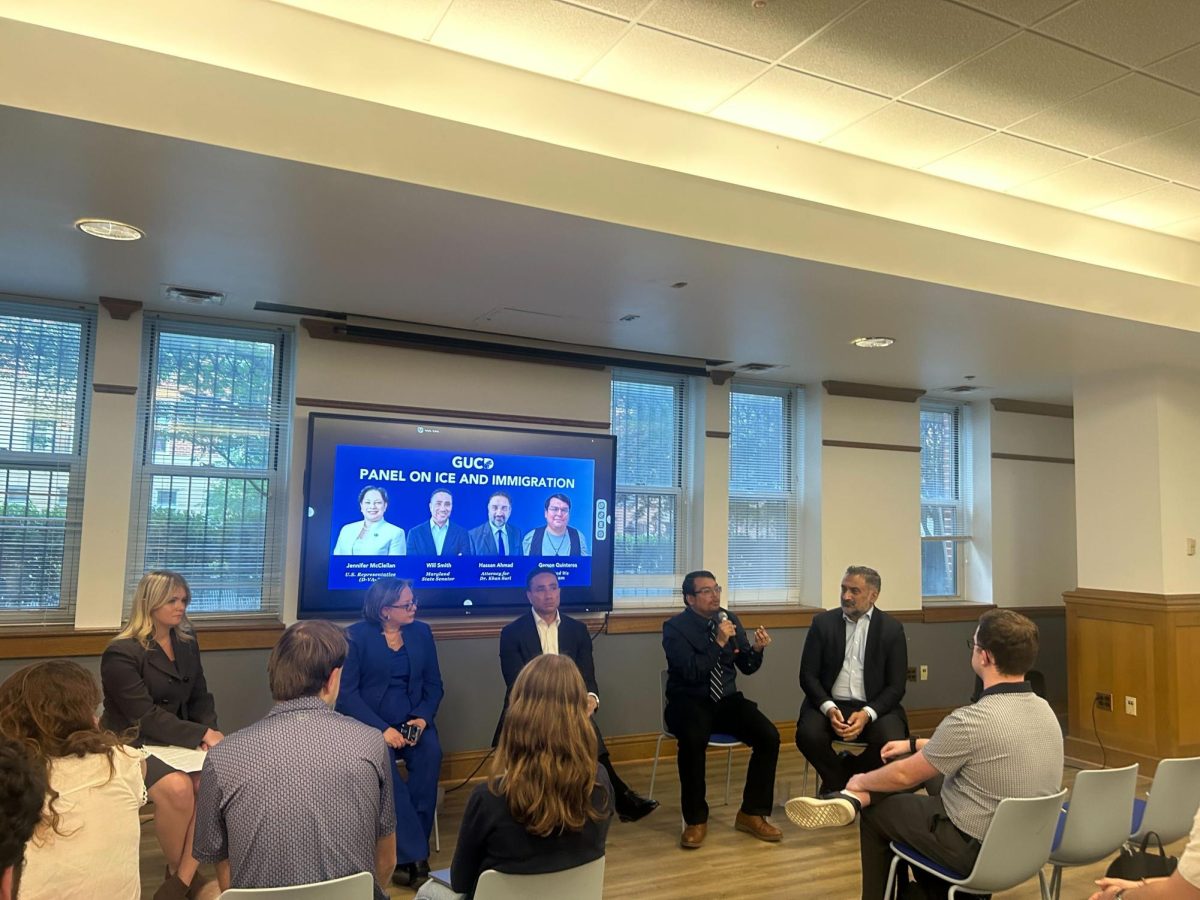
An expert on East Asian demographics and national security warned about the security challenges that states with aging populations face at a Georgetown University event Nov. 12.
Andrew Oros — author of “Asia’s Aging Security” and Japan program director at the Stimson Center, a nonprofit thinktank focused on national security and global peace — warned about the dangers facing super-aged states at a book talk hosted by Georgetown’s Asian studies program. He argued that these states, where over 20% of the population is aged 65 or older, face shrinking workforces, weak international perception and technological advancements.

Sheila A. Smith, a visiting teaching professor for the Asian studies program, moderated the event aimed to educate students on how the demographic changes in Asia affect U.S. policy and relations.
Oros said that, while most of his prior scholarship had focused on Japan, the growing number of super-aged societies allowed him to take a broader scope in his new book.
“This year, great timing for this book, both South Korea and Taiwan hit super-aged status,” Oros said at the event. “A number of countries in Europe have become super-aged as well. So I thought, ‘Well, this is the overlap.’ A book that won’t have Japan in the title, and a book that will allow me to put the challenges that Japan is facing with its demographics in a context that I think is important.”
In his book, Oros compares 16 states in East Asia, arguing their rapidly-aging populations and shrinking workforces have become a significant factor in their security policy, potentially shaping their strategic behavior in the coming decades. In addition to researching Japanese domestic and foreign policy at the Stimson Center, Oros currently works as director of the international studies program at Washington College in Chestertown, Md.
Oros said other global powers theoretically perceive super-aged states as weaker due to their limited workforce.
“So it’s a theory that other states will treat you differently if you are an aging state, right?” Oros said. “It’s a fact that part of late-stage rapid aging is that your working-age population is going to shrink. That’s going to happen first, and then the total population will begin to shrink next. That’s just an empirical reality.”
“Older states are weaker, but it links to these other three factors: Older states will not be able to afford good militaries; older states will have recruiting challenges; older people will, if you threaten them some more, quickly cave,” Oros added.
Smith said throughout her 17 years of research on Japan as a senior fellow at the Council on Foreign Relations, it seems that the population cares far more about the domestic — rather than international — implications of national aging.
“I have rarely heard a Japanese person argue to me that population decline is a source of weakness vis a vis external actors,” Smith said. “Mostly it’s about the ability of society to function, the ability to get access to health care, the ability to shoulder the social consequences of the accelerated pace of aging. I’ve rarely heard a Japanese colleague or friend worry about the outside world thinking they’re weaker.”
Oros said older societies can dampen the effects of low military recruitment with technological advancements.
“We often associate aging with things like frailty, but we also often associate it with wisdom, wealth accumulation, broader social networks, and these things are very important for security,” Oros said. “So a country that is having a shortfall in military recruiting, if you have the technology to substitute human labor with drones, and you have the money to buy those drones, and you have the wisdom to know how to use them properly or not.”
“These are reasons why I think countries like Japan or South Korea can continue to be very strong, because they have those capabilities,” Oros added. “More youthful countries tend to not be places with a high technology base or wealth.”
Oros said countries must shift their belief that military might comes from manpower and focus more on technological superiority via developing artificial intelligence (AI) models and quantum computing.
“What’s been happening in the United States — and also in Japan, in Korea, in China — is a belief that the way that these countries are going to weather their demographic challenges is having a wider range of people involved in protecting their countries,” Oros said. “It doesn’t matter whether you’re able bodied or not. It’s how well you can program those drones, how well you can help us compete against China in the critical race with AI and in quantum computing.”