Two experts warned about instability in the Middle East amid ongoing protests against the Iranian government at a Georgetown University event Jan. 22.
Thousands of Iranian citizens have been protesting the government since late December following widespread economic issues, prompting a government crackdown. At the event, Negar Mortazavi, a journalist and senior fellow at the think tank Center for International Policy (CIP), argued that domestic reform is difficult, while Daniel Brumberg, an associate professor in Georgetown’s government department, warned that Iran has a record of evading collapse despite internal unrest.
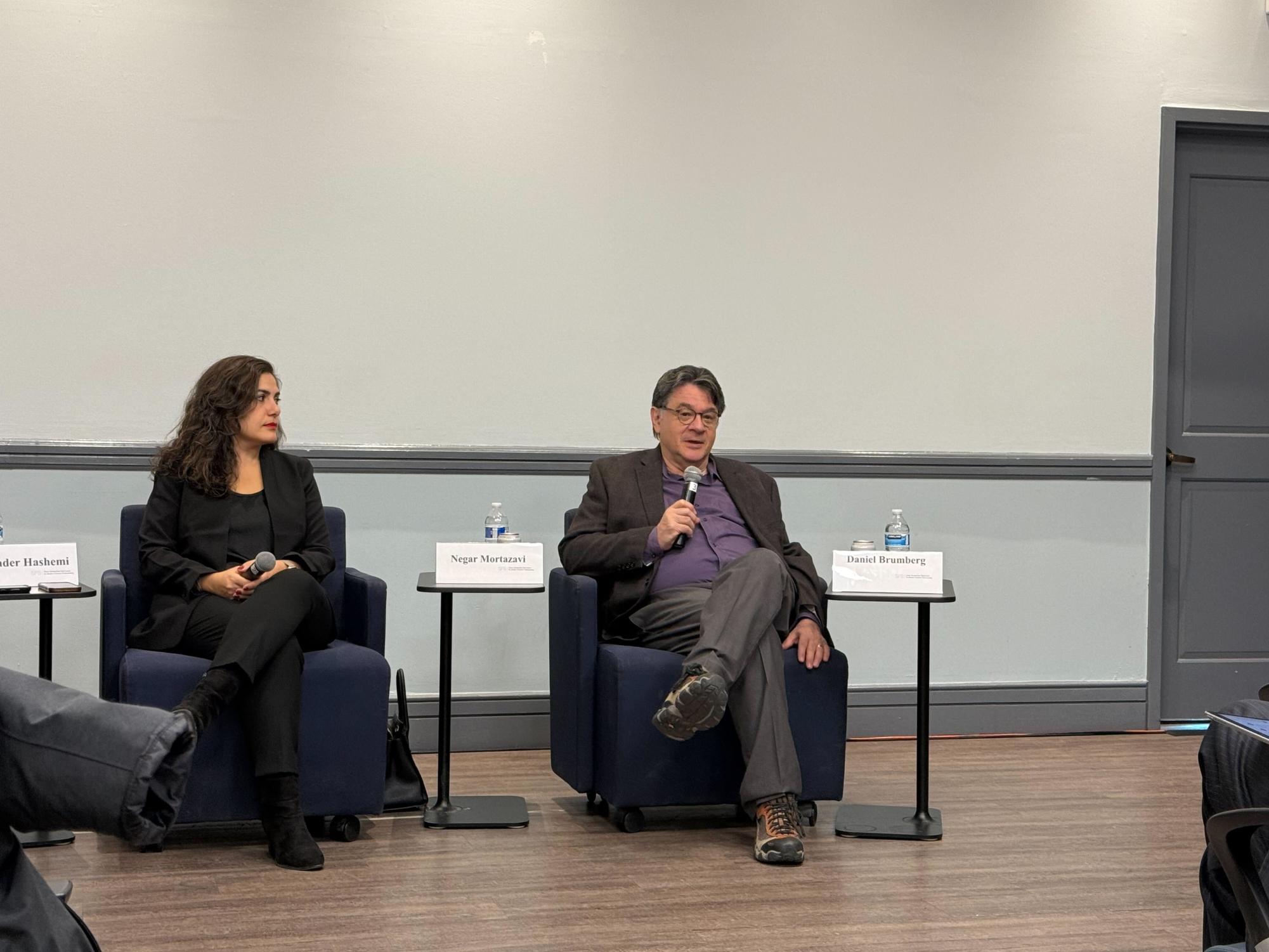
Mortazavi said Iran’s economic conditions have worsened due to internal mismanagement and economic sanctions.
“Conditions have just become worse and worse in a country that is sort of dealing with this triangle of mismanagement, of a lot of corruption—domestic, so there is internal–and then also very severe economic sanctions,” Mortazavi said at the event. “Iran is one of the most sanctioned countries in the world and has been isolated economically, financially, and that has delivered, of course, with policies on the ground.”
Brumberg said the violence in Iran is a result of desperation.
“From the outset, it was a battle, an almost existential battle between an opposition that had nothing to lose and a regime that had everything to lose,” Brumberg said at the event.
Mortazavi said the Iranian regime’s inability to address the grievances of their citizens will only cause more violent protests.
“We’re going to see more and more of these mass protests,” Mortazavi said. “Because unless the grievances are addressed, unless people see an improvement in their lives, they’re just going to pile up and every time come up angrier.”
The recent protests, following economic turmoil in the country in December, have resulted in at least 5,000 deaths, according to activists.
Brumberg said U.S. President Donald Trump’s switches between negotiations and military buildup in the region risks Iran’s stability.
“It’s just very chaotic as far as how he wants to get from point A to Z by, you know, zigzagging between military coercion, maximum pressure, but then again, back to diplomacy,” Brumberg said.
Trump announced Jan. 22 that in response to the Iranian government’s crackdown on protests, the U.S. has sent a U.S. aircraft carrier to the region in an effort to de-escalate the conflict. Prior to the announcement, Trump described ongoing negotiations with the Iranian government to de-escalate the use of violence against protestors Jan. 11.
Brumberg said the Iranian government cannot generate domestic support with nationalist sentiment given the collapse of Iran’s military capabilities.
“I think it’s going to just be much harder to leverage those sort of issues for the regime going forward, given the situation in the region,” Brumberg said. “It just doesn’t have the assets, and so the emperor wears no clothes in that sense.”
Nader Hashemi — the director of Georgetown’s Alwaleed bin Talal Center for Muslim-Christian Understanding (ACMCU), which hosted the event — said he also felt pessimistic about the range of possible solutions.
“I’m very pessimistic, because I don’t think there’s any easy, quick fixes here, that some external intervention is going to produce a democracy,” Hashemi told The Hoya. “It’ll probably produce more chaos and destabilization.”
Hashemi said the ACMCU is dedicated to teaching students about important issues across the Middle East.
“The question of Iran has been a key point of tension and conflict and misunderstanding between the West and Islam for a very long time,” Hashemi said. “So that’s why this topic, I think, is so important, because it speaks to the mandate of our center, focusing on themes of political controversy, discussion, U.S. foreign policy.”
Mortazavi said Western-led regime change is not the solution given the controversial track record of past nation-building campaigns.
“One struggles in recent years to think about an American or Western intervention in the region that has produced positive results for the people of the region,” Mortazavi said. “And so the likely scenario of an American military strike would be to create state collapse and more chaos and disorientation rather than a smooth transition to democracy.”
This article was updated Jan. 27, 2026, to cut a quote.