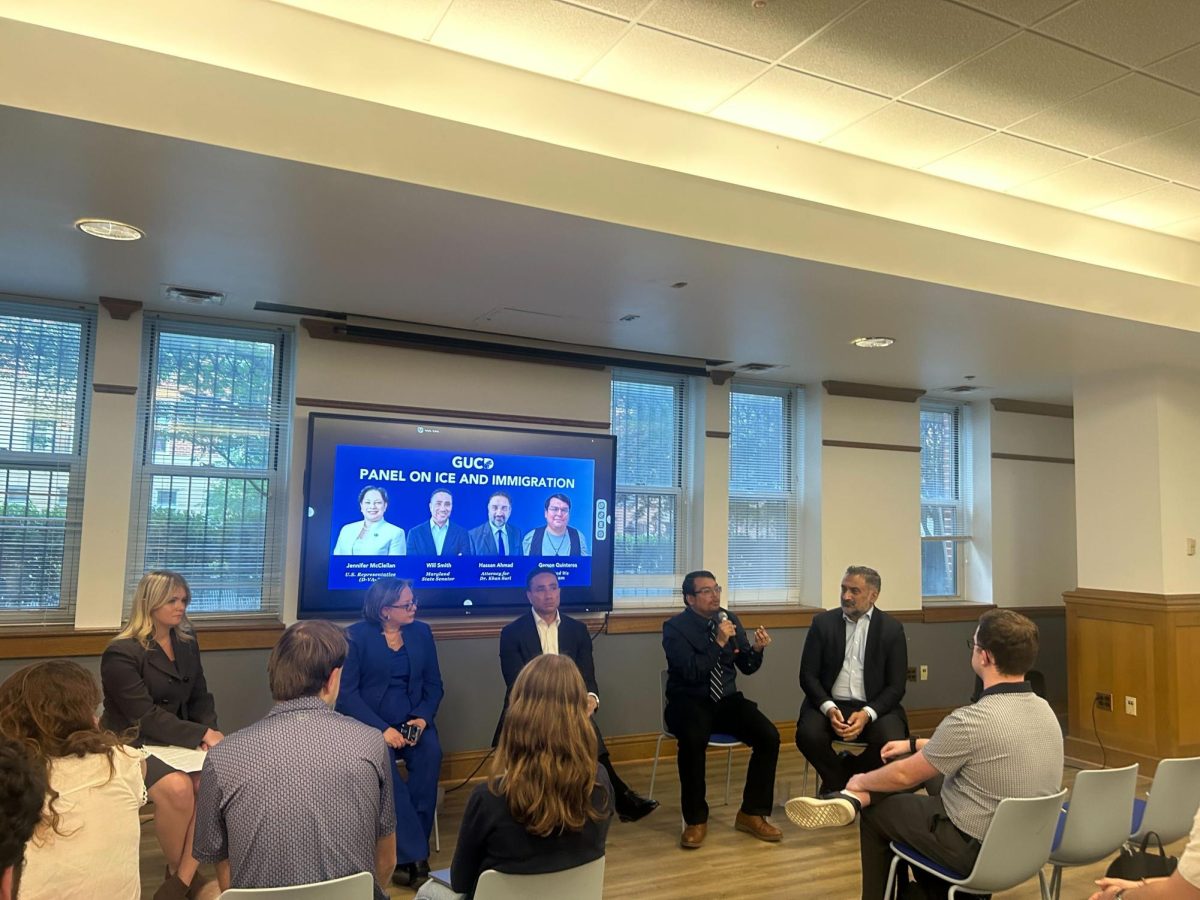

Four global health experts, including Dr. Anthony Fauci, analyzed lessons from the COVID-19 pandemic and examined necessary improvements to prepare for future global health crises at a Georgetown University event March 17.
The panelists — Fauci, a Georgetown distinguished professor and former director of the National Institute of Allergy and Infectious Diseases (NIAID); Jason Gale, Bloomberg global health editor; Stephanie Psaki, a former White House global health security coordinator; and Nina Schwalbe, former COVID-19 vaccines access director at the U.S. Agency for International Development (USAID) — analyzed responses to the pandemic. The experts warned that despite pandemic-era scientific advances, failures in planning, communication and global cooperation have left the world unprepared for the next pandemic.

Fauci said the quick scientific response to COVID-19 was one of the pandemic’s greatest successes.
“The thing that we did really, really well, incontrovertibly, was the science,” Fauci said at the event.
“Vaccine development began six days after the publication of the genomic sequence,” Fauci added. “69 days later, we were in phase one trials; 125 days later, phase two; 195 days later, phase three. 11 months later, we had a 93 to 95% effective vaccine that went into the arms of individuals.”
Though President Donald Trump took controversial actions when responding to the pandemic, the U.S. government helped facilitate the development and public distribution of a vaccine.
The panelists described how failures in planning and coordination between public health leaders limited the impact of these breakthroughs, particularly on a global scale.
Fauci said there were inequities in vaccine distribution, citing the inability of some to receive even the first vaccine while booster shots were available to others.
“In the world in which we stand for as physicians, healthcare providers and public health people, equity is a fundamental core principle of public health, and that wasn’t being implemented, so we were standing in our own way,” Fauci said.
“There’s no excuse for people getting their second and third boost when millions of people never got their first shot,” Fauci added.
Panelists also identified misinformation as a major barrier to effective pandemic response. Fauci said traditional scientific communication alone is insufficient to counter misinformation.
“You can’t fight misinformation with data,” Fauci said. “You have to fight misinformation by figuring out a better way to communicate.”
Panelists also outlined key steps to improve preparedness for future pandemics.
Psaki emphasized the need for stronger surveillance and response systems, saying officials should identify threats with precision and quickly enact their plans.
“We also need to have better biosurveillance systems in place,” Psaki said at the event. “We need to be able to quickly detect threats when they emerge, even if it’s a novel threat, and be able to respond quickly.”
Schwalbe said that following the pandemic, the United States continues to face deep public health vulnerabilities, particularly in primary healthcare systems.
“One thing that I think was a missed opportunity in COVID was not building out our primary healthcare system,” Schwalbe said. “We are the sickest people in the world, with diabetes, obesity, you name it. And healthier people survive better when they’re hit with threats. So that is number one.”
Fauci said international cooperation during health crises is crucial to a rapid and efficient response.
“Pandemic preparedness is not just a domestic thing, it’s interaction with our international partners, and that’s something that, unfortunately, we seem to be steering away from right now,” Fauci said.
Psaki said declining global coordination, particularly regarding international institutions like the World Health Organization (WHO), raises concern for future health emergencies.
“It’s an imperfect institution,” Psaki said. “There’s a lot of work that needs to be done to make it stronger, but it makes us less safe to be withdrawing from WHO.”
Fauci said international partnerships are crucial in pandemic response.
“If we shrink away from our interaction globally with our partners, it’s going to be to our own detriment,” Fauci said.