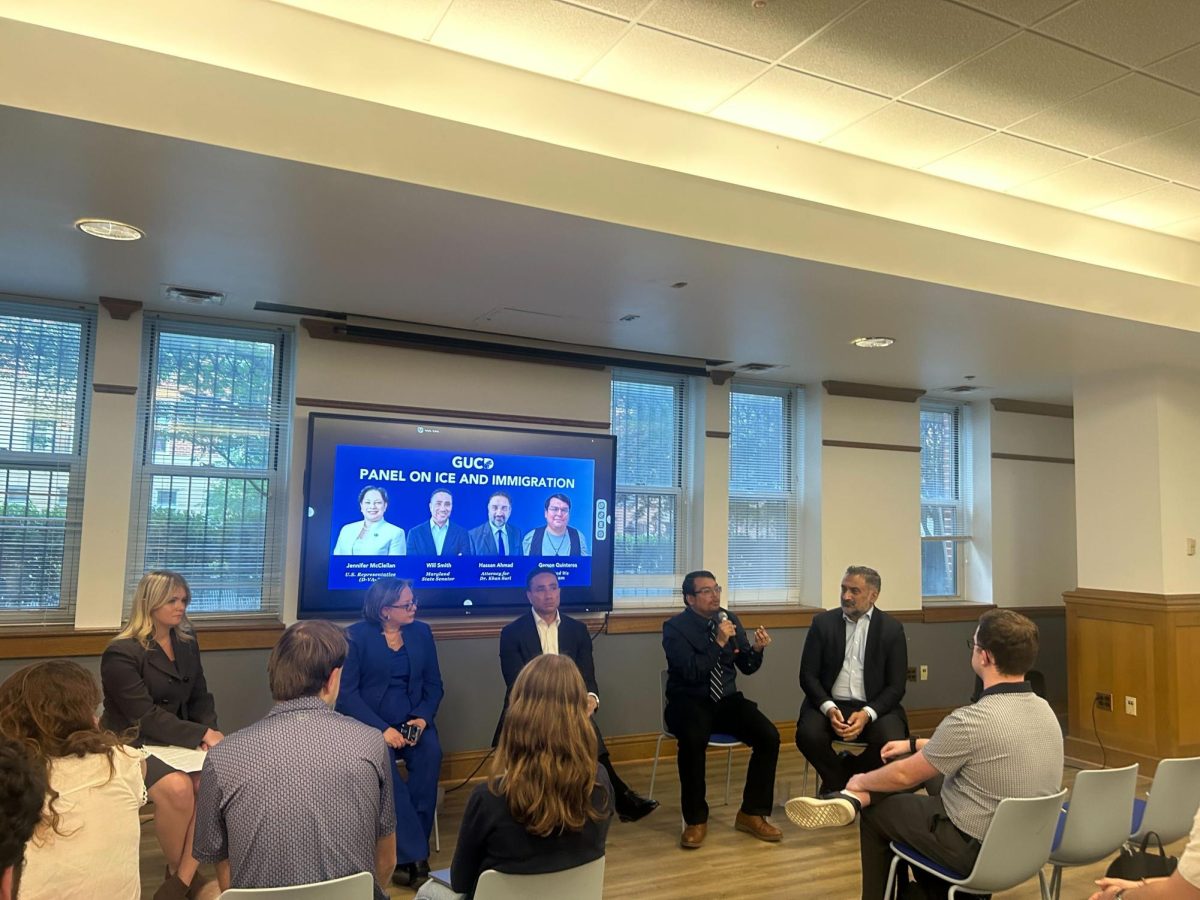

Two investigative reporters criticized the politicization of the U.S. Department of Justice (DOJ) under President Donald Trump’s administration at a Georgetown University event Nov. 17.
Carol Leonning, a five-time Pulitzer Prize winner, and Aaron Davis, a Georgetown professor and two-time Pulitzer Prize winner at The Washington Post, delved into the lack of separation between the White House and the DOJ and the source of those issues at an event hosted by Georgetown’s journalism program and the McCourt School of Public Policy. Their talk centered on their recently published book, “Injustice: How Politics and Fear Vanquished America’s Justice Department,” which examines the evolution of the DOJ, identifies a “crisis” in the department and assesses the department’s loss of credibility among the judiciary and public.

Davis said the book documents the ways in which members of both the DOJ and federal government have weaponized and politicized the department under Trump’s influence, diverging from DOJ values of “independence and impartiality.”
“It’s about this time period. It’s about reaching this place where politics and prosecutions are mixed in this state, really injustice that we have reached, so that’s how we evolved,” Davis said at the event.
Rebecca Sinderbrand (COL ’99), Georgetown’s journalism program director who introduced the authors, said narrative investigative journalism is especially important in the current political climate.
“The kind of investigative journalism that you are about to hear tonight — careful, patient, expert — has perhaps never been more challenging to undertake or more important, more vital to understanding the country and the world in which we live right now,” Sinderbrand said at the event. “We’re fortunate that in these interesting times, we have some of the smartest, most dedicated journalists in the profession, writing the first draft of history as the story shifts beneath them, assembling the car while they drive it.”
Leonning said the Trump administration’s ability to influence the DOJ is a result of his political appointees’ willingness to follow his orders blindly, which she said differed from his first term, when intervening officials such as John Kelly, Trump’s former White House chief of staff, helped check Trump’s influence.
“Why has he been so successful this time around? Because all the guardrails are gone,” Leonning said at the event. “There’s no John Kelly in the White House chief of staff saying, ‘You really don’t want to do this, boss.’”
To show the difference in DOJ’s independence from the White House, Leonning cited the recent incident in which Trump asked the DOJ on Nov. 14 to investigate convicted sex offender Jeffrey Epstein’s ties to prominent Democrats. Later that evening, Attorney General Pamela Bondi thanked Trump and announced that the DOJ had opened an investigation.
Davis said the U.S. Supreme Court has enabled the DOJ to continue working with the White House, even if lower courts dissent.
“There is a recognition inside the Justice Department that the Supreme Court has gone to a place that nobody ever expected, and no case had ever really provided even a hint that we would’ve been in that position,” Davis said. “So there’s a lot of things you can say about the Supreme Court, but in the course of our book reporting, that was a huge, huge point.”
“You’ve got a judiciary that now does not trust the Justice Department,” Davis added. “You’ve got a public that in many ways is skeptical of the Justice Department of the highest rung of the judicial system.”
Davis said the DOJ needs to work on the timelines of its cases and has to have more dialogue with the American public about its decisions.
“In the world of the internet age, we’re not going to wait for a year or two, three years to pass while the Justice Department methodically decides if something should be prosecuted or not, and only speak through a court document,” Davis said.
“There must be some middle ground between waiting years and also deciding, ‘We’re going to investigate, we don’t know if we’re going to investigate yet, but we’re going to investigate something now,’” Davis added. “More transparency to say, ‘This is what we’re doing, this is why we’re doing it,’ and to try to rebuild some of that trust with the American people.”
Leonning said she is hopeful because there are still people within the DOJ who firmly believe in the institution and its purpose.
“We have talked to a lot of sources, and some of them are still inside the building and they’re holding on by their fingernails with the goal of rebuilding,” Leonning said. “They’re absolutely, dead-set committed to this institution returning to its venerable position as the chief defender of our democracy and the chief deliverer of fair treatment, fair and equal justice.”