
A veteran journalist presented two diverging visions of the possible long term effects of artificial intelligence (AI) on the labor market at a Georgetown University event Nov 13.
Ben Casselman, the chief economic correspondent for The New York Times, discussed differences in the effects of the popularization of free trade and the computer revolution on the labor market. Casselman illustrated the uncertainty around the growth of AI at Georgetown’s annual Ellen C. Gstalder Memorial Lecture, a lecture fund that supports discussions of social issues in the United States.
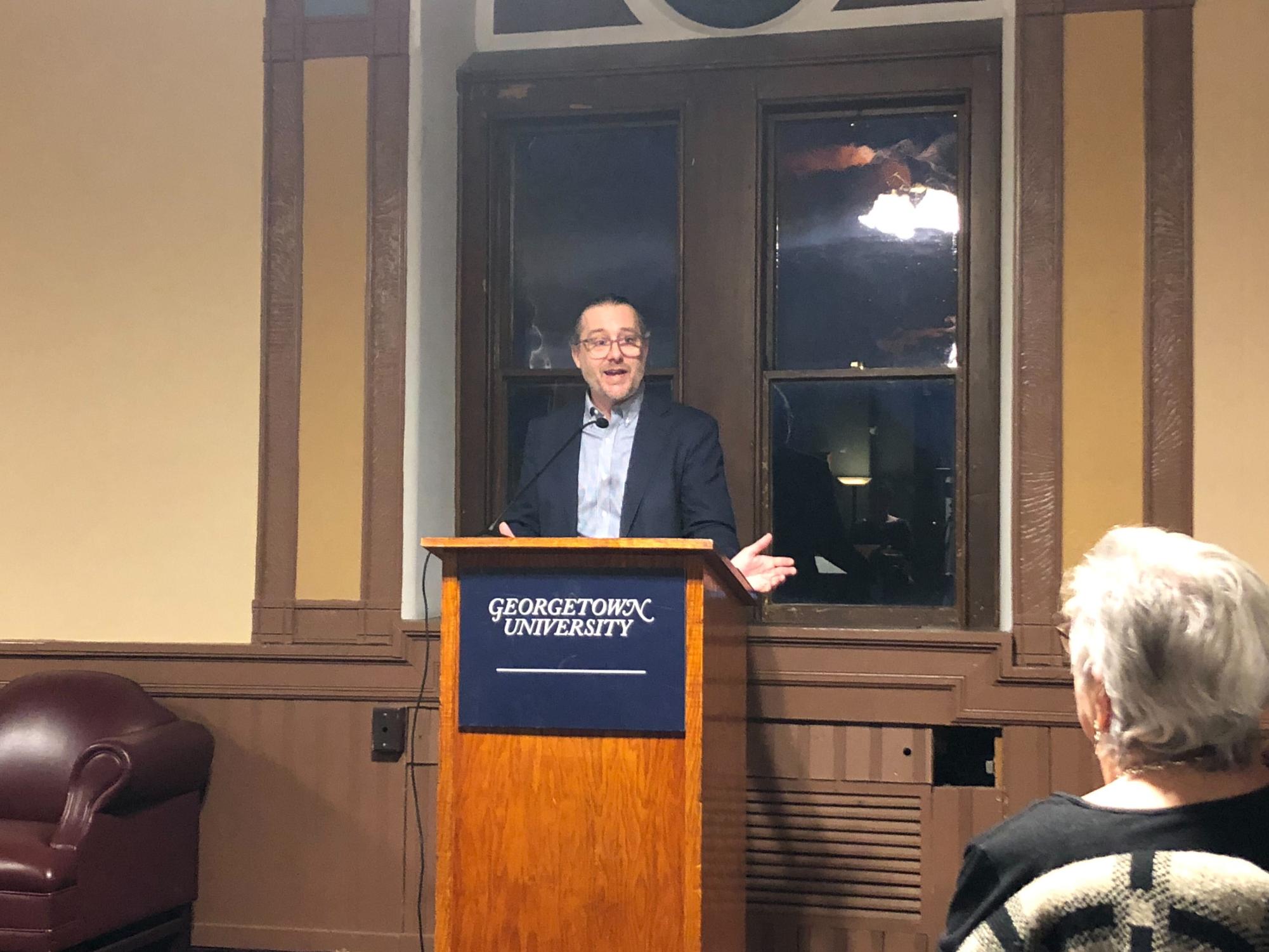
Casselman said he chose to compare “the China shock” — a term coined by economist David Autor used to describe global trade liberalization — and computer revolutions because each has differing public perceptions.
“The China shock in the popular narrative is associated with shuttered factories, shattered lives,” Casselman said at the event. “It’s a recent narrative for the decline of rural America, for the opioid crisis, for the divisions of defining politics for the past two decades. It’s totally different when we think about the computer that is associated with the rise of Silicon Valley, with the creation of old industries and whole categories of jobs.”
Casselman said Hickory, N.C., a small town affected by the financial effects of the China shock, demonstrates how changing economic conditions affect communities.
“Take Hickory, N.C., which was a home of the U.S. furniture industry,” Casselman said. “In 2000, furniture factories there employed about 32,000 people, a fifth of all private sector workers. Within a decade, that number had been cut by nearly 60% as the flood of cheap furniture came in and displaced those jobs.”
Casselman said Hickory is successfully recovering from deindustrialization.
“If you go to Hickory today, old mill buildings have been redeveloped as restaurants and breweries and loft-style offices, the unemployment rate there is now consistently below the national average,” Casselman said.
Casselman said public and private initiatives, like those behind Hickory’s redevelopment, are needed to address innovation in AI.
“Hickory’s revival required public support and private investment and foresighted civic leadership,” Casselman said. “It required policies that recognize the particular challenges in that community, and the particular resources available to address those challenges.”
“Getting through this AI transition, whatever this transition ends up looking like, will require the same; it will require recognizing challenges and thinking through solutions,” Casselman added.
Casselman said the computer revolution unfolded gradually, which allowed people working as typists, for example, time to adjust to the changing industry.
“People had time to adapt,” Casselman said. “Older typists had time to finish out their careers and retire. Younger ones had the opportunity to learn new skills and evolve into new roles, as administrative assistants for office managers, broader roles that required more expertise and autonomy and were generally better paid.”
Casselman said that despite concern, data does not suggest a mass AI-driven lay-off trend.
“We know, for example, there were a whole bunch of tech layoffs a couple years ago,” Casselman said. “I think not — this wasn’t really an AI thing. This was just a tech overhiring thing. But it turns out most of those workers just went and got coding jobs just from other industries.”
Casselman said the future of AI is uncertain, so its potential impact on careers could change as technology develops.
“If AI is the Internet and plays out in that way, then the best advice is to run towards this, to embrace it, to figure out how to use it to maximize your productivity and adaptability — in the same way that people of my generation learn to use the internet to advance our careers,” Casselman said. “But if AI is the next China shock, then the best advice is to run away, find the jobs that will be hardest for AI to replace.”