A journalist praised South Africa’s response to the ongoing Israel-Hamas war and encouraged the Global South to play a greater role in condemning international violence at a Georgetown University event Nov. 19.
William Shoki, a South African journalist and the editor-in-chief of Africa Is a Country — a publication focusing on the legacies of colonialism and exploitation in Africa — argued South Africa’s history of apartheid influences its current policy on international violence. The event, coordinated by Georgetown’s Alwaleed Center for Muslim-Christian Understanding and the Center for Contemporary Arab Studies alongside four other university departments, aimed to educate students on the solidarity between South Africa and Palestine.
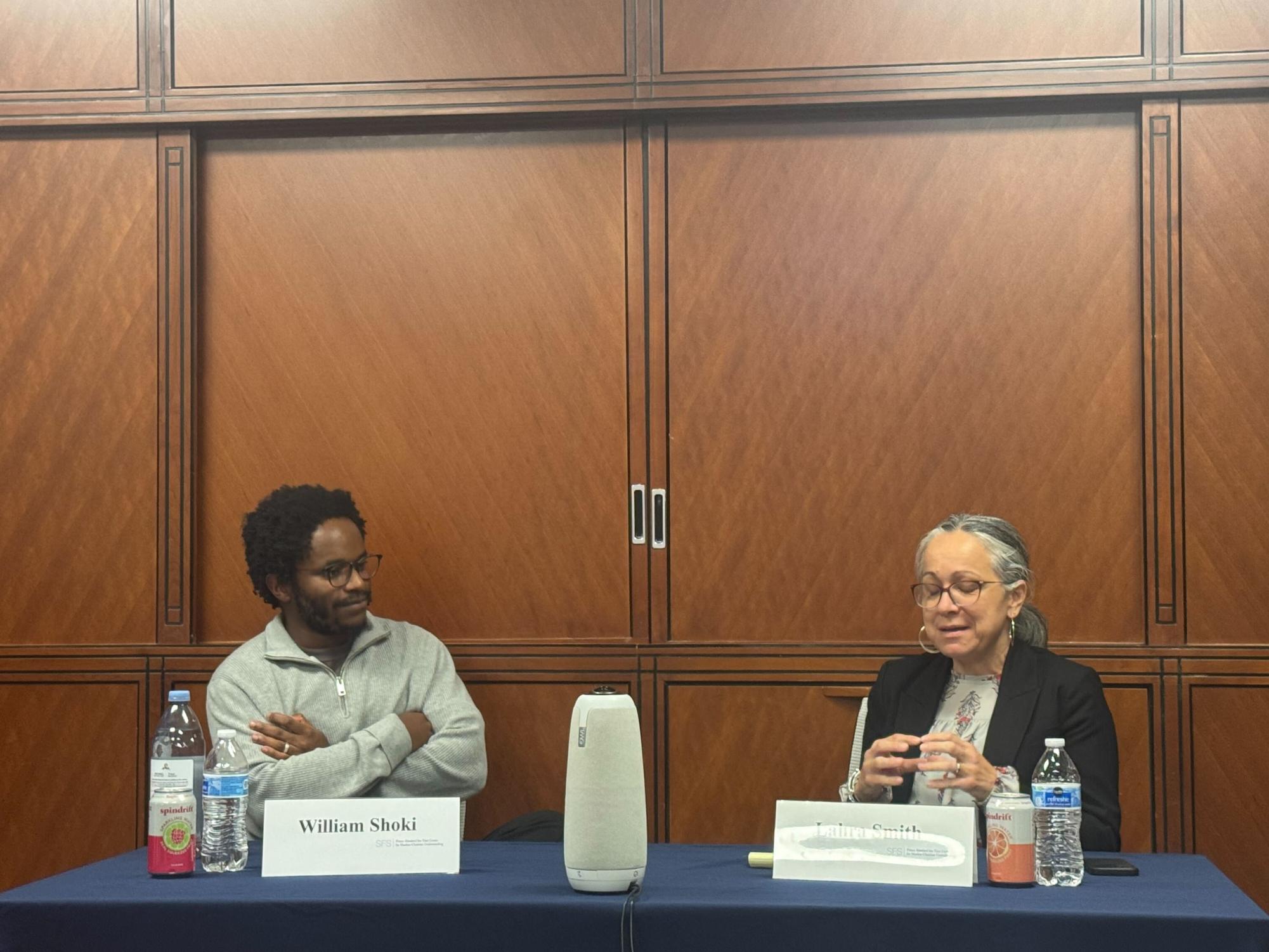
Shoki said South Africa, which was ruled by an apartheid government for 46 years until 1994, has found itself at the forefront of the Israel-Hamas war’s refugee crisis.
“Diplomatic mechanisms like safe passages and evacuation corridors obscure that the line between evacuation and expulsion has thinned, and South Africa, by accident or design, now finds itself inside that architecture at the end of this episode,” Shoki said at the event. “It condenses, in a single story, the themes that run through this lecture: the violence of engineered movement, the frailty of international law, the contested meanings of solidarity and the shifting role of the Global South as both sanctuary and a moral insurgent in a collapsible order.”
Shoki’s lecture came just days after a plane holding 153 Palestinians without documentation or return tickets arrived at a South African airport. Although initially denied entry, all passengers were eventually allowed into the country, and many continued traveling to their final destinations. South African officials are still questioning Al-Majd Europe, the company that many passengers said helped organize their flights.
Shoki said South Africa’s stance on humanitarian crises and international law stems from its history as an apartheid state.
“The new government became a champion of multilateralism, not out of obstruction, but because it understood how decisive multilateral structures had been in its own struggle,” Shoki said. “Its participation in peacekeeping missions, its mediation roles and regional conflicts, and its early leadership on issues like landline bans and nuclear non-proliferation were all built on this conviction that small states can exercise normative power even over greater powers when they speak from a history of moral struggle.”
Shoki said that while South African global positioning has been guided by its history, it has also lacked consistency in its condemnation of violence.
“South Africa’s foreign policy had never really been consistently principled,” Shoki said. “The post-apartheid state inherited a powerful ethical vocabulary but also had to survive in a world structured by hard power. Its moral commitments were always in tension with geopolitical pressures, domestic crises and institutional limits.”
Shoki said that for South Africans, Palestine is not just another foreign conflict, but a replaying of the decolonization they experienced, drawing comparison to the Bantustans, territories designated for Black South Africans that the racist National Party of South Africa established during apartheid.
“For many South Africans, Palestine is not an abstract foreign conflict but a site where the unfinished work of global decolonization is being replayed in real time,” Shoki said. “The language of Bantustans, past laws, ethnic fragmentation and fortified borders resonated with painful familiarity. This resonance wasn’t always analytically clean, but it was politically powerful.”
Shoki said the humanitarian crisis in Gaza demands active intervention from the international community and grassroots movements.
“The lesson of this moment matters now more than ever,” Shoki said. “If a new world is to be made in the 21st century, its foundation cannot be the state alone. It must be movements, the insurgent, youthful, intersectional movements that have re-emerged across the greater south.
“These movements, from feminist networks to climate justice coalitions to anti-austerity uprisings, are coordinated in ways the mid-20th-century worldmakers could never achieve,” Shoki added. “They articulate demands that exceed the caution of governments.”
Shoki said Palestine’s struggle particularly resonates with the vague grouping of the Global South, in that the struggle should ground these states and encourage anti-apartheid movements.
“If the greater south should be read as an unsettled moral geography, then Palestine has become its compass,” Shoki said. “The place where the world fractures is rendered unmistakably clear. Palestine is no longer merely a cause some people try to investigate and intervene in. It is a lens through which the contradictions of the international system are revealed.”
“Palestine exposes the unfinished business of decolonization, a people dispossessed, repeatedly governed by legal architecture that denies the nationhood and people abandoned by an order that promised self-determination whilst accommodating occupation,” Shoki added.