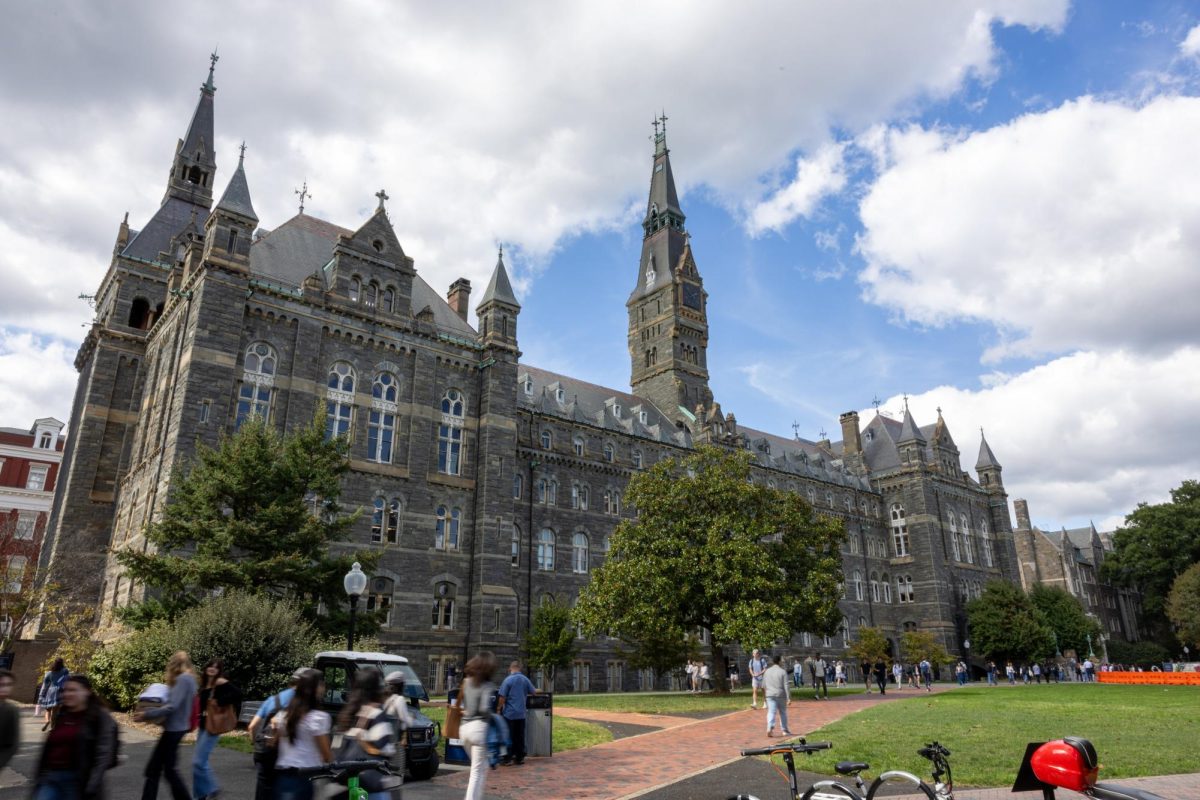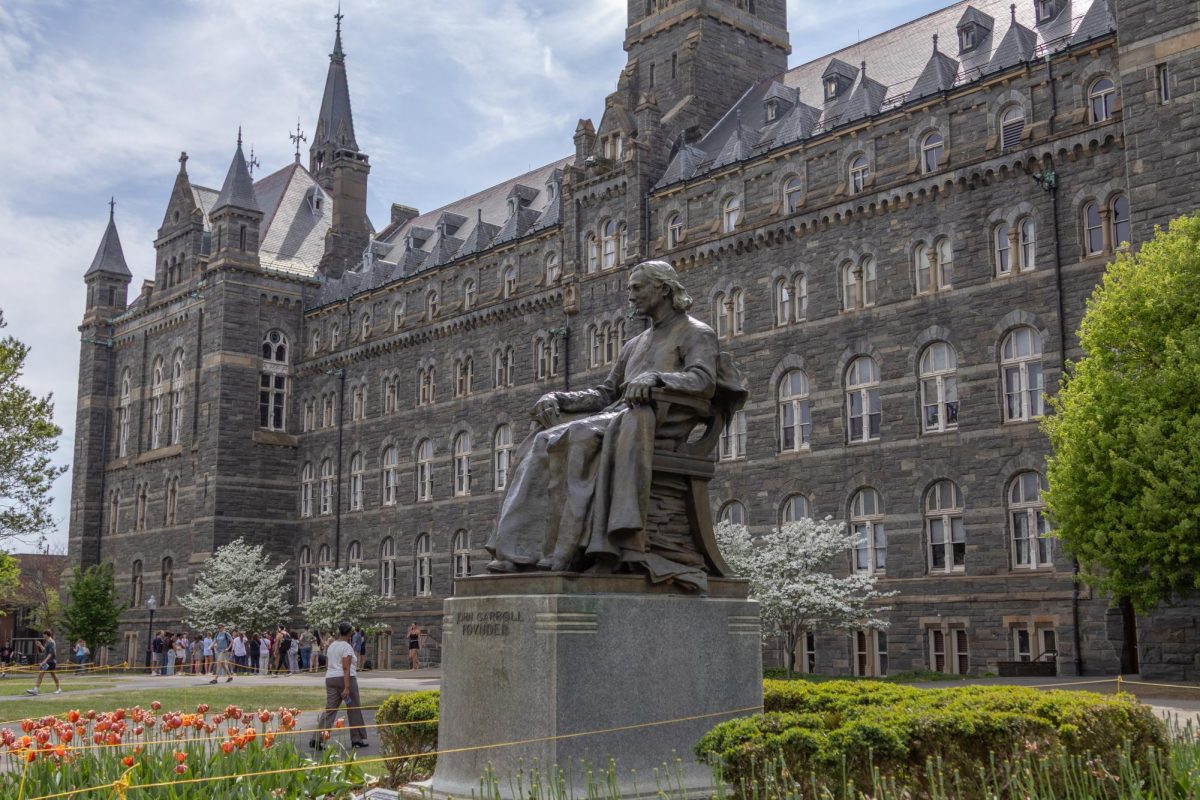

Georgetown University leaders briefed the Faculty Senate on the university’s ongoing austerity measures amid federal cuts to higher education at its April 14 meeting.
Administrators announced that the university will provide more details on Georgetown’s finances at an April 29 town hall, including on proposed budget safety measures. The senate also debated non-discrimination policies and a research collaboration effort.

At the meeting, the Contingency Development Working Group, a team charged with proposing solutions for potential federal funding cuts, briefed the senate on its ongoing process to increase revenue amid the university’s budget shortfalls. In December 2025, the university projected a revenue reduction of at least $91 million for fiscal year 2026, citing federal spending cuts to higher education and increased visa restrictions.
Vicki Arroyo, the working group’s chair, said the committee initially aimed to reorganize the university’s federal indirect cost (IDC) allocations — overall funds that aren’t linked to specific projects — but after Congress blocked the Trump administration’s plans to cut indirect research funding, the group found the reorganization was unnecessary.
“We were looking at reconfiguring our indirect cost allocations, where it’s allowed, to try to mitigate some of the risks, to extend our current negotiated rates where possible,” Arroyo said at the meeting. “Since Georgetown was at a time when we were renegotiating those with the federal government, to develop revenue generation strategies to diversify our revenue so that we would mitigate any impact of the potential IDC cuts and to establish some principles to guide our work.”
“I have some good news: that the proposed IDC cuts from this administration were generally stopped by Congress, and we hope that will continue to be the case,” Arroyo added.
Interim University President Robert M. Groves said he will announce some of the group’s strategies at the upcoming town hall.
“We’ll have an announcement of those ideas that would either save money or produce more revenue to help us out at this time, and we got over 200 suggestions,” Groves said at the meeting. “The other thing we’re doing is refining our projections on the end of this year’s finances, and I’ll be able to do it to announce that, as well as looking forward to next year and issues of how we’re looking next year.”
Arroyo said the Trump administration’s threats to international visas, which make it harder for students to attend U.S. universities and work in the country, pose additional challenges to revenue strategies.
“Some of the early revenue generation strategies that we had as a group to diversify revenue and mitigate the impacts themselves came under threat as the year went on, because this administration started going after international visas for our students and faculty fellows and financial aid,” Arroyo said.
Following the budget updates, the senate discussed a plan to use GU360, an internal university platform, for faculty activity reporting, which collects and displays staff academic appointments and accomplishments, to bolster collaboration.
Elliott Crooke, the vice president for faculty and academic affairs who works on the faculty activity reporting project, said GU360 will increase the convenience of activity tracking and boost cooperation among faculty.
“We’re getting away from that manual creation of either filling things out on paper or having to do it on Word documents or whatever,” Crooke said at the meeting.
“We have this database of faculty activities, and what they’re doing will hopefully be able to mine each others’ scholarship to really help enhance finding collaborations,” Crooke added.
The faculty senate also approved changes to the procedures in the Office for Equal Opportunity Compliance, an office that ensures observance of non-discrimination policies. The senate increased the clarity of administrative reviews, or assessments of alleged university anti-discrimination policy violations, and faculty input in the reviews’ appeal process.
The Contingency Development Working Group also highlighted the impacts of restrictions on federal student loans, such as the eclipse of Grad PLUS loans, a federally managed student aid service for graduate students that will stop accepting new applicants July 1, 2026.
Arroyo said the restrictions may cause admitted graduate students to not attend Georgetown.
“I’m hearing from some of the financial aid experts that they might be able to actually negotiate something even better than Grad PLUS, but that’s people who have very good credit and maybe somebody to co-sign — for some, they might be not eligible at all, so it’s really going to be a mixed bag,” Arroyo said at the meeting. “I don’t think we know yet, given that we’re just admitting classes, how many of our students might have to make a different decision about coming to Georgetown or pursuing grad education at all.”