
The union representing Georgetown University facilities workers began negotiating their contract’s financial clauses at a Feb. 25 bargaining session.
The facilities workers’ union, 1199SEIU, includes a variety of departments such as bus drivers, sanitation workers, housekeepers, maintenance staff and landscapers, among others. During the negotiations, union representatives advocated for an increase in wages and stable parking rates.
Charles Gore, a facilities worker on the bargaining team, said the final contract should feel fair to both the workers and the university.
“It’s going as bargaining goes — it’s such a cat and mouse game that’s being played,” Gore told The Hoya. “But I’m not sure where it’s going yet. What we want is better pay and better treatment, and we’re trying to come to an agreement of better pay without the university feeling like they’re overpaying for something that they should be paying for.”
A university spokesperson said Georgetown respects the bargaining process, citing the university’s Just Employment Policy, which guarantees fair and competitive compensation for all full-time employees and contractors.
“We will continue to negotiate in good faith with 1199SEIU as we work together to reach agreement on a new union contract,” the spokesperson wrote to The Hoya.
The union’s primary demand is to increase wages across the board by over 12%, which was the rate increase in the previous contract, according to Carrietta Hiers, the vice president of the union’s Washington, D.C. branch. The new contract would also spread the wage increase across four years, according to Elinor Clark (CAS ’27), the facilities team lead for the Georgetown Coalition for Workers’ Rights (GCWR), a student labor advocacy group.
Hiers said the representatives aim to keep employee pay above, not just equal to, D.C.’s minimum wage of $17.95.
“We always want to stay above whatever the D.C. minimum rates are — which Georgetown, as a thumb-rule, has been doing — but we want to make sure that it’s bargained for and memorialized in the contract,” Hiers told The Hoya.
The workers’ current contract initially expired last month, but was extended indefinitely during negotiations. Workers will receive retroactive pay through January for any wage increases agreed to in the new contract. The contract negotiation began in November 2025, focusing on noneconomic proposals such as inclement weather and uniforms. The Feb. 25 session was the first focusing on financial policies.
Hiers said the union representatives will not concede the provisions previously won in negotiations, including the current rate for parking passes.
“We’re not accepting anything below what we earned during the last contract cycle,” Hiers said. “So that’s the way the union opened up with that, and we’re not taking any concessions on things that we’ve already bargained and won for in our previous contracts. It was received well.”
Hiers said the session went well for the workers as they continue to bargain for wages increases.
“The negotiation session actually went well,” Hiers said. “They came in actually higher than we thought they would, which is a good thing, with a concentration of across the board increases, which our members were pleased about. So they came ready to bargain respectfully with the increases that they offered. We’re not there yet, but it was a great start.”
The representatives adjourned after negotiating for over five hours and will resume in a Mar. 2 session. Hiers said she expects the contract to be finalized by the end of March.
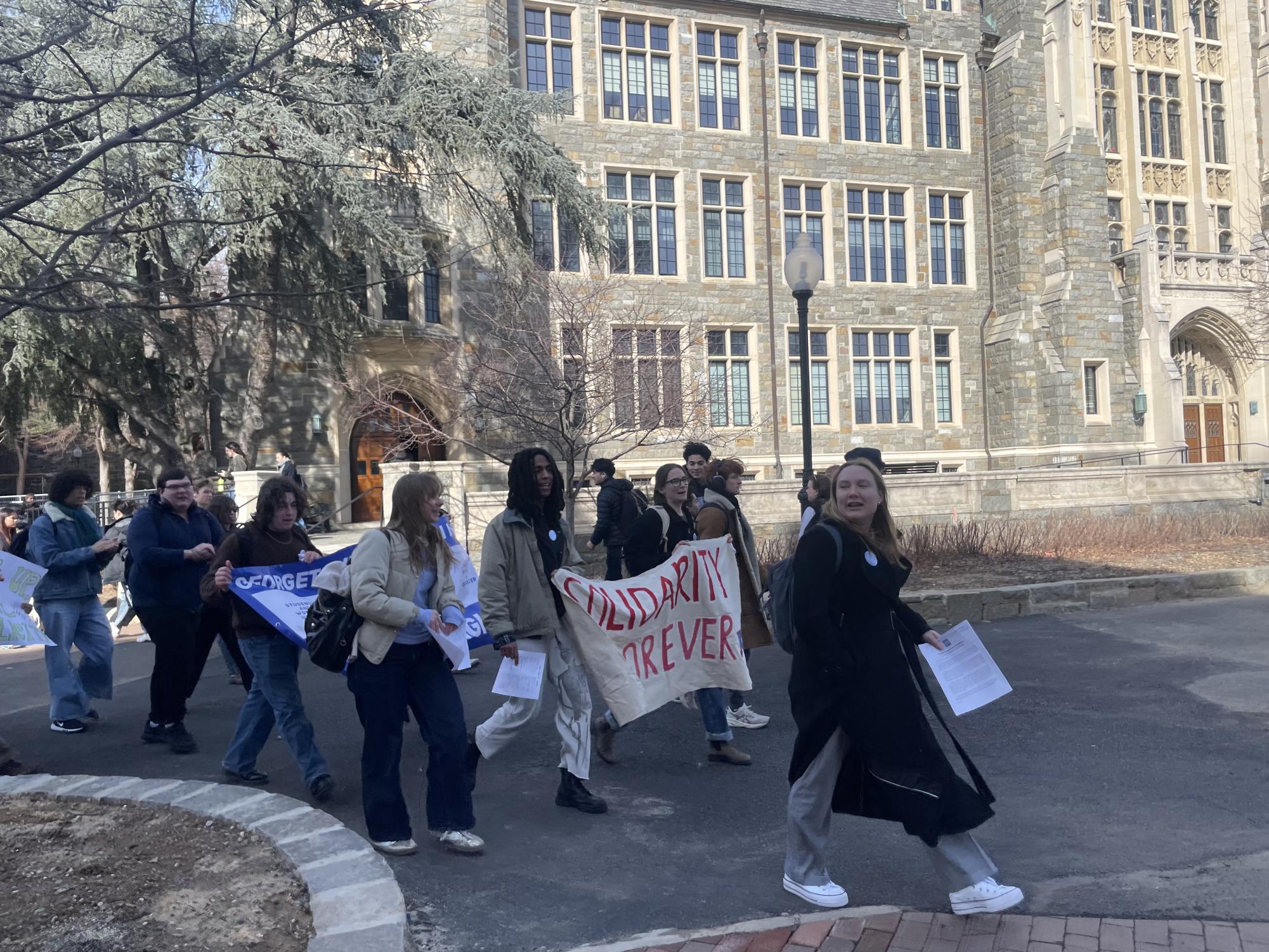
The day before the bargaining session, a group of students led by GCWR delivered a petition to the president’s office demanding the university provide fair compensation. Students called on the university to remain faithful to the Just Employment Policy as well as its Jesuit values.
GCWR students were originally present in the negotiation room but left at the representatives’ request when bargaining began.
Clark said students wanted to show solidarity with workers by standing outside of the negotiation room in McShain Lounge.
“We made the decision to leave the bargaining room, but will remain present in McShain throughout the day, so the workers know that we are here for them, and we will fight to make sure that they have the best contract possible,” Clark told the Hoya.
Roy Linton — a Georgetown University Transportation Shuttle (GUTS) driver who was present at the negotiations, which were open to all university employees — said the bargaining seemed promising for the new contract.
“It seems like it’s going to be a good negotiation,” Linton told The Hoya. “I don’t think it’s going to be too long, so hopefully we will have a contract soon.”
Throughout Fall 2025, GUTS drivers engaged in a protracted campaign against the university to stop a plan to outsource their employment to a third-party vendor. In December, the university pledged to allow the drivers to remain university employees, thus retaining their benefits. However, last month, 1199SEIU alleged the university was retaliating against the drivers through a plan to move the bus depot to Maryland.
Clark said she remains confident in the union’s position even though a contract was not immediately reached.
“The union will walk out of negotiations with a better contract — they will not be making any concessions,” Clark wrote to The Hoya. “Georgetown needs to remember that the workers have the power, and the students will fight alongside them until their demands are met.”
Gore said student support shows employees that the Georgetown community stands with them throughout negotiations.
“I appreciate what the students do for the employees. That solidarity is so important because it makes me feel like I’m not alone,” Gore said. “It makes me feel like somebody does appreciate what we’re doing, and they see what we do, and they know that the university should notice it also.”