
A Georgetown University Law Center professor argued there is a historical precedent for paying reparations for the United States’ long history of enslaving Black people in a new book published Jan. 20.
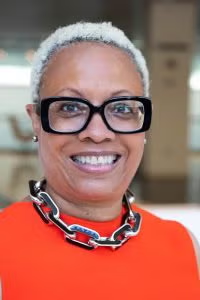
Dorothy Brown (LAW ’83), taxation professor and Martin D. Ginsburg Chair in Taxation at Georgetown Law, posits that the United States has dismissed paying reparations for Black Americans despite being able to. The book, titled “Getting to Reparations: How Building a Different America Requires a Reckoning With Our Past,” outlines Brown’s journey from skepticism to active advocacy for reparations for Black Americans.
Brown said a conversation with a former colleague from Emory University initiated her switch from skepticism to curiosity, referencing the government compensating for the lynching of 11 Italian immigrants in New Orleans in 1891.
“She mentioned that the federal government paid reparations to Italy on behalf of Italian immigrants who were lynched in Louisiana,” Brown told The Hoya. “And I said, ‘Wait a minute. We paid them, but we never paid Black Americans, even though they were the disproportionate percentage of those who were lynched.’”
Brown said after conducting further research, she found many other instances of the U.S. government compensating groups who were wronged, such as an 1862 bill that ended slavery in Washington, D.C., and paid enslavers up to $300 per freed person.
“The next thing I found was that the federal government paid white enslavers in D.C. following the passing of the 1862 Compensated Emancipation Act,” Brown said. “Then I found out we paid tribal nations for economic exploitation and land theft. And finally, we paid Japanese Americans for mass incarcerations.”
“So the federal government paid to all of these different groups, but not Black Americans who experienced each of these harms,” Brown added. “I was no longer a skeptic.”
Although reparations in the United States remain a polarized issue, it has gradually gained support. From 2000 to 2022, the percentage of Black people in the United States who supported reparations increased from 67% to 77%, while support from white people grew from 4% to 18%.
Brown said she hopes to change skeptics’ minds by exposing them to the history that often goes untaught, pushing back against the Trump administration’s erasure of Black history.
“This is the perfect time to talk about this, because the Trump administration wants to erase race from history,” Brown said. “Working with a political strategy firm, we learned that if you tell people about the history of what happened to Black Americans after slavery ended — ‘separate but equal’ and sharecropping — they realize it wasn’t fair. There are a lot of people that just don’t know.”
Brad Snyder, professor of constitutional law at Georgetown Law, said he believes Brown’s work is important to understanding the need for reparations in the United States’ historical context, citing “The Whiteness of Wealth,” Brown’s previous book, which contends that tax law is racially biased.
“Brown is a pathbreaking scholar whose books ‘Whiteness of Wealth’ and ‘Getting to Reparations’ accomplish the rare feat of speaking to fellow academics, policymakers, and the American people,” Snyder wrote to the Hoya. “‘Whiteness of Wealth’ remade the field of tax law by viewing it through the lens of race. ‘Getting to Reparations’ will have a similar impact.”
Brown said changing people’s minds on the issue of reparations requires telling concrete stories of U.S. history.
“You need to accessibly talk about ideas and catch people’s hearts, not just come up with 10-point plans,” Brown said. “If you tell people there have been four instances where the government paid cash to remedy harms, and those exact four harms happened to Black Americans, but they’ve never been paid, people feel the unfairness.”
Nick Monocchio (LAW ’26), a third-year student at Georgetown Law who took Brown’s course on critical race theory, said Brown is a top-tier professor who is well-equipped to change people’s hearts.
“You’re not going to take her critical race theory class and come out of it agreeing with everything you thought before,” Monocchio told The Hoya. “It wasn’t just like a leftist cabal; we actually were doing real legal analysis. She makes you think about uncomfortable things in a way where you learn and you grow from it.”
In “Getting to Reparations,” Brown outlines the groundwork for policy change, arguing for the creation of a federal commission dedicated to researching historical harm against the Black community.
Brown said this commission would be the first tangible step by the government in achieving reparations for Black Americans.
“We don’t know what the cost would be because we’ve never studied it, and the plunderer who took our wealth didn’t keep good records on purpose either,” Brown said. “We absolutely need to study all of the various ways that harm has occurred and impacted the Black community.”