
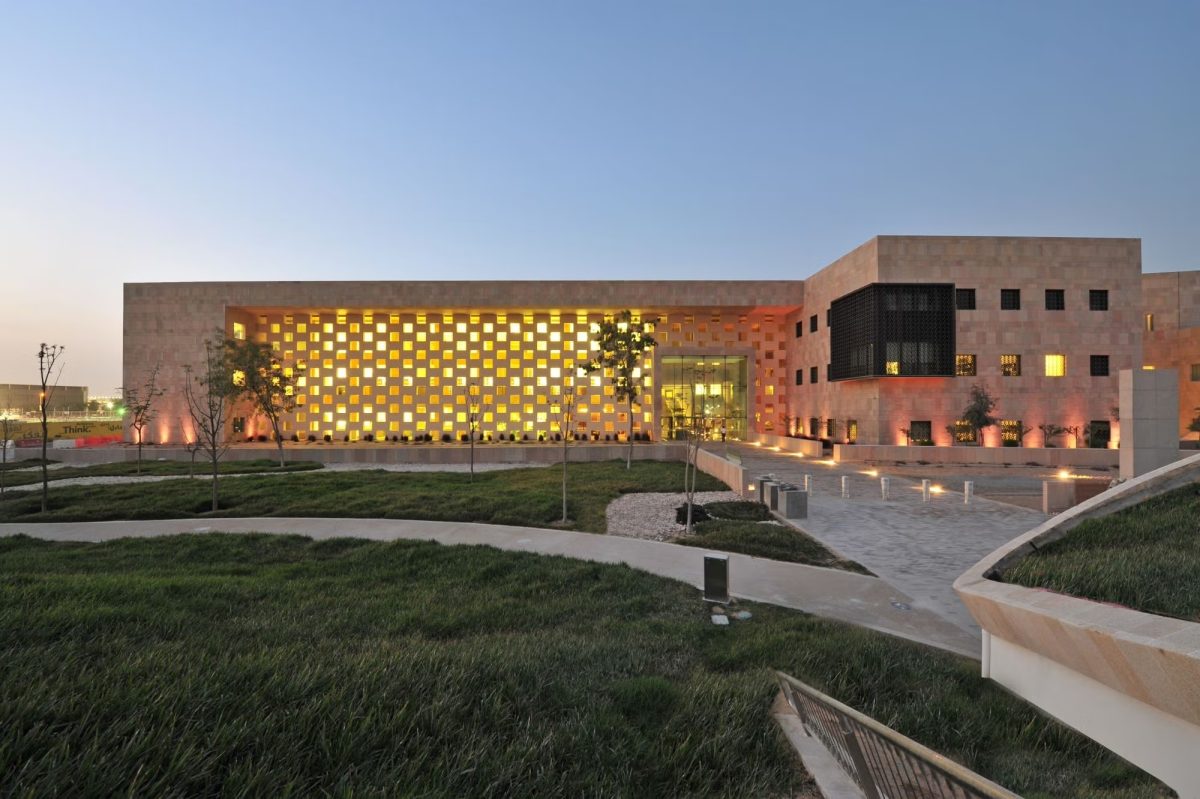
Students at Georgetown University in Qatar (GU-Q) published a series of case studies examining interreligious diversity, based on a religious pluralism course, the university announced March 10.
In a Spring and Fall 2023 undergraduate course on religious pluralism that included Northwestern University in Qatar and Hamad Bin Khalifa University, GU-Q students developed and published a series of case studies promoting interreligious literacy. The case studies, now available through Georgetown’s Alwaleed bin Talal Center for Muslim Christian Understanding (ACMCU), explore different interreligious relations across the world through a new pedagogical approach.
Josef Meri, a former GU-Q professor who led the initiative, said case studies such as the ones GU-Q students developed are especially important during periods of conflict.
“Case studies focus on teaching about how religion, politics, memory and public life actually intersect in moments of tension,” Meri wrote to The Hoya. “Case studies teach us how to center our humanity, to energetically engage with lived complexity, and the human stakes involved.”
The case studies were developed over the two-semester course titled “Religious Pluralism in the Middle East and Islamic World” and were supported by a Qatar Foundation Multiversity Teaching Grant. The course took inspiration from the Harvard University Pluralism Project, which focused exclusively on religious pluralism in the United States, and explored how legal, cultural and political frameworks influence religious practices in a broader international context.
Meri said the project expanded the scope of the Harvard project.
“In the case of the Middle East and the global South, we’re dealing with diversity in a different way than we are in the United States,” Meri told The Hoya.
“We are looking at taking into account global south perspectives in writing these case studies as well, learning about the voices from the Global South, which are not part of the American model,” Meri added.
Akintunde Akinade, a GU-Q professor who co-taught the course, said students exchanged novel ideas on religious pluralism in the Middle East throughout the course.
“The audacity to explore the boundless resources and case studies on religious pluralism in the Arab and Islamic world was creative, engaging and remarkable,” Akinade wrote to The Hoya. “I thoroughly enjoyed working with students on various case studies on interreligious engagement.”
“The classroom context provided both the institutional and intellectual ‘safe space’ that enabled students to grapple with novel topics and ideas,” Akinade added.
Reigna Dukhan (SFS-Q ’26), who focused her case study on a Turkish mosque controversy in Switzerland, said interreligious dialogue is important due to the significant role religion plays in many people’s lives.
“I’ve always been someone who’s interested in interreligious conversations, especially coming from someone who lives in the Middle East where religion is so involved in our lives, in our traditions and how we behave, how we speak, in our politics and our culture,” Dukhan told The Hoya. “So I think that such conversations are pretty important out of genuine interest in ‘Why people believe in what they believe in,’ people’s different interpretations and perceptions, but at the same time, out of genuine cultural necessity.”
Seynabou Tall (SFS-Q ’25), who examined a controversy over burkinis — a type of modest swimwear for women which covers the whole body except for the hands, feet and face — in France, said the case studies are applicable to studies of interreligious conflict around the world.
“I believe this resource is particularly important at the present moment because questions surrounding religion, public space, and identity are becoming increasingly visible across many societies,” Tall wrote to The Hoya. “While the case I worked on is situated in Europe, similar debates emerge in many parts of the world, whether in secular states or in countries where religion plays a more central role in public life.”
Tall said she hopes the case studies will foster conversation about interreligious relations in the everyday world.
“Beyond raising awareness about religious difference, they also encourage reflection on broader questions related to coexistence in shared public spaces,” Tall wrote. “In many societies today, people from diverse religious and cultural backgrounds interact in schools, workplaces and public institutions. Understanding how these interactions unfold and the tensions that sometimes arise, is essential for building more thoughtful and inclusive dialogue.”
Meri said he hopes the case studies will give people a way to reexamine interreligious relations and conflicts.
“I would very much encourage students and policymakers and NGOs to read these case studies, to learn about these controversies that are time and place specific, to say, ‘Maybe we should be looking at the patterns here, maybe we should be looking at how we can promote social cohesion in our societies,’” Meri said. “One of the keys to doing so is through religious literacy, but it’s also about understanding our shared humanity, whether we’re students or academics, or policymakers, or government officials, or even military commanders, we should be looking at case studies.”