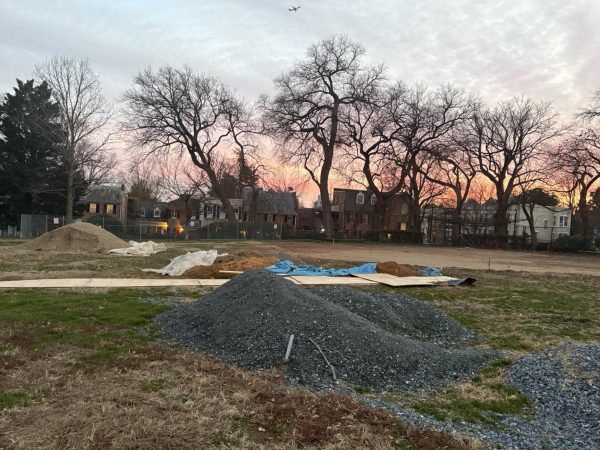
After human remains were originally discovered at a Volta Park construction site in August, residents have raised questions about how the remains have been handled, as further bone fragments continue to be discovered.
An anonymous letter published Jan. 2 in the popular Washington, D.C. blog, Prince of Petworth (PoPVille), detailed the discovery of several bone and skull fragments in November, which appear to have been left exposed for months after. According to photos reviewed by The Hoya, protective tarps and orange flags were placed on top of the remains after PoPville’s letter, yet as of Jan. 22 at 5:30 p.m., sections of the tarps were crumpled up away from the original spot.
Knox Graham (CAS ’27), who represents sections of main campus and Burleith on the Advisory Neighborhood Commission (ANC), said next steps in the excavation process need to be done with proper respect.
“The most important thing is for these remains to be handled with care and dignity by the appropriate authorities,” Graham wrote to The Hoya.
Remains were first discovered in August during a renovation to the field’s drainage system, and were submitted to the D.C. archeologist.
The graveyard operated from 1802 to the 1890s, and was converted into a playground in 1909. While the families of the bodies in the roughly 2,700 graves were alerted to collect the remains, the vast majority were left.
Friends of Volta Park, a coalition of residents who care for the park, alerted residents in October that human remains were found and the construction project would be halted until further notice.
However, in early January, neighborhood residents walking their dogs discovered multiple fragments above ground, according to videos reviewed by The Hoya. Officials confirmed the skull and bone fragments are human remains.
At a Jan. 12 meeting of the ANC 2E, a governing body that represents Georgetown and Burleith, Commissioner Topher Matthews said the human remains have been regularly disturbed throughout the last 150 years.
“There’s, throughout the property, a lot of disturbed graves with a lot of bones, shards and other things just in the soil,” Matthews said at the meeting. “It’s very gothic and grim, but unfortunately that’s the situation.”
The D.C. Department of Parks and Recreation (DPR) and the Office of Planning did not respond to requests for comment.
At the meeting, Matthews said an entire undisturbed grave was discovered during the installation of a drain at the park, causing them to halt progress.
Matthews also said DPR representatives were unaware the bones were exposed when they left the site, and that the remains may have become exposed due to rain and wind.
“It’s very alarming that that happened, it’s disturbing that human remains are treated that way,” Matthews said.
A DPR spokesperson said the remains will be reinterred.
“DPR is working closely with the city archaeologist and our contracted archaeologist to move forward with an approved plan to respectfully reinter disarticulated human remains discovered at Volta Park,” DPR wrote in a statement to Fox 5. “The site has been further secured. DPR anticipates completing drainage work by the end of winter, with field restoration underway for a spring reopening once the grass is established.”
According to video footage reviewed by The Hoya, fragments of bones and part of a human skull appear to be visible on top of the dirt in the park.
Matthews said that going forward, a deeper trench will be dug away from the burial in order to finish the drainage.
Ben Ferrara (CAS ’26), who lives in Burleith and frequently walks by the park, said the discovery of the remains have changed his perception of the park.
“It’s a little unsettling,” Ferrara told The Hoya. “It’s not that I won’t ever go back, but whenever I’m there I definitely am going to be thinking about it.”
Graham said that although the remains are striking, they serve as a reminder of Georgetown’s past.
“It is always startling to find human remains which may have not been treated with due respect in the past,” Graham wrote. “At the same time, their existence reminds us of the deep history of this neighborhood and our forebears who once lived here.”