

Over 40 Georgetown University students, faculty and staff members alleged the university is mistreating workers at a protest May 1.
A coalition of student-led workers’ rights groups — including GU SCAR, a student protest group, and the Georgetown Resident Assistant Coalition (GRAC), the resident assistants’ (RAs) union — held the rally in honor of May Day, which celebrates workers globally. At the protest, students, faculty and staff asserted that the university has contradicted its Jesuit values by underpaying and disrespecting workers.
Ray Velasquez, a facilities worker who spoke at the rally, said he joined the demonstration to protect his rights as a Georgetown employee.
“It’s important for me to speak today, because I feel like there’s no harm in reminding Georgetown of its Jesuit values, and as somebody who wants to continue to see Georgetown to be prosperous, I’m speaking because I care,” Velasquez told The Hoya. “I know it seems like it’s kind of counterintuitive, but I appreciate Georgetown, the entity of Georgetown itself, for putting food in my mouth, money on the table, things of that nature and I would like to continue the way it’s going.”
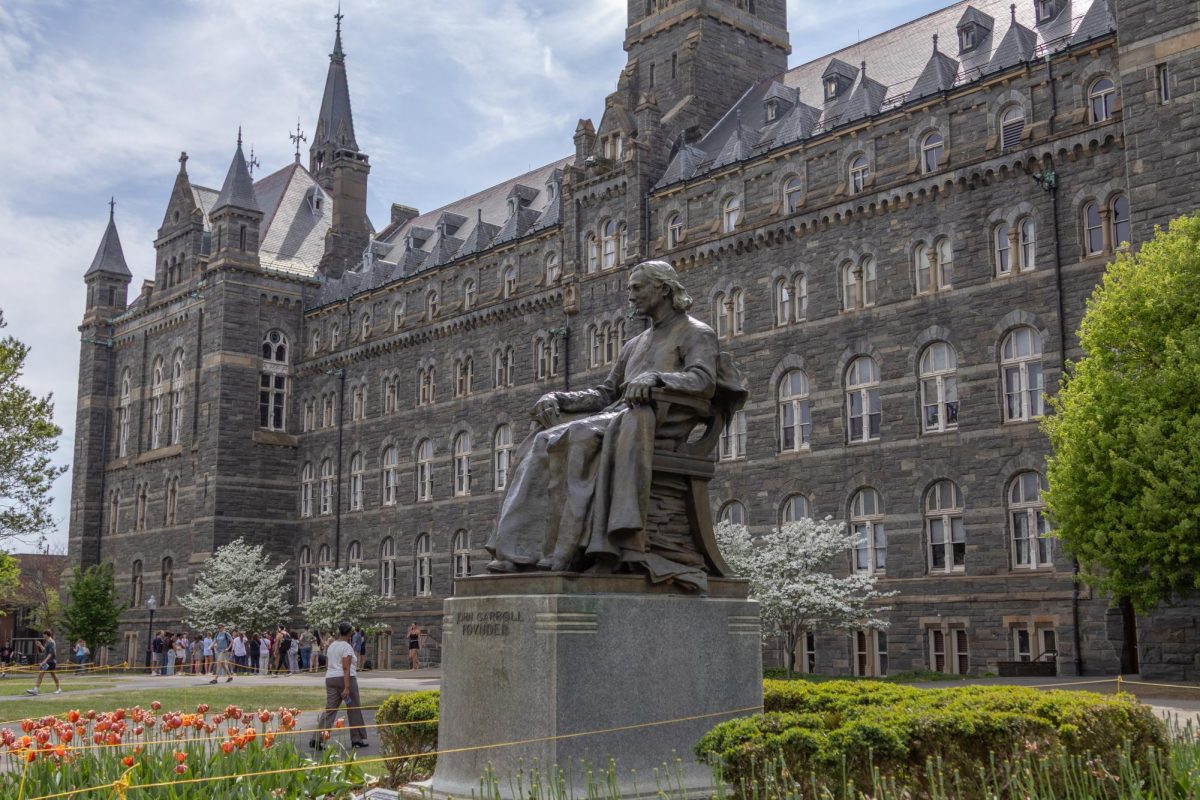
The protesters demonstrated in Red Square before marching to Healy Hall, Leo J. O’Donovan Dining Hall and Harbin Hall. At each location, speakers accused the university of disrespecting the university’s Just Employment Policy, which ensures fair and competitive compensation for full-time university employees.
A university spokesperson said Georgetown is committed to working collaboratively with employees and unions.
“We deeply appreciate the contributions that University faculty, staff, student employees, and contracted workers make to the Georgetown community,” the spokesperson wrote to The Hoya. “Georgetown is committed to respecting the dignity of all members of our community and upholding our Just Employment Policy, which affirms employees’ rights to freely associate and organize.”
“The University has a long history of working collaboratively with unions representing our employees, and we will continue to engage in good faith through the channels that the University and these unions have mutually established,” the spokesperson added.
In the past year, both RAs and facilities workers have ratified contracts with the university. The adjunct faculty union is currently negotiating a new contract. At the same time, student groups have petitioned the university to include wage increases and broader protections in its contracts.
Fiona Naughton (SFS ’26), a Georgetown Coalition for Workers’ Rights (GCWR) board member, said the university does not pay workers enough to live comfortably in Washington, D.C.
“People can’t live like this and that’s why people are out here today,” Naughton told The Hoya. “It’s in solidarity with the workers on campus who are working two jobs, who don’t make enough to live just by working at this university.”
Georgetown facilities workers ratified a new union contract in March that involves a 15% pay increase compounded across five 6-month segments. While workers praised the raise, some were also disappointed that the increase was not greater, which they said would have been more commensurate with their living expenses.
Theodora Danylevich, an adjunct faculty member who serves on the bargaining team of the adjunct faculty’s union, said the university does not respect adjunct faculty.
“Once you’re an adjunct, nobody wants to hire you as any other rank of faculty; the university is ashamed of us,” Danylevich said at the rally. “They’re ashamed and they desperately need us. They want us to remain invisible. So, yeah, short-term context: no job security, no benefits, our pay is quite low.”
Georgetown must pay adjunct faculty a minimum of $7,000 per three-credit course, which faculty members have criticized as far below a living wage. Around 41% of Georgetown faculty are adjuncts.
Izzy Wagener (SFS ’26), a GRAC chairperson, said recent policy changes from the Office of Residential Living (Res Living) have also unfairly treated RAs.
“They say we used to be student leaders, but are now ‘employees,’ yielding the term as if it’s an insult, as if we haven’t always been workers, even if we weren’t unionized ones, and as if employees aren’t what make this very university function as much as it would like to ignore us,” Wagener said at the protest. “It’s also low and middle-income students who suffer the most as a result of our employer’s actions.”
On April 23, GRAC published a petition alleging that the university engaged in union-busting efforts against student RAs. The petition claims that multiple Res Living policy changes — including suitemate selection restrictions, the delayed release of summer RA positions and requiring more RAs to remain on campus during holiday breaks — negatively affect RAs’ quality of life.
A university spokesperson said last week that the university disagrees with GRAC’s characterization of Res Living’s policies, which the spokesperson said are compliant with labor law.
Naughton said tensions between workers and university administration have risen amid increasing student protests and disputes over worker contracts.
“There’s something really happening and shifting on campus,” Naughton said. “It’s boiling over and I think people here recognize that nothing can stay as it is; the administration is targeting workers across the campus. It’s making their lives unlivable.”
Velasquez said he hopes administrators, students and workers can collaborate to develop more fair labor practices.
“At the end of the day, we can’t avoid each other,” Velasquez said. “Let’s put our differences to the side. We’ll bring them up when it’s appropriate.”
Jackson Schnabel (SFS ’27), who helped organize the protest, said the rally demonstrated student leaders’ commitment to solidarity with workers.
“We’re here in solidarity with workers all over the world,” Schnabel told The Hoya. “We want to send the message that all the power belongs to the workers for my entire life and for all of our entire lives.”
“By showing out, by going on protests today, we’re here to demonstrate our power as a collective,” Schnabel added.
The adjunct faculty union is meeting for its next bargaining session with the university on May 4.
Velasquez said he appreciates students’ continued support, even though many students don’t experience the struggles workers face.
“Most of the students here come from a background that is very privileged,” Velasquez said. “They, quite frankly, don’t have to go through the stuff I’ve got to deal with once I clock out. So the fact that they have life on ‘easy mode’ in certain aspects, the fact that you’re going out here and supporting us, I, quite frankly, appreciate it.”
Wagener said GRAC and student advocates will continue protesting until they feel the university is respecting workers’ rights.
“I know that we will never stop fighting for the basic rights we are owed, and every day, I’m inspired by the other workers on this campus for their perseverance and courage, because this is no easy task, but just a necessary one and it’s an honor to stand with them today,” Wagener said.
CORRECTION: This article was updated May 1 to reflect that the Georgetown Coalition for Workers’ Rights was not involved in organizing the protest.