
Georgetown University administrators contextualized rising tuition costs, reviewed the university’s budget and provided updates on campus improvement projects at a town hall for students March 17.
For fiscal year 2026, the university projects a revenue reduction of at least $91 million amid federal reductions in higher education spending and immigration restrictions. In February, the university announced its fifth consecutive undergraduate tuition increase, citing rising costs and efforts to expand student resources.
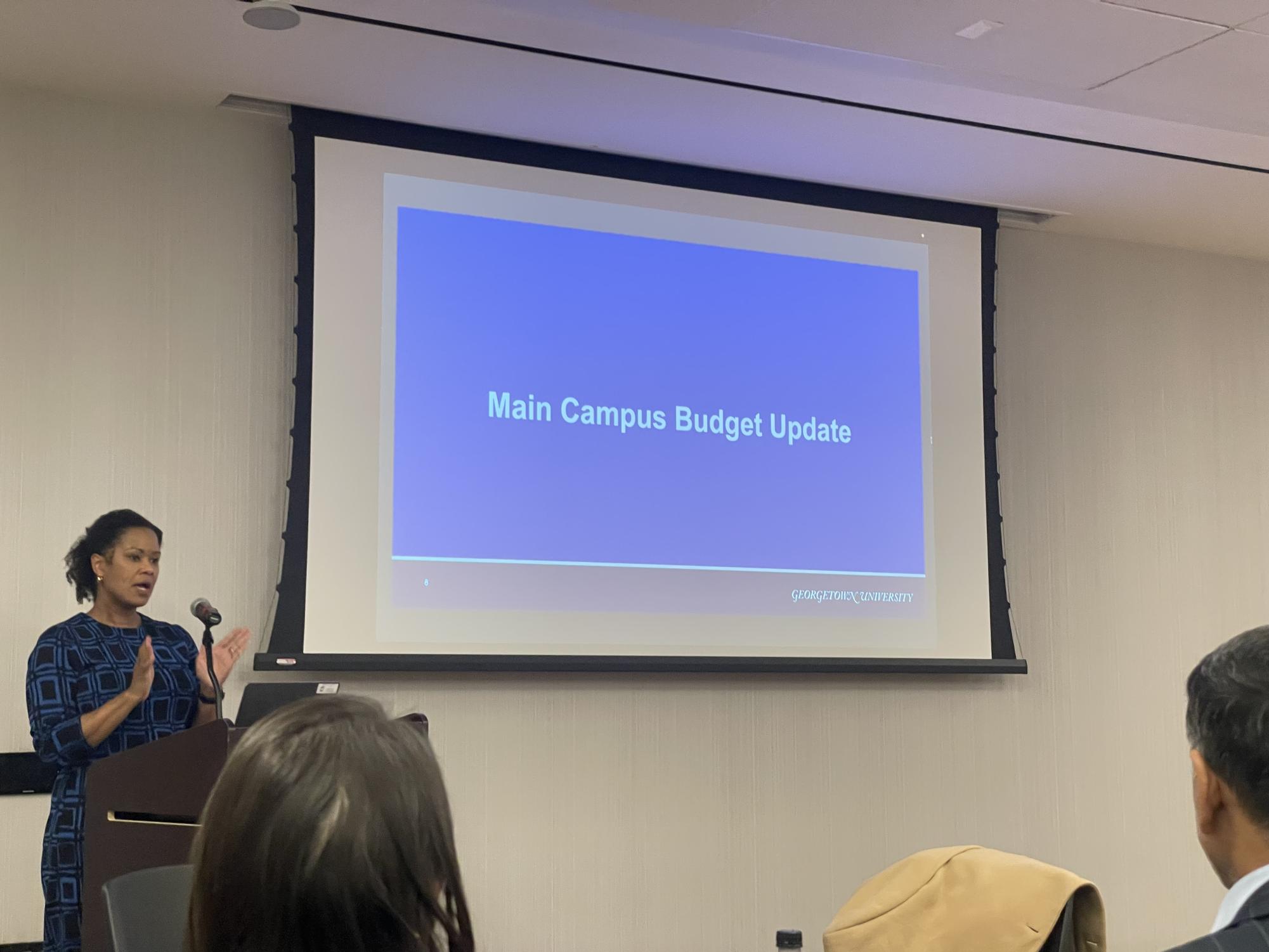
Interim provost Soyica Diggs Colbert said the cost of tuition, which was $71,136 for the 2025-26 academic year, is less than Georgetown’s yearly expenditure per student.
“Tuition is around $67,000 a year — 68 if you want to round up,” Diggs Colbert said at the town hall. “The cost of your experience here — just in tuition, so not in housing and room and board — is almost $100,000 a year. So what you get for your admissions here is about $30,000 more than what any student pays — even a full-pay student.”
Diggs Colbert said the university anticipates the conditions causing funding reductions, including federal cuts, to continue.
“This current fiscal year, we anticipated a $100 million drop in our revenue, so a 5% drop in our revenue, which we realized,” Diggs Colbert said. “And so that is impacting all of our budgeting, and we don’t anticipate that those conditions, which are primarily reflective of a larger ecosystem for higher ed, are going to change in the next academic year.”
In November, the university projected a $17 million loss in international graduate student tuition and 20% decrease in graduate student enrollment amid obstacles to students obtaining proper visas.
Hari Sastry, Georgetown’s chief financial officer, said the university anticipates continued drops in graduate student enrollment in the future.
“We saw a reduction last year in graduate and international enrollment, largely because of both visa policies and just it wasn’t a very welcoming environment,” Sastry said. “Well, that unwelcoming environment continues, and so we’re seeing another kind of dip this year in applications as we’re looking at our graduate and international enrollment.”
Lisa Belokur, Georgetown’s vice president of Planning and Facilities Management, also updated students on current maintenance operations, including the ongoing utilities projects on Healy and Copley lawns as well as the solar panel installation in the Intercultural Center.
Belokur said deferred maintenance, or postponed repairs on university buildings, is a major focus of her office.
“We have an entire program just to manage deferred maintenance,” Belokur said at the town hall. “We have, compared to other institutions, a really mature program. And our board is really, really generous every year, helping us to really pull down that backlog number.”
Belokur presented that over 68 buildings are currently involved in the deferred maintenance program, noting over 1,400 facilities “deficiencies.”
Belokur said the university’s board of directors approved a project to add solar panels to nine university buildings: the Healey Family Student Center, Intercultural Center, Ida Ryan and Isaac Hawkins Hall, Lauinger Library, Regents Hall, 500 1st Street, Building D, Hariri Building, McDonough Arena and Thompson Athletic Center.
“We have a project that just got approved by the board — we’ve been able to identify about nine buildings across campus that are appropriate for solar power,” Belokur said. “This project just got approved by the board, and we’re going to be starting that this coming fiscal year.”
Diggs Colbert and Sastry also briefed attendees on the status of financial aid amid university austerity measures.
Diggs Colbert said the university is working to raise the level of financial aid funded by gifts to offset increased tuition costs.
“The rate of giving — which is basically what undergraduate financial aid is funded by, gifts and endowments, as I said before — has remained steady over time, but costs have increased, and so we’re working on helping to increase the rate of giving to match with the costs as they are increasing,” Diggs Colbert said.
Sastry said the university generally refrains from cutting financial aid, pointing to the previous fiscal year’s loss of revenue.
“The goal is never to have less financial aid,” Sastry said. “In fact, this past year, when we were dealing with all of these federal impacts, we lost $100 million in revenue. We did not cut financial aid as part of that.”
CORRECTION: This article was updated April 1 to clarify the $91 million figure.