

Throughout the Fall 2025 semester, Georgetown University has unilaterally implemented a series of policy changes affecting residential assistants (RAs), drawing criticism for anticipated impacts on RAs’ living situations and employment with the university.
RAs denounced five policy changes, which date back to a Sept. 9 email, and include requirements that RAs living in suite-style housing may choose only their direct roommate and must commit to being an RA before learning their building assignments. These changes went into effect this semester, and many RAs allege they will negatively impact their housing process and quality of life.
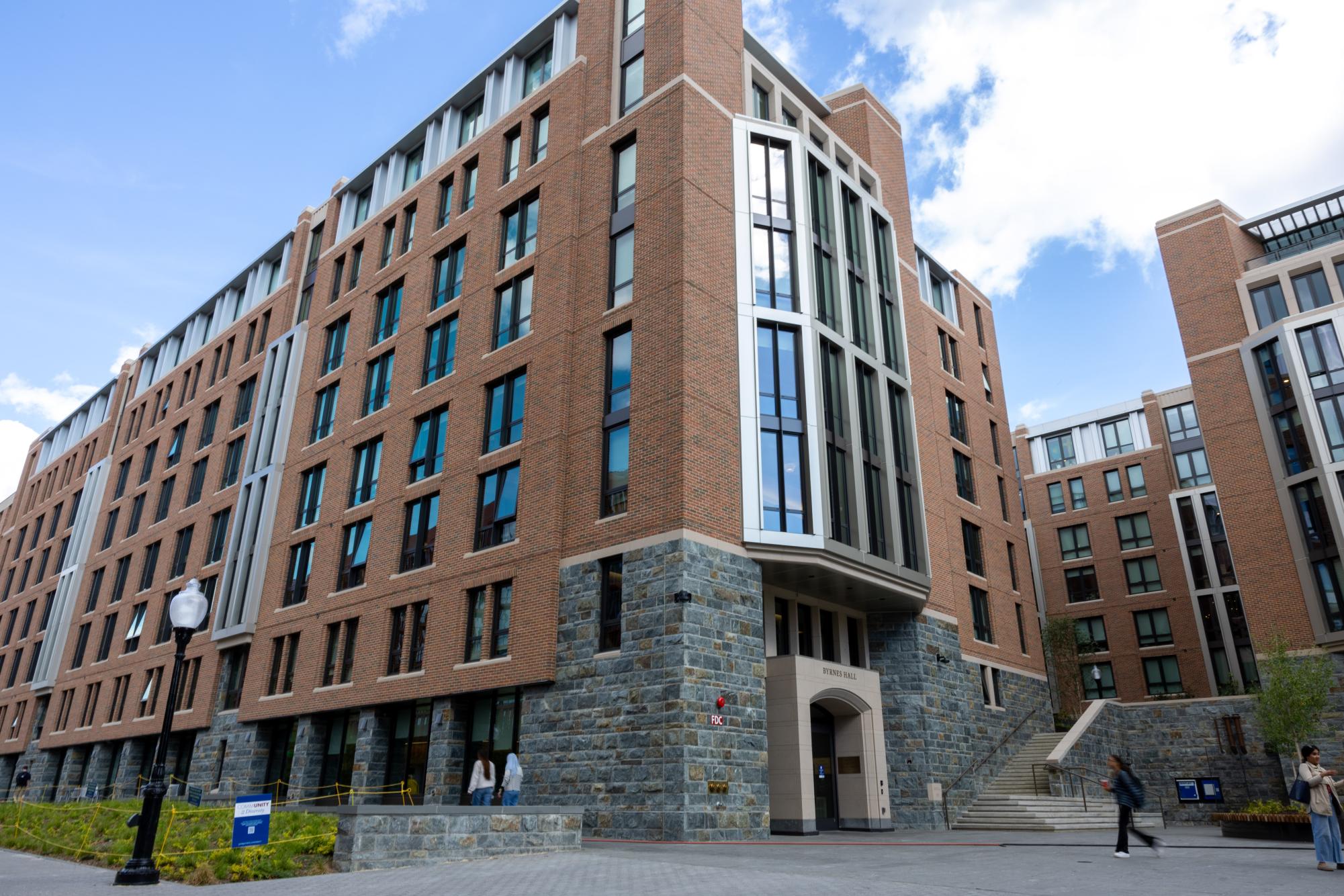
Isaiah Vasquez (CAS ’27), the RA union’s vice chair and an RA for Copley Hall and Ida Ryan and Isaac Hawkins Hall, said the changes have made RAs distrustful of management.
“It’s created a sense of distrust with RAs and with management,” Vasquez told The Hoya. “It just feels like there’s a loss of a sense of control.”
This semester is the first in which the new contract between the university and the Georgetown Residential Assistant Coalition (GRAC), the RA union, is in effect. The Office of Residential Living (Res Living) announced the roommate selection and RA commitment policy changes at a Nov. 7 all-staff meeting for RAs.
The Hoya obtained a partial audio recording of the meeting in which Heidi Zeich, Residential Education’s executive director, explained the roommate-choice change.
Zeich said Res Living made the decision in the interest of “equity” without RA input.
“This was a decision that I will own. It’s a management decision,” Zeich said at the meeting. “I did not consult RAs in making this decision because of the values that I already shared that were considered when doing this.”
A university spokesperson said Res Living makes policy changes for RAs based on the university community’s needs and well-being.
“The beginning of the academic year provides us with the opportunity to ensure that our policies and procedures reflect current best practices to serve the needs of our students, staff and community,” the spokesperson wrote to The Hoya. “Our goal is to foster intentional communities that nurture individual growth, encourage reflection and promote holistic well-being.”
Izzy Wagener (SFS ’26), GRAC chair and RA for Darnall Hall, said she thinks the policy change is illogical.
“Honestly, I shouldn’t still be surprised by the decisions that have been coming out of management this year, but I think I still was just because the new roommate decision just feels nonsensical in a lot of ways,” Wagener told The Hoya. “I don’t think it even makes sense from a management perspective or from an RA perspective.”
With the policy changes, RAs will not be informed of the specific room they are in until after Phase 2 of the housing process, when residents are in groups of two.
According to multiple RAs, this change means that even if an RA’s friends attempted to join the suite through the standard housing portal, the RA would not yet have a specific room assignment.
Previously, RAs selected their suitemates in advance, and Res Living placed the group in a room without the RA entering the housing portal.
A university spokesperson said the university “makes housing assignments that best meet the needs of each of its residential living communities.”
Anna Holk (CAS ’27), a GRAC steward and RA for Nevils Hall, said requiring RAs in suites to live with roommates they did not select may present difficulties.
“Living with people you don’t know is no small thing,” Holk told The Hoya. “I’m gay. I don’t want to live with a group of homophobic girls who are going to make my life hell. A Black RA doesn’t want to live with a racist roommate. People deserve to feel comfortable and safe in their homes, in their private spaces, and a big part of that is knowing who you’re going to live with and consenting to live with that person.”
Peter Sukstorf (SFS ’26), an RA in Ryan Hawkins Hall, said he disagrees with Res Living’s claim that the policy changes make RA experiences more equitable.
“The ideology of making the experience worse for those who currently have a good experience in order to make it equal — rather than making the experience better for those who have currently poor experience — seems very flawed, in my opinion, because it doesn’t really benefit them to make the experience worse for some RAs,” Sukstorf told The Hoya.
Zeich said RAs’ experiences mediating residents’ concerns could inform potential future conflicts among RAs and their roommates.
“As RAs, you often work with other residents who have roommate conflicts and concerns in their room,” Zeich said at the Nov. 7 meeting. “So we understand that, and there’s some skills from those experiences that you can apply to your own living experience.”
“One of the things I talked with a couple of our pro staff with is we can provide the opportunity for folks that are in units with unit mates to come together in the spring, and we can provide some money to facilitate a dinner or a snack opportunity for them to get together and start talking about what relationship they want to have come the next academic year,” Zeich added.
Vasquez said this plan will not work for everyone.
“Sometimes, Residential Living issues cannot be resolved just through mediation,” Vasquez said. “Sometimes it requires escalation, sometimes it requires bias report forms, sometimes it requires room shifts. But the process would need to work completely different for RAs; we’re not allowed to move spaces.”
The Sept. 9 email included expectations for RAs not to enter romantic or sexual relationships with any residents in their immediate community, or their direct residential building. Zeich, who wrote the email, explained Res Living established the policy to prevent conflicts of interest.
The email also said RAs “are expected to be positive role models 24/7 and should report concerns regarding students, facilities and behaviors regardless of whether or not you are serving in an official capacity at that moment.” According to multiple RAs, the new policy requires RAs to report concerns or violations whether or not they are on shift.
The 2024-25 RA manual includes a chart outlining when RAs are and are not acting in their official capacity, including examples to guide them through complex situations when living and working in the same space. The 2025-26 RA manual lists this section in its table of contents, but the guidelines do not exist in the manual’s body.
Holk said last year’s training included a session regarding these distinctions, while this year’s training did not.
“The guidance that was given this year post-RA training, with no mention of this during RA training, was that regardless of whether you’re technically acting in your RA capacity, you should have those types of reporting obligations,” Holk told The Hoya.
RAs formally voted to unionize April 16, 2024, accepting representation from Local 153 of the Office and Professional Employees International Union (OPEIU). The union approved the contract May 9 after seven months of collective bargaining.
According to multiple RAs, the RA holiday staffing procedure has also changed to require all RAs in their immediate community to serve a holiday shift. Previously, one RA volunteered to cover all communities in an extended community, such as Village A, Copley and Ryan Hawkins Hall.
The holiday staffing update was intended to address concerns about holiday understaffing while classes are not in session. However, RAs have said this policy limits their time during break periods.
Vasquez said the new holiday policy impedes RAs’ ability to recuperate during breaks from school.
“If it’s the middle of spring break, obviously you’re not going to be back in D.C. just for your role as an RA,” Vazquez said. “It’s taking away time from RAs to be with their families, to be with their friends, to have the kind of relaxation that is honestly necessary coming out of Georgetown.”
Multiple RAs have said the changes will reduce overall quality of life for RAs on campus, leading to decreased RA retention and disproportionately affecting RAs with lower incomes.
Holk said she expects a number of current RAs not to return in subsequent semesters.
“This makes the RA experience considerably worse, and I think it will lead to a lot of RAs leaving the position, even if they’re really, really talented, quality RAs, solely because their rights as students are being violated,” Holk said.
Holk and Sukstorf both said many students choose to become RAs to help offset Georgetown’s high tuition and housing costs. They added that not allowing RAs to choose their suitemates, while other students can, creates inequities between RAs and other students based on financial status.
Sukstorf said the new restrictions will limit the pool of potential RAs to those students who rely most on the position’s benefits.
“I think the result of these policies will be that Res Living will have a smaller but more desperate pool of applicants, giving them more power over their RAs, because the only people who will want to be RAs as conditions get worse and worse are the people who absolutely are desperate for financial aid, and therefore it gives Res Living more power over those RAs,” Sukstorf said.
Vasquez said RAs are united.
“I just feel more motivated than ever to fight for fellow RAs,” Vasquez said. “I want this job not only to be fun, educational and a good experience for me but also for other RAs.”
“I am very motivated, very ready to take on whatever the university presents us with after we make our grievance about these changes,” Vasquez added.










Sam Lovell • Nov 16, 2025 at 11:35 pm
It is, in my mind, an exceptionally great shame that new leadership in the Department of Residential Living has chosen to abrogate the collaborative spirit that pervaded our collective bargaining negotiations. As the former Chairman of GRAC, I made an honest attempt in every action to model what a collegial relationship might look between student employees and university staff.
As the Department and the Office of Student Affairs surely know well, the unilateral modification of a contract which was ratified unanimously by student employees serves only to further agitate a relationship that had been in dire need of mending. It is incumbent upon all members of our community to question why, in light of the obvious implications of such a choice, administrators plowed forward anyway. The Director of the Department may be new to Georgetown, but the values which animate this institution are decidedly not—and they demand an honest commitment to collegiality and respect for the decisions rendered by a democratic process.
Certainly, the unionization of student employees and subsequent negotiations provided a new yet enduring challenge to university leadership. Yet I was proud that our initial campaign and subsequent negotiations were amicable. We called no strike, we made fair concessions in collective bargaining, and we conducted our campaign without identifying particular staff members responsible for objectionable behavior. At such a critical moment, I feel only deep regret that my alma mater has chosen now to cease reciprocating this good will, integral to any productive relationship between an employer and its union.
It is a choice I believe it will one day look upon with deep regret.