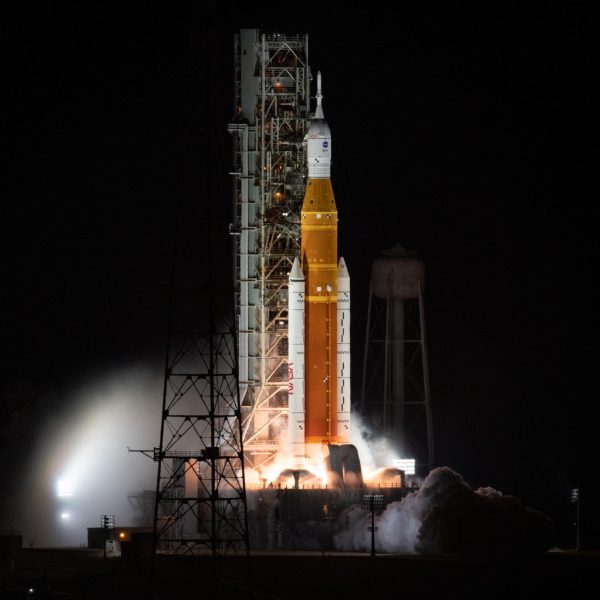
NASA’s Artemis II rocket launch date has been delayed from early March to early April following the resolution of a problem with the rocket’s fuel mechanisms, NASA announced in a March 3 report. The rocket’s launch had previously been delayed a month prior due to a separate issue.
The Artemis II mission, which aims to orbit humans to the Moon for the first time in decades, was slated to launch March 6 after the resolution of an issue with hydrogen fuel leaks in early February. The morning of Feb. 21, officials observed issues with the flow of helium through the rocket, disrupting the pressurization of fuel tanks and the powering of the rocket’s engines. Engineers identified an obstruction in the quick disconnect, a fitting that transports helium, and reassembled the system. Though the helium leakage delayed the launch of the rocket, the emergence of issues during testing is not uncommon.
Julia Small (CAS ’27), president of the Georgetown Astronautical Society, said the complexity of the mission’s systems makes issues inevitable, but rigorous testing is conducted to ensure the mission goes smoothly upon launch.
“These issues emerging during testing are very common, and it’s very likely more issues will appear given how complex the systems required to ensure the safety of the mission are,” Small wrote to The Hoya. “Scientists ensure these issues don’t appear during the mission through simulations, uncrewed missions, and redundant testing. They intentionally push the system to its limits to identify the weak spots and detect stress failures before they arise in a mission.”
The delay will give officials time to resolve the issue before the next launch window, which is when the Moon will be aligned in a position on its orbit that will allow gravity to naturally guide the rocket on its path.
“Launch windows are required for orbital mechanics to align properly — these dates ensure precise orbital alignment with the Moon, which optimizes a free return trajectory where gravity assists the aircraft in placing the rocket in high Earth orbit and looping around the Moon, returning to Earth,” Small wrote.
Upon launch, the Artemis II mission will send a crew of four astronauts to the Moon’s orbit for the first time since NASA’s Apollo mission in 1972, opening investigations of deep-space travel and life support.
Anish Patel (CAS ’28), believes the rocket will pave the way for humanity’s return to the Moon.
“The Artemis 2 rocket launch is a pivotal step to getting people back on the Moon,” Patel wrote to The Hoya. “Even with all of the delays, I think that the rocket will finally launch next month with a crew and will help NASA gain crucial insight on the spacecraft’s life support and future missions.”
Small also said the Artemis II mission is novel because its ultimate goal is to increase human presence on the Moon and Mars, making the lessons scientists learn from testing even more important.
“This is far from a been there, done that situation,” Small wrote. “We’re looking to test new systems, research more complex infrastructure initiatives, and work towards a sustained presence in space.”
“It’ll be the first time humans are reentering deep space in over 50 years, so there’s a lot more advanced technology and computing systems that need to be validated,” Small added.
Small said the mission will test systems and technology that would be crucial to a sustained human presence in space.
“I believe NASA hopes to discover further validation of life support systems as a main goal, having humans exposed to radiation beyond Earth’s magnetosphere. They’ll also be testing navigation in-deep space and more reusable technology such as the Orion Crew Capsule,” Small wrote. “Additionally, the aircraft has to carry food, water, oxygen, and include waste management, which adds weight and requires completely different technologies than robotic space missions.”
The mission will take astronauts beyond the Earth’s magnetosphere, which acts as a shield against harmful solar radiation. NASA’s earlier uncrewed Artemis I mission tested and confirmed the Orion spacecraft’s capability of shielding passengers against radiation, paving the way for the Artemis II mission to further investigate the capsule’s life-support features.
The mission will also be a landmark achievement for women in astronautics, as Christina Koch will become the first female astronaut to travel beyond Earth orbit.
Charlotte Phillips (CAS ’28) said Koch’s accomplishment will be an inspiration to women across all scientific fields.
“Increasing female representation in important STEM projects like this one is integral to the future of the scientific field,” Phillips wrote to The Hoya. “Even as a Georgetown student in a different field of science, it is amazing to see women in these spaces.”
Even after a series of delays, the Artemis II mission still holds exciting potential for sending humans to the Moon and even further to Mars.