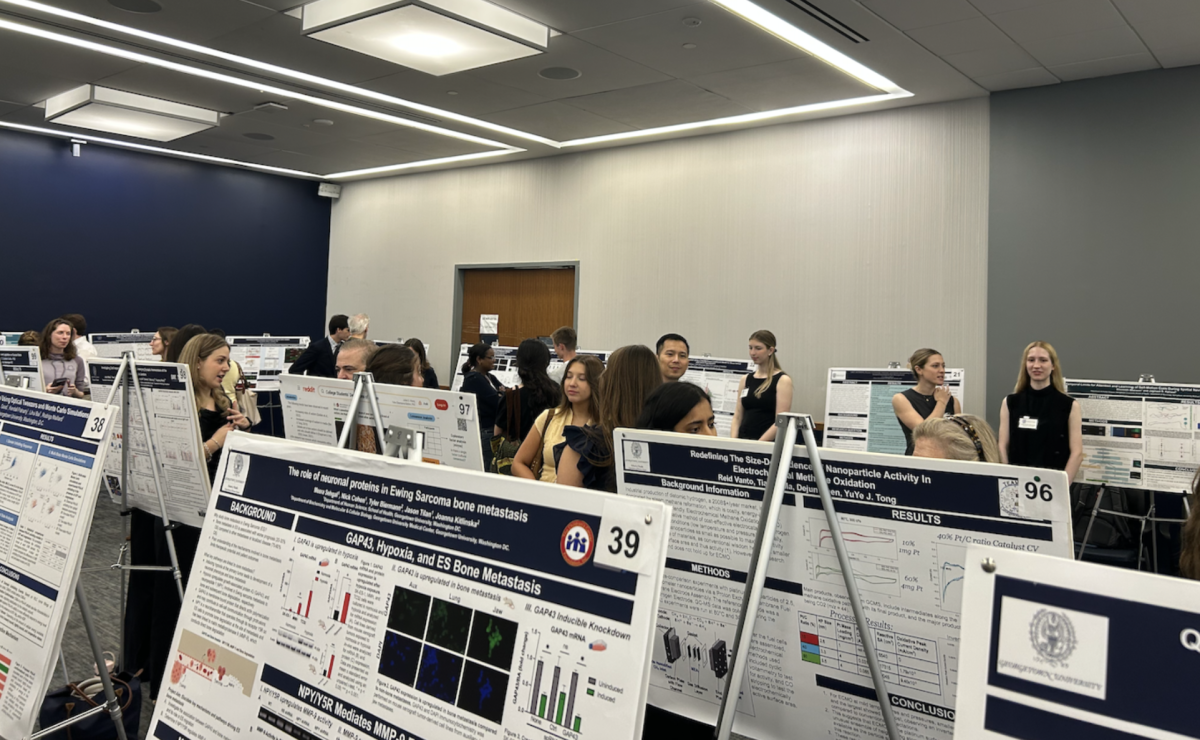


Congress moved to undo proposed cuts to federal scientific and public health research funding Jan. 9, which may increase Georgetown University students’ access to community-based health initiatives that give them hands-on experience in public health and medicine.
The move occurred amid bipartisan pushback and concern over the potential impacts cuts would have on research, innovation and public health. The Trump administration’s proposed budget reductions targeted agencies like the National Institutes of Health (NIH) and programs tied to equity, public health and pandemic responses.
Matthew Kavanagh, director of Georgetown’s Center for Global Health Policy & Politics, said Congress’s resistance to the proposed cuts reveals a deeper political struggle over science funding rather than a retreat from global health investment.
“Congress has never been fully on board with the cuts to entities like NIH or pandemic preparedness or HIV/AIDS funding,” Kavanagh wrote to The Hoya. “What is really going on is not an end of U.S. global health funding but an intra-branch struggle over global health and science funding.”
Wide-ranging health funding debates in the past year have led to congressional cuts to Medicaid and federal NIH staff cuts.
Kavanagh said that despite congressional intervention, the damage caused by funding instability may have already weakened the nation’s ability to respond to future public health crises.
“Because of the cuts and halt to funding enacted by the Trump administration, the world is less prepared to fight the next pandemic than we were at the start of COVID-19,” Kavanagh wrote.
Samuel Yin (SOH ’28), a Georgetown pre-medical student, said that, despite the refund, previous budget cuts have already reshaped research and opportunities on campus. Yin was preparing to work on an observational research project examining nutrition, diet and adverse health outcomes in Washington, D.C.’s Wards 7 and 8, communities that have historically faced disinvestment and health disparities.
Yin said he intended to apply for NIH funding early in the semester for the project, which was being developed with faculty in the School of Health.
Yin said the proposal never made it through the approval process.
“After they didn’t give a response, it became very apparent that the budget had significant impacts,” Yin told The Hoya.
Yin said his research team pivoted to a smaller private grant instead, forcing them to scale back their original plans.
“The grant is a smaller amount, so we kind of had to adjust the plans,” Yin said. “It took time to find different avenues in terms of where we could get money from.”
Although Congress has since pushed back against the proposed cuts, Yin said the effects are unlikely to be reversed immediately for students already affected.
“Labs not getting funding leads to people not getting positions,” Yin said. “And that leads to students not being able to work in those environments.”
Charlotte Phillips (CAS ’28), a biology of global health student, said scientific research has guided her academic experience.
“My experience with research has been very important to me,” Phillips wrote to The Hoya. “Funding is essential to keep our lab running and for sourcing reagents and materials.”
Kavanagh said aside from impacting researchers, cuts to science funding disproportionately harm marginalized communities while leaving wealthier populations insulated.
“Reducing funding for cutting-edge science and global health programs only makes inequality worse,” Kavanagh wrote. “The wealthiest among us can simply exit from health problems like pandemics.”
Kavanaugh added that the disruption extends beyond public health emergencies to research on chronic conditions including cancer, diabetes and heart disease.
Despite congressional pushback, Kavanagh said the disruption caused by the proposed cuts should motivate researchers to advocate for continuous funding.
“Standing by and watching this happen is simply irresponsible,” Kavanagh wrote. “Scientists and academic leaders have a responsibility to speak up.”
Yin said the funding uncertainty has not diminished his commitment to public health, but it has underscored how fragile research pathways can be.
“Public health is a necessity,” Yin said. “But when the government neglects it, it’s easy for people to think they should too.”