
A baby arrives early, small enough to fit in the crook of an elbow. Silent and blue-lipped, the medical team quickly transfers her to the neonatal intensive care unit — a tiny breathing mask fitted around her head — and prepares her for a long period of incubation and monitoring before she is ready to go home.
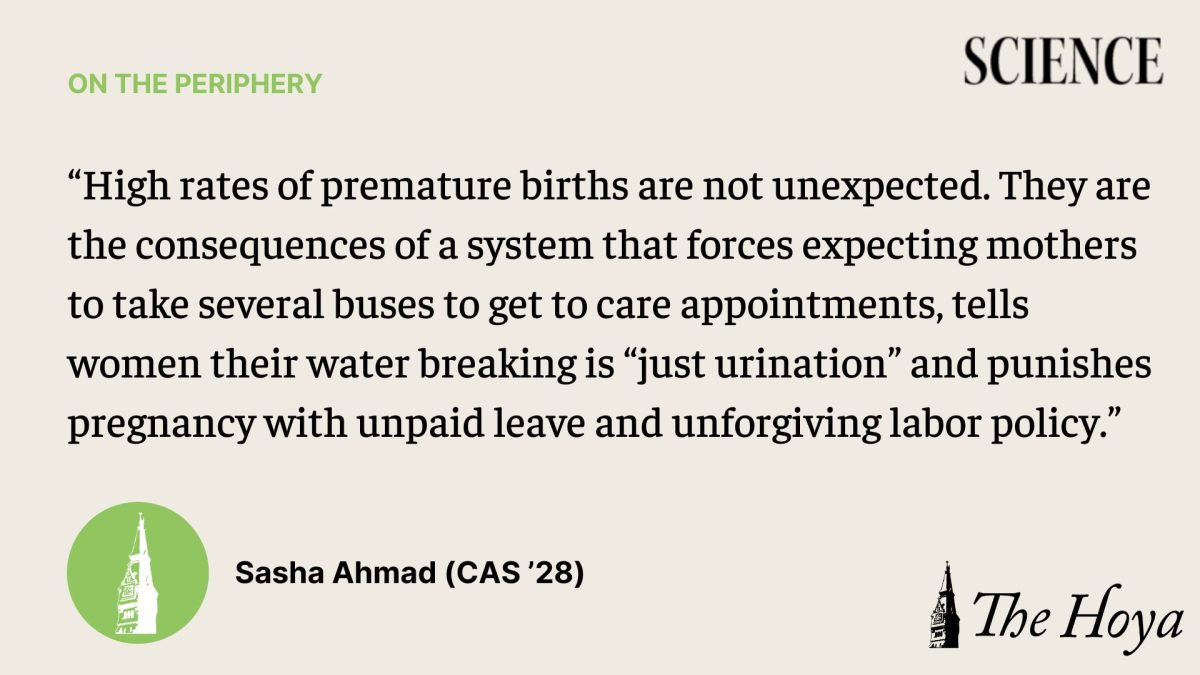
High rates of premature births are not unexpected. They are the consequences of a system that forces expecting mothers to take several buses to get to care appointments, tells women their water breaking is “just urination” and punishes pregnancy with unpaid leave and unforgiving labor policy.
Washington, D.C., earned a failing grade on premature births in November 2025 from the March of Dimes, a nonprofit organization founded in 1938 by President Franklin D. Roosevelt to improve the health outcomes of mothers and babies throughout the United States. Known as “preemies,” premature babies are typically born before 37 weeks gestation, just shy of the 40 week full-term.
The timing of birth is more than a clinical threshold; it is a strong indicator of health care inequity. Babies born too soon are at greater risk for low birth weight, long-term health problems, developmental disabilities and infant death. D.C. has a high premature birth rate within the United States, with Black infants being born prematurely at almost twice the national average. In a city dense with hospitals and health policy experts, this is no fluke. This is a referendum on a long history of medical inequity, with Black mothers and infants shouldering the greatest costs.
It is important to recognize that preterm birth is not random, and has trends that can be predicted. When I was in training to be an emergency medical technician, our curriculum emphasized the need to prepare for neonatal resuscitation if the mother has not received adequate prenatal care and diagnostics. The fact that we learn to anticipate these emergencies based on care access suggests that premature birth and other neonatal complications follow patterns — ones that demand explanation.
While genetics, lifestyle and comorbidities undeniably play a role, social factors upstream of the delivery room often distinguish regions with higher rates of preterm birth and infant mortality.
Local journalists covering the March of Dimes report card have further magnified the pattern. Almost a quarter of women in D.C. do not receive adequate prenatal care, and that number jumps to almost a third for Black mothers.
In political narratives, it can be simple to attribute these trends to “poor health choices” and “statistical error.” However, more recent studies point to weathering, a public health concept that connects accelerated biological aging — the “wearing down” of the body’s cells and tissues faster than expected for your actual age — to lifetimes of sustained exposure to racism and chronic stress. Weathering overlaps with systemically unequal access, or lack thereof, to high-quality medical care and safe living conditions.
The United States has a preterm birth rate that falls well behind peer nations — with approximately one out of every 10 babies born in the United States before 37 weeks gestation. D.C. health data illustrates how structural racism is a national and global inheritance. Redlining, segregation and other forms of institutional discrimination have undermined maternal care outcomes, especially in communities east of the Anacostia River. For example, the 2017 closures of labor and delivery units at the United Medical Center in Southeast D.C. have effectively created “maternal care deserts” in Black-majority neighborhoods that prompt mothers to travel across the D.C.-Maryland-Virginia (DMV) area to receive care.
D.C. has made progress in the past several years, with its 2025 Perinatal Health and Infant Mortality Report highlighting meaningful government partnership with clinics, providers and nongovernmental organizations to enhance evidence-based strategy, innovative care intervention and direct access to necessary maternal healthcare for disinvested communities. In 2014, the D.C. government passed the Protecting Pregnant Workers Fairness Act (PPWFA) to combat discrimination against pregnant workers and to require employers to make reasonable workplace accommodations for expecting and breastfeeding mothers.
D.C. Health reported a 23.6% decline in infant mortality rate from 2019 to 2023, but this data point masks the uneven distribution of that decline. A city can improve its average outcomes while certain neighborhoods remain in crisis. If our government wants to truly achieve horizontal equity for the most marginalized mothers, the perspective must widen beyond the patients and to the systems.
Some policy recommendations include aggressive management of disease burdens like preeclampsia and anemia in Black women, provider training to eradicate clinical bias and expanded doula and midwifery support for skilled birth attendance (SBA). Taken together, these interventions can improve continuity of care, the quality of clinical encounters and the health of all babies in D.C.
D.C.’s “F” grade unravels a story about how the DMV region, and the United States at large, neglects the minority pregnancy experience. It is a story about the cumulative effects of intergenerational trauma, socioeconomic deprivation and the chronic psychological stresses of racism on both mother and child. Decreasing rates of preterm births is achievable for D.C., but only if lawmakers and community members stay accountable for closing disparity gaps that stretch well beyond the delivery room.
Sasha Ahmad is a sophomore in the School of Health studying Global Health and Justice & Peace Studies.