
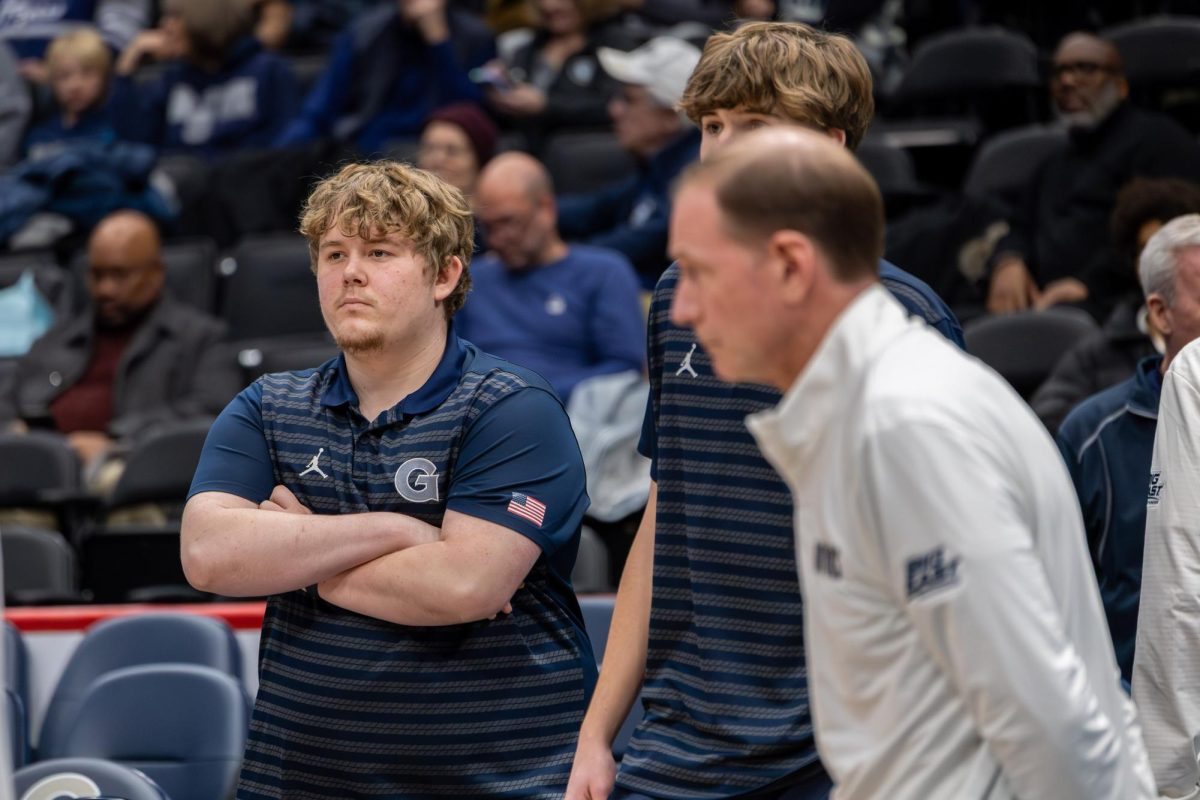
On the eve of the Georgetown University men’s basketball team’s 80-73 loss to Villanova University on Feb. 7, a different squad of Hoyas defeated the Wildcats 86-85.
Traditionally, the student managers play an informal basketball game against the other team’s managers the day before most real matchups. There are no cheerleaders and no Jack the Bulldog, just a chance at bragging rights.
Manager Dylan Perlstein (MSB ’27) said the night’s MVP was obvious: Harry Kilman (MSB ’26), one of the head managers.
“Harry,” Perlstein told The Hoya. “It’s no question. He rebounds with the best of them. Maybe not the biggest guy on the team, but he rebounds like he’s a seven-footer.”
“Harry definitely set the tone for the game,” Head Manager Ben Cooper (MSB ’27) told The Hoya.
With the win, Georgetown’s managers improved to 4-2 in the Big East. (Since, the managers have moved to 5-2.)
Perlstein said the manager group has postseason aspirations of its own.
“Hopefully, we can get a couple more wins before the end of the year to boost our position in the manager KenPom before the tournament,” Perlstein said.
For 40 minutes the night before games, the managers are the ones taking the shots. The rest of the year, their responsibilities look very different.
Associate Head Coach Jeff Battle said the team’s managers handle nearly every logistical responsibility for the program.
“They do everything behind the scenes,” Battle wrote to The Hoya. “Essentially, they make everything convenient for us so that all we have to focus on from a coaching standpoint is the basketball side.”
Manager responsibilities are logistical and organizational — from ordering food to packing bags — but some aren’t listed in the job description.
Cooper said he once retrieved former center Ryan Mutombo’s (CAS ’24) forgotten shoes shortly before tipoff.
“We had to drive back to campus,” Cooper said. “It was 20 minutes before the game started when we got back and had his shoes.”
Other requests are less urgent but equally unconventional — from tracking down 85 Santa hats in bulk for a community service event to finding the best Ethiopian food in Washington, D.C., for a recruit on a visit.
Even driving Head Coach Ed Cooley home is not an atypical ask. On one ride back from Delaware, it turned into “a great three-hour Whitney Houston sing-along,” according to Cooper.
Cooper said the managers, who arrive at Capital One Arena four hours before every game, are deeply integrated into the program.
“Every team event, every team meal, we’re there,” Cooper said. “I would say sometimes I feel more invested than some of the players, which is, I feel, a bad thing.”
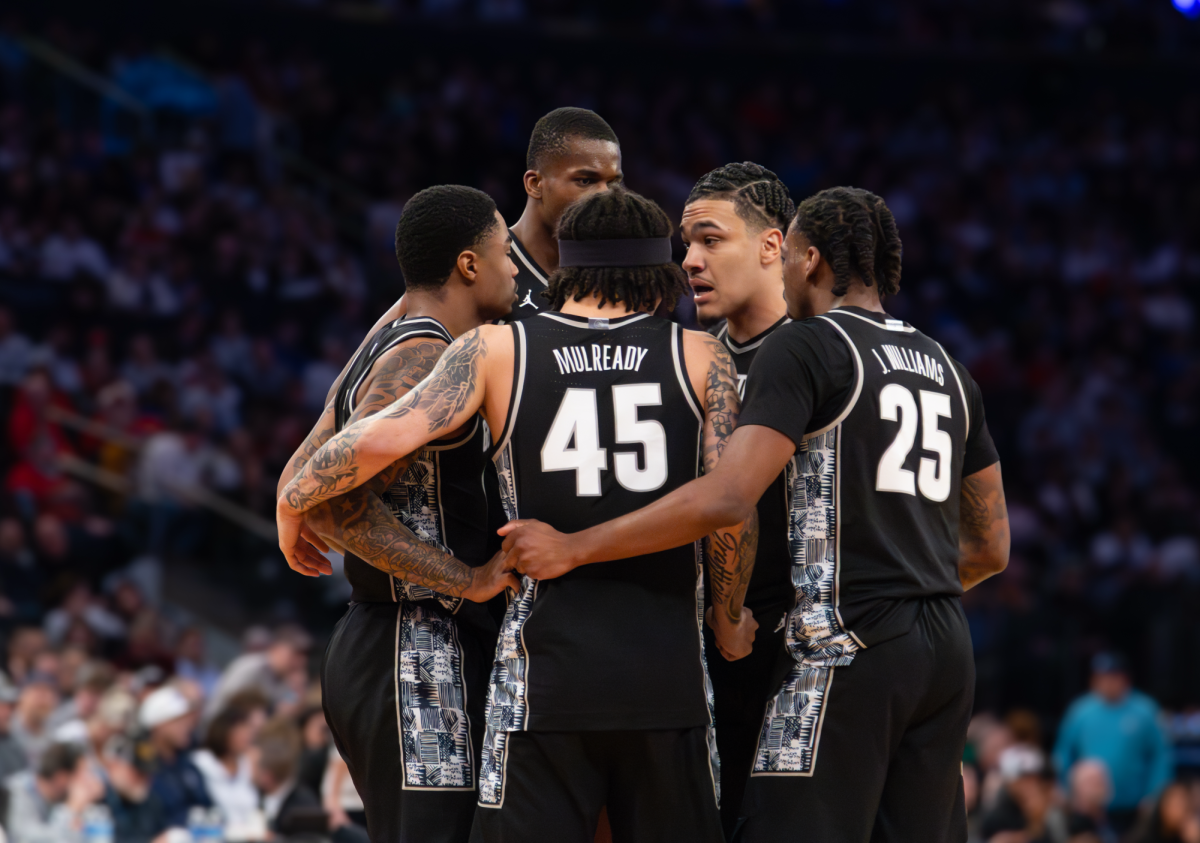
At practice, managers stand under the basket with towels during drills, help with film and feed balls back to players. When a huddle forms at halfcourt, the managers listen from a distance.
Spending so much time around the team reveals players’ quirks that most fans never see, including who keeps the locker room laughing.
Cooper said first-year guard Gabriel Landeira, who has not yet played a game for the Hoyas, is one of the most entertaining players on the sidelines.
“Making a late push for this season’s funniest player would be Gabriel,” Cooper said. “He just sometimes says the most random things on the bench. He’ll say random things in Portuguese.”
Perlstein said sophomore center Seal Diouf was one of his favorites.
“Seal can be funny, definitely, at times,” Perlstein said. “He refers to me exclusively as ‘big guy.’ I’m not sure if he knows my name. I think he does.”
The managers have also gotten a close look at Cooley beyond press conferences. Kilman said Cooley’s personality remains consistent behind closed doors.
“The Cooley that the public sees is the Cooley that we get as well,” Kilman said.
Cooper said spending time with Battle, the second-in-command, is also a highlight.
“I think Coach Cooley gets the most screen time, but Coach Battle is the most underrated, for sure,” Cooper said. “He’s just a great guy. Some people, not myself but some people, would call him a father they never had, and I could see him in that light.”
The access comes at a cost; during the season, managers work roughly 30 hours a week, excluding travel. Practices can last three to four hours, while gamedays require up to eight.
Kilman said the job can be overwhelming at times.
“It’s definitely a lot. It’s a significant time commitment,” Kilman said. “There are gonna be some weeks where you feel like you’re drowning because you have 6 practices, 2 games and 2 midterms as well.”
Cooper says the job’s overwhelming nature is what makes it worth it, highlighting the atmosphere after the team’s Oct. 30 preseason win over Kentucky.
“It’s a job that has very high highs and very low lows,” Cooper said. “But being in the locker room after we beat Kentucky this season, it’s something I wouldn’t give up for, anything else on campus.”
“I don’t know where I would be at Georgetown without it,” Cooper added.
Emily Higgins (CAS ’26), an Arlington, Va. native, grew up watching Georgetown basketball games with her father and became a manager to experience the program from the inside. Higgins is the only woman in the group.
Higgins said that at one game, a first-year arena worker at Seton Hall University was surprised to see her with the team.
“She was genuinely shocked,” Higgins told The Hoya. “She told me she had never seen a female manager travel with a men’s team before.”
Moments like that, Higgins said, reinforce the impact of simply showing up.
“Being able to give her guidance and encourage her to apply was incredibly meaningful,” Higgins said. “It made me realize that just doing my job could expand what someone else believed was possible for themselves.”
Higgins added that much of the job’s importance lies in work that most don’t know about.
“A lot of the work we do is invisible, but that’s the point. If everything runs smoothly, it means we’ve done our job right,” Higgins said.
Battle said he appreciates the commitment.
“I believe we have the best manager crew in the country,” Battle wrote. “It’s really their dedication to do all of these things that people don’t see.”
While coaches appreciate their behind-the-scenes work, the managers have their own measure of success. Perlstein said the conference has taken note of the Georgetown managers’ recent wins.
“Teams are kind of ducking us now,” Perlstein said. “We’re making some noise, and suddenly some of the other Big East manager squads are maybe a little bit more nervous than they were a few months ago.”
Perlstein said the managers have simplified their approach to the game.
“For us, it’s more about the Jimmies and Joes than Xs and Os,” Perlstein said.
Cooper said he agreed.
“Who wants it more kind of game. And that’s usually us,” Cooper chimed in.
The managers take the floor the night before the real game. The rest of the season, they make sure everyone else can.