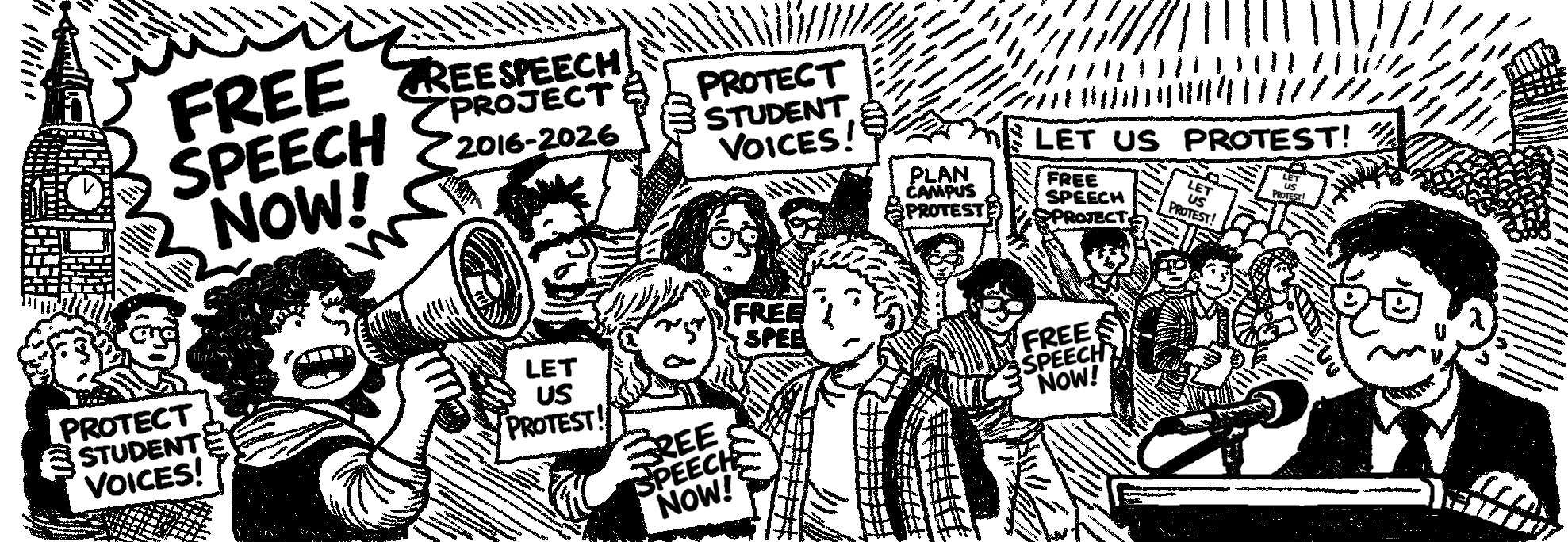
After almost a decade of operation, Georgetown’s Free Speech Project will close its doors at the end of the Spring 2026 semester.
Luke Daugherty (SFS ’28) — a student involved in the program, which tracks First Amendment violations across the United States — said its loss will have major ramifications for campus expression.
“I don’t believe that Georgetown shutting down the Speech Project represents an active silencing of free speech, but I think it has unintended consequences that can be really far-reaching and hurt the community,” Daugherty told The Hoya.
“You don’t have to ban speech to hurt free speech,” Daugherty added.
The closure comes amid a series of federal attacks on campus speech, part of a broader tension between President Donald Trump and the perceived progressive bias of elite universities.
Since February 2025, his administration has threatened to pull funds from universities that permit “illegal protests” and investigated the presence of pro-Palestinian groups at several top schools.
The Department of Homeland Security also detained several students legally residing in the United States — including Columbia University’s Mahmoud Khalil, Tufts University’s Rumeysa Öztürk and Georgetown’s Badar Khan Suri — citing social media posts, academic writings and campus advocacy when deciding to arrest them.
Elinor Clark (CAS ’27), a student organizer, said this new speech environment has forced activists to fundamentally reassess their approach to protesting.
“The barrier to participate in our movements is significantly higher than what it has been historically,” Clark told The Hoya. “When we’re planning protests, whether on campus or off, we have to carefully weigh the pros and cons of different goals.”
“The fact that we have to have discussions about how to protect ourselves and our community when we’re standing up for what’s right is disheartening,” Clark added.
As a private institution, Georgetown is not bound by the same First Amendment protections as public universities. Instead, its Policy on Speech and Expression endorses time, place and manner restrictions — limitations on when and where speech can be expressed — and also permits administrators to regulate speech that violates the university’s harassment policy.
A university spokesperson said Georgetown is dedicated to encouraging respectful exchange.
“Georgetown is committed to ensuring that all members of our community have a safe and welcoming place to learn and receive the support they need to do so,” the spokesperson wrote to The Hoya. “While members of our community exercise freedom of speech, we work toward a living learning community that is free of bias and geared toward thoughtful, respectful dialogue.”
Still, many worry that Georgetown’s free speech policy does not adequately protect students in this new federal environment. Ahead of the arrival of incoming university president Eduardo M. Peñalver in July, they say the university is at a fundamental crossroads for free speech protection.
At this critical moment, Daugherty said students must be able to engage with the university’s free speech policy.
“I want there to be more open channels for students to propose ways to change free speech policy,” Daugherty said. “If I wanted to change free speech policy, I don’t necessarily know where I would go.”
Not a Free-for-All
Georgetown has operated under a free speech policy since 1989, but updated its approach in June 2017 to provide additional guidance on the regulation of offensive or controversial speech.
John Hasnas, who served on the faculty committee that redesigned the policy, said the 2017 revision intended to prioritize free speech protections over community cohesion.
“The university can do whatever it wants to make an inclusive, happy, comfortable, diverse learning environment, but only short of stopping people from expressing their genuinely held beliefs freely,” Hasnas told The Hoya. “It’s supposed to be that freedom of speech predominates over comfort.”
The final policy was largely modeled after the University of Chicago’s, which is often considered the gold standard for free speech protection and has been adopted by almost 120 universities across the country.
The two share many provisions, but Eleanor JB Daugherty, the vice president for student affairs, said they diverge in their implementation.
“The way we steward the policy feels different here, and what feels different is the inclusion of our Jesuit values,” Eleanor JB Daugherty told The Hoya. “We really feel that dignity matters, and so when I’m looking at a protest on campus, I’m looking at are we respecting the rights of others? Are we caring for the rights of others?”
UChicago, also a private school, endorses institutional neutrality, which prohibits the university from taking a stance on political or social issues. In contrast, Georgetown’s approach gives administrators greater power to regulate speech that disrespects others.
Jessica Jones, another faculty member who helped develop the 2017 policy, said the decision to avoid blanket neutrality blurred the boundaries of acceptable speech.
“Free speech is supposed to end where it is considered threatening or harassing to members of the community, but it’s hard to draw that bright line, and it’s not always clear to the speaker when they’ve crossed it,” Jones told The Hoya. “It always seemed like something that was not possible to put down in really clear terms.”
Still, Eleanor JB Daugherty said this balance is an essential dynamic at a Jesuit institution.
“It would be incredibly antithetical to Georgetown’s purpose if we didn’t live in both places, where we conceivably deeply hurt others, and then sit with the pain that it causes as well,” Eleanor JB Daugherty said.
“I will go to a rally and then meet with a faith community that is hurt by the speech that came out there,” Eleanor JB Daugherty added. “That tension is the right place for us to be in.”
Georgetown has repeatedly applied the Speech and Expression Policy in situations where student groups target peers or raise contentious social issues. In 2021, a professor was fired after making discriminatory comments about Black students’ grades. Similarly, in 2022, the university placed Ilya Shapiro, then the incoming director of Georgetown Law’s Center for the Constitution, on administrative leave after he posted a racist tweet.
Hasnas said these applications violate the intended spirit of Georgetown’s free speech policy.
“In the years that followed, things like that constantly were repeated,” Hasnas said. “People would say things there and they would be punished for it. Our actions were completely inconsistent with the policy that we adopted.”
In part because of its differential approach, Georgetown has historically struggled in the Foundation for Individual Rights and Expression’s (FIRE) rankings, which evaluate free speech protections on college campuses.
In 2023, the organization, which has faced criticism for its financial ties to conservative think tanks, listed Georgetown among the four lowest-ranked schools surveyed, at 245th. In the years since, Georgetown’s place has improved marginally, to 240th in the 2025 rankings and 129th in the 2026 rankings, but the university has retained a grade of an “F,” signaling a poor speech climate.
UChicago, meanwhile, has historically excelled in FIRE’s rankings, placing first in the 2024, 13th in the 2025 and third in the 2026 rankings.
Eleanor JB Daugherty, who previously served as an administrator at UChicago, said her approach to free speech has remained relatively consistent across the schools.
“I have worked at schools that have been applauded by FIRE,” Eleanor JB Daugherty said. “I have been responsible for speech and expression in schools that FIRE has loved. What I’m really trying to wrestle with is that is there a difference in the way we do the work in an ‘A’ school versus an ‘F’ school? I would say the only thing that has happened in my career is a deepening sense of responsibility for the impact of the speech that you protect.”
On the Outside Looking In
While the current free speech policy was developed by faculty and administrators, students can shape its implementation through the Speech and Expression Committee, which advises the vice president of student affairs.
Eleanor JB Daugherty said the committee has helped guide the university’s response to student protest.
“In the minute of disruption on campus, we were kind of making up the rules as we went,” Eleanor JB Daugherty said. “We don’t want that perception, so Speech and Expression is a place where we go with incomplete thoughts, or we go with tension between the values and the practice.”
Still, some committee members say there is little clarity on how they can meaningfully influence university policy.
Mahika Sharma (SFS ’27), a former student representative on the Speech and Expression Committee, said administrators were open to student input, but she saw little practical change.
“They were actually very open to absorbing those opinions, and then responding in a way that felt true to administrative concerns, but also considerate of those sorts of opinions that students had,” Sharma told The Hoya. “But in terms of policy changes or anything to that effect, I’m not entirely certain what that looks like.”
The committee consists of about eight members, appointed by student and faculty government.
Jason Brennan, a faculty member of the committee, said the group has no enforcement power.
“The committee itself has no real authority,” Brennan told The Hoya. “We are an advisory committee, so we can recommend what we think is the right thing to do. We can propose policies and so on, but we don’t actually set anything.”
“The issue with the university is that there’s so many decision makers who have different levels of authority, different levels of power, and these things frequently overlap,” Brennan added. “Sometimes a decision can be made in one place and it gets overwritten by someone else, somewhere in a different area.”
With few avenues for students to formally petition the university, activists have turned to protest to push for policy change.
In 2025, Georgetown introduced a partial restriction on face coverings, requiring students to remove masks at the request of administrators and preventing them from wearing masks while engaging in conduct that violates university policy. Additionally, the university implemented a new ban on amplified sound, barring protests from producing disruptive noise.
Mikenzie Hapworth-Eldridge (CAS ’28) — the outreach director of Georgetown’s American Civil Liberties Union (ACLU) chapter, a legal nonprofit — said these regulations make protest more difficult but ensure the university’s daily operations continue.
“I think that soft barriers can definitely have an impact on people’s willingness, but I also think that it’s a nice way of balancing the administration with student voices,” Hapworth-Eldridge told The Hoya. “Because you’re still allowing students to voice their opinion, but you’re also allowing people who don’t know what’s going on to still live their day-to-day.”
Clark said these policies make protest more difficult, particularly in a hostile federal environment.
“Organizing has a long history of disruption being the most effective tool,” Clark said. “When Georgetown so strictly curbs that through threat of arrest in some cases — but in less severe cases, disciplinary action through this university — it puts a dampener on people’s willingness to engage on fundamental issues.”
“I think Georgetown University needs to remember its Jesuit values of promoting faith that does justice and remember its history of student activism — much of which is now bragged about by university administrators — and allow more flexibility in student organizing,” Clark added.
The Current of Change
Beyond changes to the national speech landscape, students say institutional protections are at a critical juncture ahead of Peñalver’s arrival to Georgetown.
Peñalver previously served as the president of Seattle University, where students and faculty have voiced concerns about his implementation of the university’s free speech policy and the selection of campus speakers.
Seattle University does not base its free speech policy on UChicago’s, but shares Georgetown’s same emphasis on Jesuit values. In October 2022, a few months after Peñalver took office, it revised its speaker policy to prohibit student organizations from endorsing political candidates.
Natalie Kenoyer, who graduated in 2023, said the new policies implemented under Peñalver’s tenure did not reflect the university’s Jesuit values.
“While there’s the Jesuit values that I think the campus strived for, it didn’t seem like Seattle U was led by those specific Jesuit values,” Kenoyer told The Hoya.
“When Peñalver became president, I was leaving Seattle, and I definitely felt like things were changing for the worse in terms of censoring students,” Kenoyer added. “I’m not sure how it looks now, but I definitely felt like the administration was attempting to chill student activism.”
In a May 2024 statement to the Seattle Spectator, Seattle University’s student-run newspaper, Peñalver said the university’s Jesuit values influence its approach to free speech.
“Seattle University does not take positions on world issues in order to preserve the freedom for members of our academic community to express their own views,” Peñalver wrote to The Spectator. “This is not the same as a blanket assertion of neutrality. But, as a university, the primary way we take positions is through our actions, and always at the same time with an affirmation of the importance of the academic freedom of those who may disagree.”
In April 2024, The Spectator reported that students were frustrated when the university allowed StandWithUs, an international pro-Israel educational organization, to speak on campus but not Jewish Voices for Peace, the largest U.S.-based Jewish pro-Palestinian organization.
Alexander Johnston, a film professor at Seattle University, said that Peñalver’s support of free speech was inconsistent, not always allowing for disagreement.
“In the aftermath of October 7, everyone had wanted to bring Jewish Voices for Peace, which is an anti-Zionist, Jewish-led group, and that was not permitted,” Johnston told The Hoya. “It was this push and pull to allow them to come to campus. That stuff has been fairly complex.”
“There are certain ways that he very much adhered to a free speech ethos,” Johnston added. “But there were also instances of disallowing certain ways of speech or certain visitors.”
Kenoyer said student speech is particularly vulnerable in this moment of transition.
“The Free Speech Project being sunsetted right before Peñalver becomes president seems especially concerning to me, as far as safety and well-being of students and the future of Georgetown as an institution,” Kenoyer said. “I think right now, especially as free speech is under attack, that’s a huge red flag.”
Clark said Peñalver’s administration should engage with Georgetown’s unique history of activism.
“I hope that as he enters the Georgetown community, he learns about our history of organizing and student activism in the hopes that we can continue to hold the university accountable to its proclaimed values and ensure that it is protecting and respecting all community members.”
Luke Daugherty said it is important for university administrators to consider student and community input when interpreting, implementing and evaluating free speech policy.
“If you want to understand our country today, if you want to be able to express your views in the country today, no matter what those views are, free speech is the only way to do so,” Luke Daugherty said. “On this macro scale, you really need to have these protections and these guarantees for democracy to function, and now on a micro scale, at Georgetown, it’s very much the same.”


