

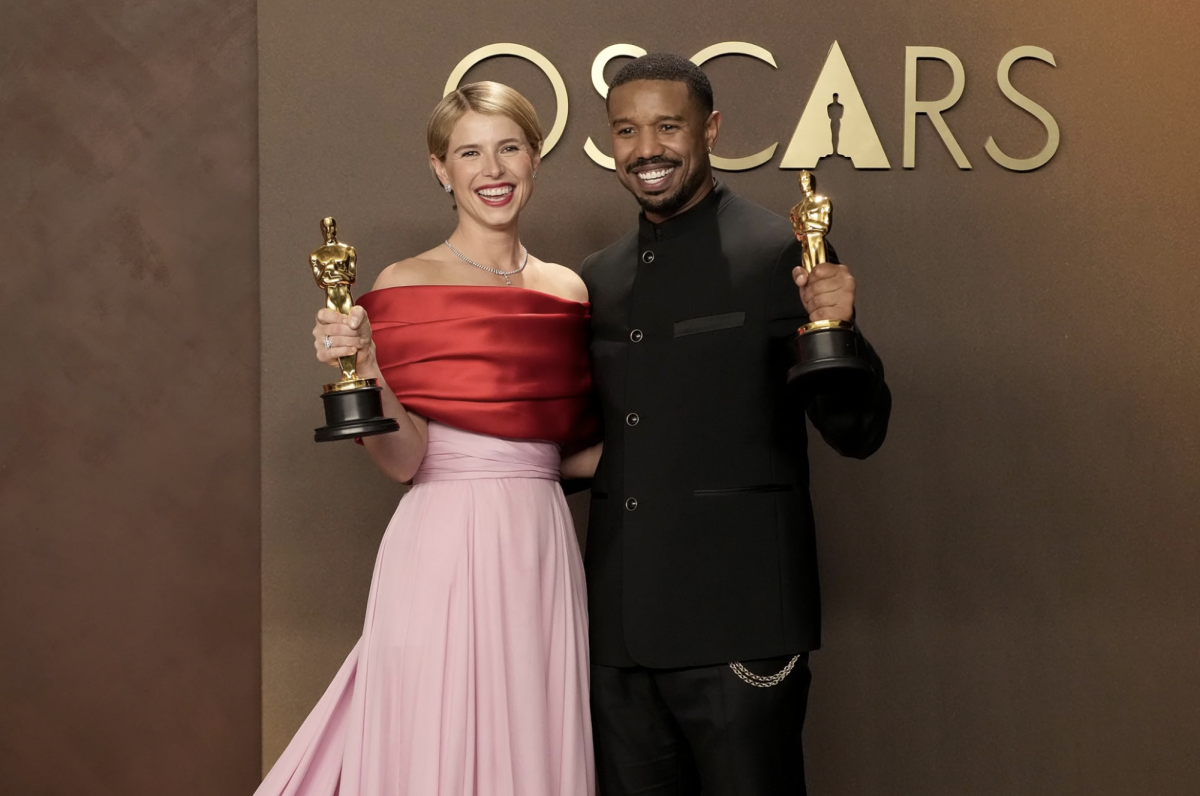
Although the 2026 Oscars largely conformed to expectations, three particularly unexpected wins revealed the kinds of stories that the Academy was most eager to award. Amy Madigan’s win in Best Supporting Actress for her performance as Aunt Gladys in “Weapons” was her first win after a record-breaking 40-year gap between nominations. Autumn Durald Arkapaw’s win in Best Cinematography for “Sinners” was monumental, as she became the first ever woman to win in the category. Finally, of course, “One Battle After Another” triumphed in Best Picture. While this was hardly shocking on paper, the win refuted a narrative surging online in the days leading up to the ceremony that claimed Ryan Coogler’s “Sinners” had taken the lead in the race.
Overall, the results reflected an awards season that, despite some surprises, ultimately ended in a familiar vaunting of prestigious cinema. “One Battle After Another,” Paul Thomas Anderson’s sprawling action satire, claimed six Oscars, while “Sinners,” a 1930s Mississippi vampire thriller, remained a formidable presence with four wins. Lower down on the ballot, Guillermo del Toro’s “Frankenstein,” a Gothic reimagining of the literary classic, solidified itself as a craft powerhouse with three awards.
Madigan’s win offered the night’s clearest example of an Academy-favorite storyline: a beloved veteran who finds the right role at precisely the right moment. Madigan was the category’s expected frontrunner with roughly 58% of Award Expert users predicting her victory, ahead of Wunmi Mosaku (“Sinners”) and Teyana Taylor (“One Battle After Another”). Even though conventional wisdom suggested that Taylor was likely to win, as she was in the strongest film of the three competitors, Madigan’s Screen Actors Guild (SAG) win, which occurred during the Oscar voting period, likely secured her Oscar win. Still, the story here is less about awards campaigns and more about the longevity of Madigan’s industry career. Now 75, Madigan set a record for the longest gap between an Oscar acting nomination, which she received for “Twice in a Lifetime” in 1986 in the Best Supporting Actress category, and a win, which she obtained in that same category.
Madigan’s win broke trends elsewhere as well. Notably, “Weapons” received no other Oscar nominations, leaving Madigan a lone nominee. In recent years, Oscar acting victories have increasingly been selected from films with multiple nominations and broader support. Madigan’s win, however, proved the Academy is still willing to celebrate lone-acting nominees, especially those with compelling narratives. Another important factor to note with Madigan’s win is that “Weapons” is a horror film. Madigan was the first supporting actress winner since Ruth Gordon (“Rosemary’s Baby,” 1969) to come from horror, reminding us that genre barriers can always be broken, especially with today’s Academy.
Moving on to the technical categories, Autumn Durald Arkapaw’s win in Best Cinematography was yet another instance in which the Academy broke barriers. No win this year was more historically significant than hers. This alone would have marked a milestone moment for the industry, but the result is especially striking considering how unlikely it was, given the results of the season’s precursor awards.
Arkapaw entered the night without any wins in the category’s four major precursors, the Critics’ Choice Awards (CCA), the American Society of Cinematographers Awards, the British Society of Cinematographers and the British Academy of Film and Television Arts (BAFTA) Awards. The last cinematographer to miss all four of those awards and still claim the Oscar was Robert Richardson for “Hugo” in 2012, underscoring the rarity of Arkapaw’s path. Other contenders included Michael Bauman (“One Battle After Another”), the precursor leader and consensus favorite, and Adolpho Veloso (“Train Dreams”), who took home the Critics’ Choice prize earlier this season. In the end, the Academy gravitated towards the significance of Arkapaw’s achievement and her flashy style, which was on display throughout “Sinners.” Arkapaw’s win was part of a strong showing for “Sinners,” which also finished the night with Lead Actor, Original Screenplay and Original Score.
However, despite the recent talk that “Sinners” had surged into the lead for Best Picture, “One Battle After Another” reaffirmed that it was the Academy’s favorite. It entered with one of the strongest precursor packages possible, having secured wins at the Golden Globes, CCA, BAFTA Awards, Producers Guild Awards, Directors Guild Awards and Writers Guild Awards. Despite this dominant record, several high-profile predictors, including Variety’s Clayton Davis, had begun treating the race as a toss-up after “Sinners”’ SAG victory. On weak ground, Davis even changed his predictions for both Best Picture and Best Director to “Sinners” and Ryan Coogler, respectively.
“One Battle After Another” was a culmination of Paul Thomas Anderson’s decades-long career. As one of the most acclaimed directors of his generation, Anderson had been previously nominated several times by the Academy but had gone winless until this year. Notably, this win coincides with his shift from more austere dramas, including “Phantom Thread” and “There Will Be Blood,” to a $175 million budget black comedy action movie. “One Battle After Another” is his largest in both scope and box office performance, speaking to how auteurs are often only fully embraced after stepping out of their comfort zones.
In my opinion, “Sinners” will be remembered as the strongest runner-up since “La La Land” in 2017. When accounting for its precursor haul, record-breaking 16 Oscar nominations and eventual four wins, “Sinners” proved it had substantial support throughout the Academy. Ultimately, Oscar night was packed with surprises from beginning to end and was a great retrospective on the films that defined 2025. Until next year!