

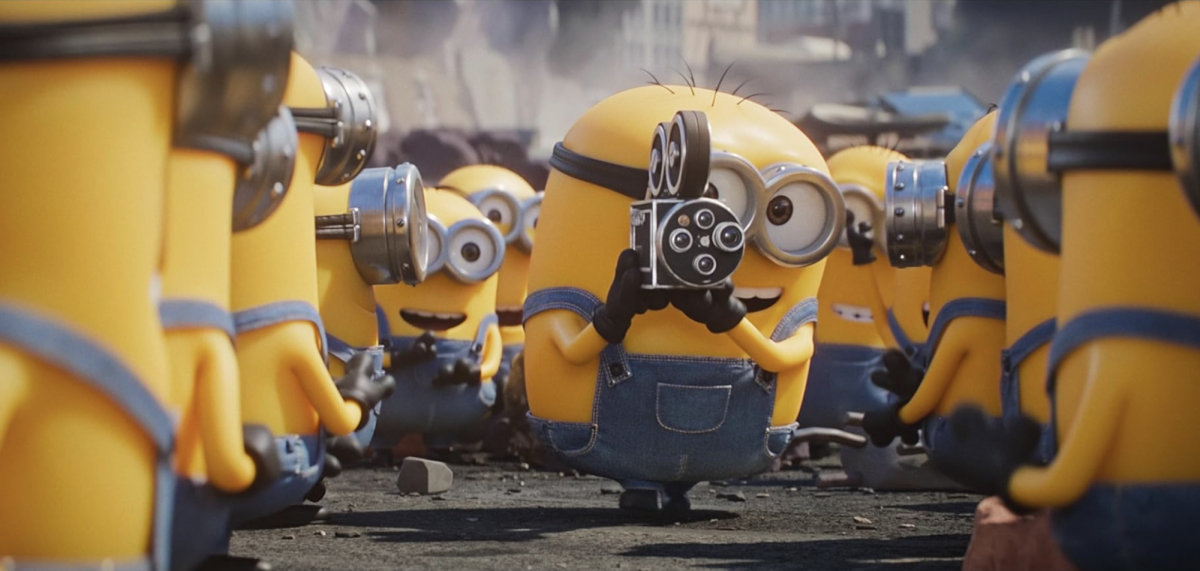

As a stalwart disciple of the “Despicable Me” cinematic universe since the first movie’s 2010 release, I was beyond thrilled to learn that, 16 years after the franchise’s debut, there was to be a new installment in the “Minions” prequel series. With “Minions & Monsters” racking in unprecedented Rotten Tomatoes praise, I was expecting nothing short of a cinematic masterpiece.
In terms of sheer entertainment value and the movie’s poignant, thematic ode to cinematic history, “Minions & Monsters” exceeded my expectations. However, surrounded by hordes of young children and their bleary-eyed parents ready to surrender their spawn to whatever lowbrow absurdities our favorite yellow friends had in store, I found myself utterly disappointed by the movie’s quasi-propagandistic whole-hearted embrace of violence.
As early as the opening credits, which edited minions into archival film clips like the Lumière brothers’ “Arrival of a Train at La Ciotat Station,” the movie established its cinephilic angle. A Hollywood-themed museum tour guide (Allison Janney) calls our attention to the stars of this installment, minions James and Henry (both voiced by director Pierre Coffin, who voices every minion), whose impact on the film industry has, apparently, been undeniable.
In true “Minions” fashion, we follow a genealogical account of this particular tribe of minions’ search for a “big boss” whom they can worship and serve. Of course, James, whose artistic and storytelling passions supersede his duty to his tribe, and Henry, whose friendship with James can only be described as heartwarming and oddly homoerotic, constantly find ways to accidentally kill their evil masters. That is, until they stumble upon the set of a silent film, where they are instantly adored by the Bright Brothers (a not-so-subtle nod to the Lumière brothers, voiced by Jeff Bridges) and recruited by film director Max (Christoph Waltz) to become the next generation of film stars.
When the advent of sound film results in the minions’ ousting from the spotlight, James’ dream of winning an Oscar is crushed. Still, James and Henry — joined by Ed, their hard-of-hearing friend with whom they communicate via sign language — set out to direct a sci-fi monster film with monsters they summon from a previous evil master’s grimoire. The rest of the movie unfolds as more of a standard adventure as the minions must fight the evil they have inflicted upon the world.
The constant nods to cinematic history include an animated cameo of Charlie Chaplin’s “Modern Times,” a Chaplin-esque sped-up chase scene, and the homage to Gort of “The Day the Earth Stood Still” with the odd but sweet robot-alien Dort (Jesse Eisenberg). These are by far the highlights of the film. While much of the sentimentality was lost to the audience of mostly toddlers, the movie’s love for the industry is felt in every scene.
This celebration of cinema and the usual glee of a “Minions” movie are not, however, enough to mask the utterly violent message that pulses throughout. While one might argue that the minions have always been violent — after all, they literally exist to serve the greatest evil they can find — their weapons have always felt comedic and divorced from reality. But here, in lieu of the absurd fart guns, lipstick tasers and cookie robots, the minions commandeer the army’s arsenal of guns and tanks. The final battle scene sees a literal bomb explosion that is not dissimilar to real-life footage of contemporaneous wars.
I desperately want to believe that, at its core, “Minions & Monsters” is just an innocent continuation of its yellow stars’ story and one that calls especially for the appreciation of the art of human filmmaking — something that feels increasingly necessary as artificial intelligence infiltrates creative spaces. However, there is something insidious in the degree of violence being normalized in a franchise that is and has always been clearly marketed toward children and families. As an impressionable 5-year-old, I thought cookie robots were all the rage; staring wistfully at the pantry, I would imagine a stream of silver, arachnid-like automatons emerging from the cookie jar. I can only imagine the girl of 5 or 6 that I sat next to in the theater going home to ask her mother about an AK-47 or a Sherman tank, or watching the news and laughing because the footage of an explosion in Gaza or southern Lebanon looks like the one from a “Minions” movie.
If “Minions & Monsters” could be divorced from the context of its effects on its marketed audience, it might have warranted a better review, but that simply is not possible. When children are routinely exposed to such sinister violence through the consumption of media, can we really be surprised at how unflinchingly people accept their governments’ wars? By normalizing brute force and war, deceptively light-hearted movies like “Minions & Monsters” are manufacturing an entire generation’s psyche to accept such violence unflinchingly and without question.