

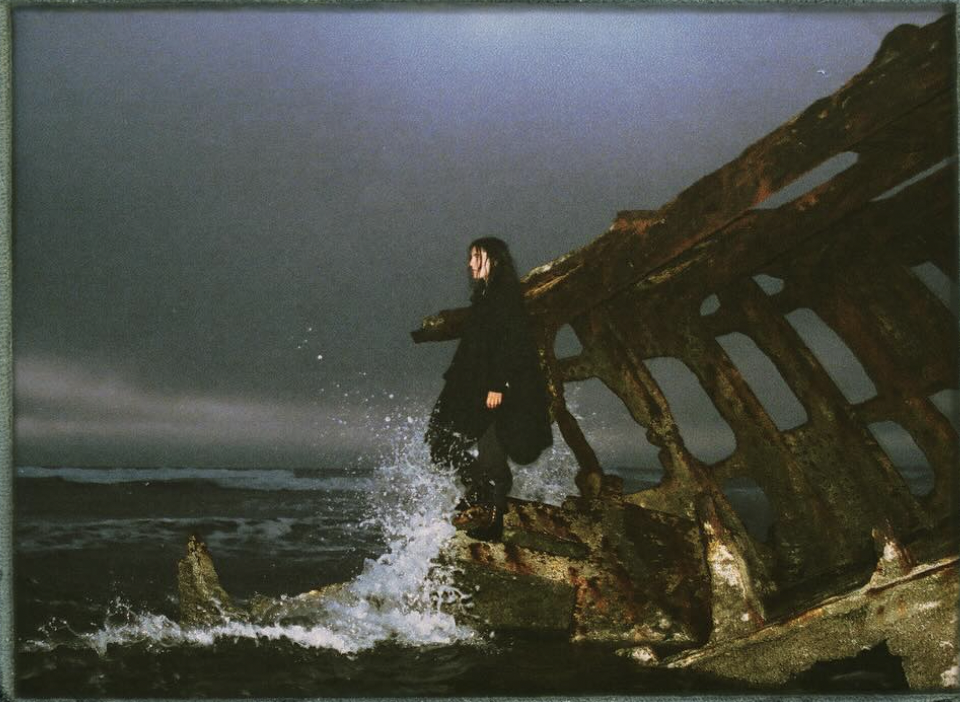

“Yes, there is death in this business of whaling — a speechlessly quick chaotic bundling of a man into Eternity. But what then?” It is with this line in Herman Melville’s “Moby-Dick” that the protagonist Ishmael begins to question matters of life and death, of the body and the soul.
In his newest album, “Death in the Business of Whaling,” indie-folk singer-songwriter Alec Duckart — better known by his stage name Searows — pursues the same line of questioning as Melville, taking it to the extremes of emotional depth through his examination of the self, both in isolation and in fractured relationships. Holistically, the album is a masterpiece of melancholy and devastation, weaving together Duckart’s haunting lyrics, bittersweet instrumentals and powerful voice.
The first of the album’s nine songs, “Belly of the Whale,” instantly establishes the hopelessness that characterizes the narrator throughout the album. Depicted through the biblical allusion when the prophet Jonah is swallowed by a whale, Duckart illustrates a scene of self-judgment — but unlike Jonah, the narrator might never be able to repent. This sentiment is visible in the lines “I’ve been here for a long time / I try and I fail.” The permanence of the narrator’s entrapment, put forward through this line, is felt in the repetitive strumming of the guitar that closes the song.
The following two songs, “Kill What You Eat” and “Photograph of a Cyclone,” belabor the subject of failed and fracturing relationships — be they romantic, platonic or familial — and the resulting loneliness the narrator feels. Haunted by the tragic, newly excavated memory of a tarnished relationship, the narrator somehow finds comfort in their isolation. Though “Photograph of a Cyclone” deviates from the previous songs’ gloomy instrumentals with a surprisingly lively and upbeat arrangement, Duckart’s lyrics hammer in the narrator’s resignation. In what is clearly becoming a consistent theme across Duckart’s discography, these songs paint a palpable image of self-loathing and self-sabotage.
In “Hunter,” Duckart delves even deeper into the fragments of the album’s central relationship. Drawing haunting parallels between hunting animals and the death of a relationship, the narrator questions the necessity of this pain, likening it to hunting for sport. Though all of Duckart’s lyrics across the entirety of his discography are masterfully crafted, resonating long after you listen, this song boasts what I find to be some of his best. The narrator’s earnest, emotional questioning drills deep into my heart with his raw, repeated “Doesn’t it? / Doesn’t it?.”
“Dirt” and “Dearly Missed” are perhaps the album’s most heartbreaking songs — a difficult feat to achieve given the album’s overarching depressive tone. The harrowing exploration of self-loathing and self-destructive mentalities raised in “Dirt” is undergirded by the bleak, reverbed strums of a guitar. Through rich natural imagery, “Dirt” evokes the stasis of such mentalities. The narrator addresses the void they have become, asking how they will satiate and satisfy it and how they can quell its endless hunger for meaning or completion. Duckart hearkens back to Ishmael’s contemplation in this song as well, his narrator responding to Ishmael’s assertion that his body is not him. The narrator says, “And it’s delusion, but it’s peaceful / That this body is not your own.” This line embodies the album’s grim thesis that pain is permanent and coping is futile. Throughout the album, the narrator wallows in painful memories, revisiting the destruction of their relationship and increasingly loathing themself.
Within the context of the narrator’s hopelessness in “Dirt,” the next track, “Dearly Missed,” is made exponentially more pitiful and agonizing. The song traces the process of an individual coming to and carrying out the decision to sell a loved one out. Brooding yet thoughtful instrumentals underscore this narrative of betrayal and death. I understand this song as the narrator addressing themself, with the death mentioned not an actual one, but metaphorical — the narrator leaving a version of themselves behind, as good as dead. As one of the album’s lead singles, “Dearly Missed” shaped my expectations for the album as a whole, and it fits perfectly into the ensemble as the song and the album altogether are moving and truly beautiful.
The album’s throughline of hopelessness takes center stage in the next two songs, “Junie” and “In Violet.” In “Junie,” the aforementioned metaphorical death materializes through the narrator’s decision: “Leaving without saying goodbye / Move in with my grandma by the seaside / I want a whole ‘nother life.” But futility still reigns — in “In Violet,” it becomes clear that the narrator cannot accept moving on, saying, “I had it, I want it back.”
The album closes out with “Geese,” which finally takes a somewhat hopeful turn, hearkening back to Mary Oliver’s poem “Wild Geese” in both imagery and message. Seemingly addressed to the very self that is giving up, wallowing in the permanence of this relationship’s end, the narrator seems to be insisting that they don’t need to do good, but they just can’t do nothing. They must continue living.
Overall, “Death in the Business of Whaling” is a beautiful but heartwrenching exploration of love and loss in human relationships. Vulnerability and raw emotion are palpable in Duckart’s skillful lyricism, supplemented by haunting and occasionally off-putting instrumentals that amplify the depth of the depression encountered on the album.