

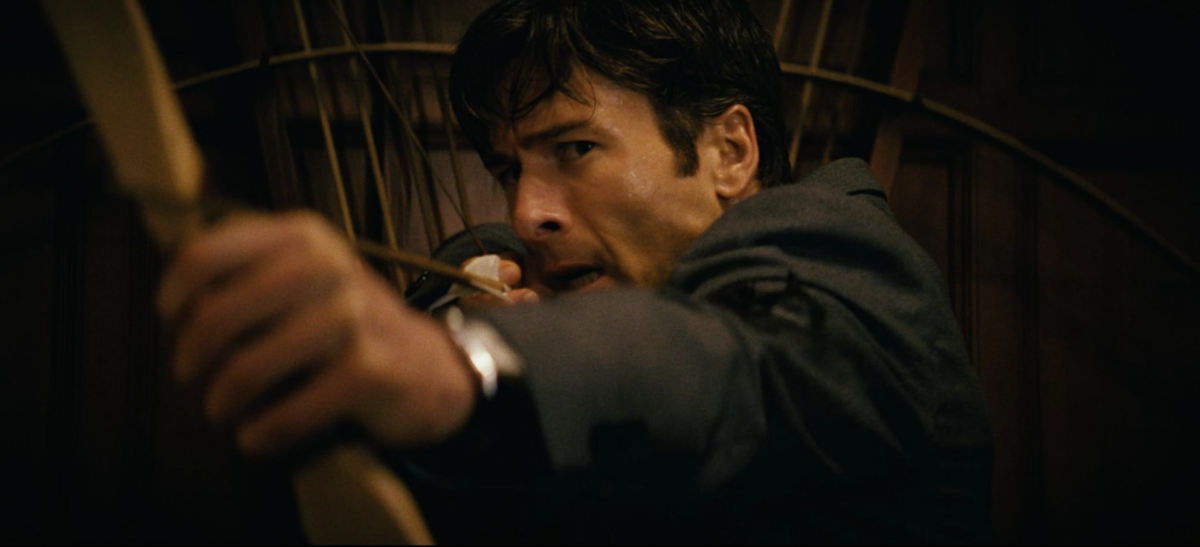

Merely hours away from his execution, a somewhat haggard yet surprisingly composed Becket Redfellow (Glen Powell) confesses to a priest the murder that led to his imprisonment. The story begins not with himself but with his mother (Nell Williams), the youngest daughter of the obscenely wealthy Redfellow family of Huntington, Long Island, whose refusal to abort her accidental pregnancy leads her father to disown her.
Despite the disownment, due to Becket’s grandfather Whitelaw’s (Ed Harris) irrevocable will, Becket remains entitled to the entire family fortune, though he must first wait for his older relatives to die. Years after his mother’s death, while working in a suit shop, Becket runs into his childhood sweetheart, Julia Steinway (Margaret Qualley). The loaded heiress to the Steinway fortune, Julia teases blue-collar Becket, telling him to call her when he’s killed his way to his inheritance. Desperate to pursue unfathomable wealth — what his mother termed the “right kind of life” — and gain Julia’s approval, Becket plots the murders of the seven wacky relatives who stand in the way of him and his inheritance.
Loosely inspired by the 1949 film “Kind Hearts and Coronets,” “How to Make a Killing” is equal parts thriller and black comedy, though the latter is more successfully executed. Insofar as its characteristically thriller aspects, the movie feels rather formulaic, and the plot twists are painfully predictable, but this unoriginality is balanced out by a killer script. Packed full of witty jabs aimed at the rich and featuring some morbidly funny kills, the script keeps you hooked even as the plot occasionally falters.
Beyond its charged jokes aimed at the wealthy, the film offers a surprisingly adept critique of the filthy rich and those who aspire to join society’s upper echelon. It does so primarily through caricatures of the wealthy; Becket’s victims are increasingly ridiculous and out of touch, using their wealth to throw ragers, pretend to be artists, fund exorbitant space expeditions through companies that severely underpay their workers, spread the word of God in questionable ways and, of course, maneuver Wall Street with an arsenal of limited competence and the great privilege of nepotism. Perhaps most irritatingly entitled is Julia, who oversteps boundaries (both literally and figuratively) with little regard for those around her. Julia correctly assumes she can manipulate everyone around her, Becket in particular, to get whatever she wants.
Even Becket’s character embodies this entitlement — incessantly rewarded for his wrongdoings, Becket climbs the social ladder with ease, partially because of his ambition but largely because of his surname. His ascent to Wall Street affluence propels his amorality even as he grows close to his surprisingly kind Uncle Warren (Bill Camp), inviting a serious consideration of the depravity of the “finance bro” lifestyle; this might be especially resonant for those contemplating whether to forgo their morals for a life in investment banking.
As hard as it is to believe, everything seems to work out for Becket; the FBI is hot on his trail as early as his first two murders, yet destiny continues to unfold in his favor. Yet again, the film is commenting on the ease some people face in acquiring what they want (the key to which is just more money, apparently). As he astutely notes toward the end of the film, this dark reality is not a tragedy for himself, but rather for the priest, who must live with the knowledge that such wickedness is not only alive in society but actively embraced by it.
Ultimately, the only character who is remotely bearable is Ruth (Jessica Henwick), Becket’s momentary girlfriend and fiancée, whose normalcy and groundedness offer a much-needed breath of fresh air. But, as is to be expected of a heedlessly money-hungry fool, Becket neglects to properly prioritize her, providing another reflection on the sacrifices people will make for wealth.
Seeing as the film is narrated by Becket and follows his story, its success hinges almost entirely on Powell’s performance, and he does not disappoint. With his classic oozing charm, Powell sells both Becket’s sincerity and slyness with a chameleon-like capacity to deceive that reminded me of Powell’s performance in “Hitman,” though slightly more polished. Qualley delivered another captivating performance, perfectly embodying Julia’s rage-inducing omnipresence and entitlement. Each of the actors portraying the various Redfellow relatives were similarly strong supporting presences — Zach Woods created a comically dull and uninteresting “artist,” Topher Grace offered a wildly funny performance as a paranoid pastor, and Ed Harris chillingly embodied a cold-hearted, cruel tycoon.
Simultaneously funny, thrilling and thought-provoking, “How to Make a Killing,” though unfortunately similar to “No Other Choice” (only Americanized), promises a greatly enjoyable experience. In depicting the truly absurd choices Becket makes in his reckless pursuit of wealth, the film asks its audience to reflect on the sacrifices they have made or would be willing to make to achieve the “right” kind of life. As they say, money can’t buy happiness. … But can’t it?