


Going into Aneil Karia’s newly released adaptation of Shakespeare’s beloved tragedy “Hamlet,” all I could ask myself was, “Do we really need another one?”
From its opening moments, the film, starring Riz Ahmed, signals an ambitious attempt to reinvent a story that has already been told countless times. Returning home after his father’s death and grappling with grief, Ahmed’s Hamlet discovers his uncle is soon to marry his mother. Karia’s direction takes on a unique Hindu-English perspective, as the film is set in modern-day London and follows a rich British South Asian family, implementing cultural and traditional elements such as costuming and music. However, the film often finds itself caught between reinvention and full loyalty to the script, ultimately unable to commit to either.
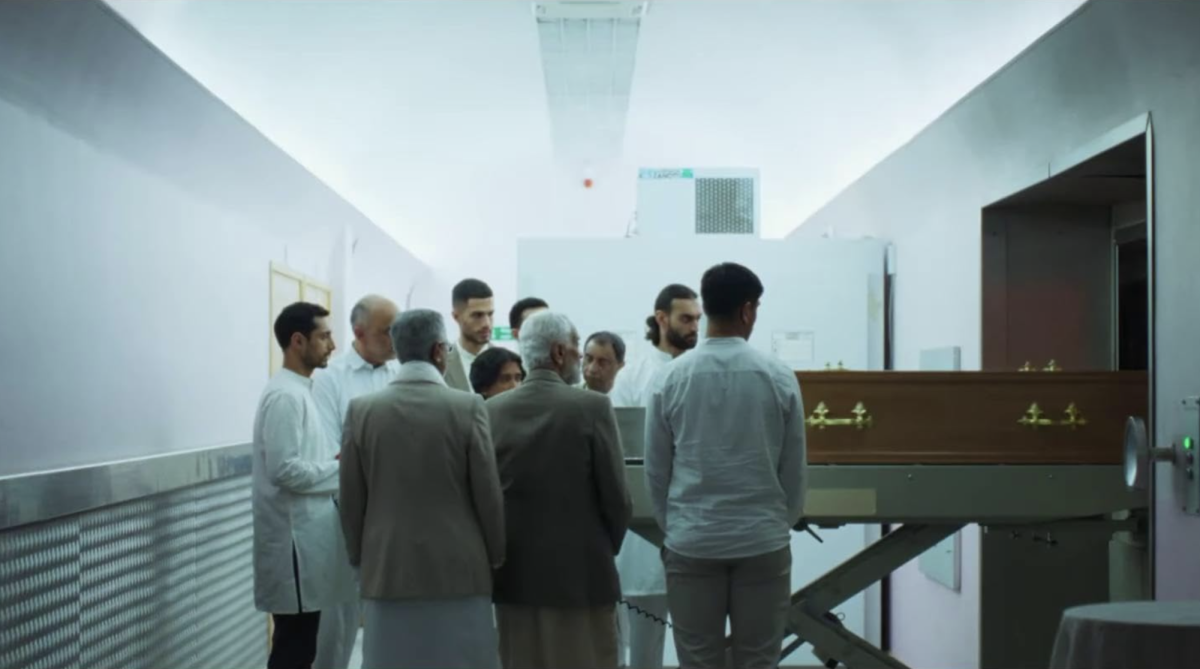
The beginning of the film immediately establishes its tone and successfully differentiates itself from other, more traditional adaptations. Instead of jumping right into Shakespearean dialogue, it begins with extended silence and depictions of traditional Hindu funeral practices. This choice demonstrates Karia’s eagerness not to create an exact replica of “Hamlet,” but instead to apply the narrative to a culture, not the other way around. It is in these moments the film feels most persistently and unapologetically unique. However, this initial boldness and individualism becomes less consistent throughout the course of the film, showing up strongly in some moments and completely forgotten in others. Because of this, the film seems hesitant to confidently embrace its reimagining of the classic.
Ahmed’s performance as Hamlet is, at times, the film’s strongest element. His raw portrayal of grief in the opening scenes is pungent; he holds a sense of vacancy, numbness and denial until, finally, emotion breaks through in his soliloquy. However, as the film progresses, Ahmed’s performance begins to fall apart, with his tonality becoming increasingly inconsistent. His delivery shifts awkwardly between formal Shakespearean cadence and a more modern rhythm and language, creating a sense of strain rather than depth. This is seen particularly in later soliloquies, where his vocal fluctuations feel forced rather than expressive, and ultimately cause the pungency and lyrical beauty to lose significant meaning.
This inconsistency extends beyond Ahmed’s performance into the film’s broader narrative choices. Early on, Hamlet’s visible grief following his father’s death establishes a strong emotional foundation for the narrative to rest on. Yet this emotional environment is abruptly disrupted when he finds himself in a strip club shortly after his father’s wake. The shift in tone and setting seems to be there solely for shock value and for the sake of reimagining with a modern touch, instead of as an intentional choice that adds to the story. The film oscillates between strict loyalty to its source text and attempts at modernization without ever blending the two seamlessly.
The overall character arcs and interactions also seem to lack continuity and rely too heavily on the presupposition that the viewer is familiar with the play. Hamlet’s relationship with Ophelia (Morfydd Clark) in the beginning is slow to start and focuses only on moments that undermine the supposed love they have for each other in the play. Their relationship’s progression is barely shown or developed on screen. Ophelia’s descent into madness is also far too quick and remains undocumented until its peak. Despite her lack of on-screen progression, Clark’s acting stands out as one of the strongest performances.
To its credit, the film’s score remains effective and offers an additional layer and atmosphere of tension to the film. It maintains a presence that is not overbearing but tastefully pungent; it serves to highlight Hamlet’s internal conflict without overwhelming the audience. In times of pause and silence between dialogue, the music works in tandem with the contemplative moments that allow these scenes of grief and emotional intensity to linger. The score, composed by Maxwell Sterling and Aditya Prakash, melds traditional Carnatic music with modern cinematic sound and is particularly strong in its execution of the film’s purpose of cultural reinterpretation.
Ultimately, Karia’s rendition of “Hamlet” succeeds in differentiating itself from the already crowded artistic adaptations of the play; however, it falters in its full execution and commitment. The film introduces a compelling and creative lens, taking on a South Asian perspective, yet remains constrained by its loyalty to the original text. In attempting to balance innovation with tradition, it achieves neither in full, leaving the viewer with a film visually and sonically beautiful, but creatively and narratively inconsistent.