

Far before virtual premieres became an inevitability in the industry, the Sundance Film Festival had already begun to think about how digital access could expand the reach of independent films beyond Park City. In 2001, Sundance launched its first-ever online slate of films, featuring 18 shorts. Over 20 years later, the festival’s online selection has fully evolved, allowing those of us unable to fly to Utah to still catch some smaller, usually more adventurous projects. This year, I was lucky enough to watch seven online premieres, including three that, despite inconsistencies, felt emblematic of the greater flexibility offered by the digital platform.
Run Amok

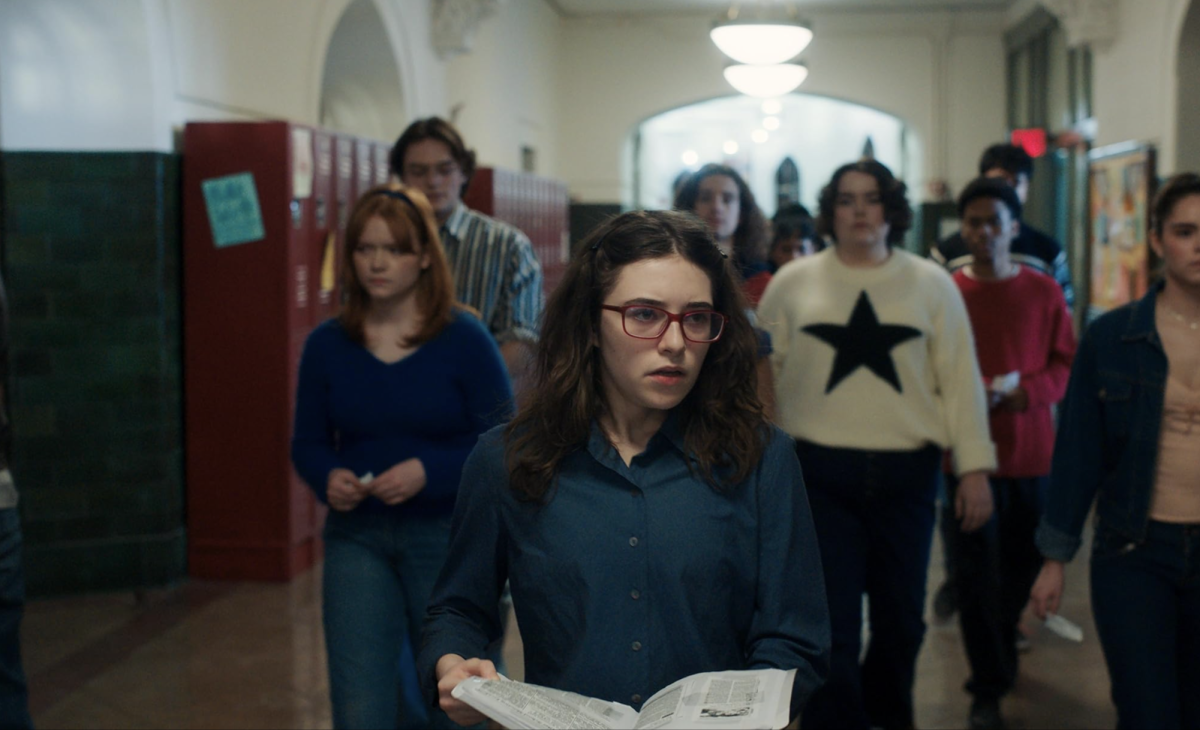
Premiering as a part of the U.S. Dramatic Competition, “Run Amok,” directed by NB Mager, is a highly issue-driven movie. The film follows Meg (Alyssa Marvin), a high school freshman living through the aftermath of a school shooting that occurred exactly a decade earlier. Meg’s personal connection to the tragedy leaves her affected to this day and she attempts to help her community process their grief by staging a musical reenactment of the tragedy. On paper, the plot might seem odd or overly intense, but I was drawn to the way the film focused on how teenagers struggle to cope with school shootings, a danger that targets them uniquely. However, in practice, Mager’s debut feature struggles to keep a consistent tonal footing, aimlessly bouncing between coming-of-age drama and weak satire in a nearly incoherent manner.
The unevenness is clearly seen in the film’s approach to dark comedy, wherein Mager seems intent on critiquing the bureaucratic, overbearing nature of the adults surrounding Meg, especially as they attempt to limit her creative vision for the musical. Administrators and teachers alike frequently feel like caricatures, embodying generic responses that prioritize “safety” in art over meaningful emotional engagement. In these scenes, though, I was left feeling like Meg did not truly understand how painful the shooting was for the entire school community, especially as many of the teachers, including her advisor, Mr. Shelby (Patrick Wilson), were present at the time. While this approach does connect with the film’s larger critiques of performative grief, the execution is simply too blunt to be meaningful.
Even so, Mager does still stumble into shockingly strong moments. In one scene, when Meg runs a rehearsal for the part of the musical that depicts the shooting itself, she guides the cast through the site of the incident, slowly assigning her classmates to their roles. The slow, deliberate pace reminded me of the anxiety of active shooter drills, and Marvin delivers a truly powerful performance here. “Run Amok” proves most effective in its quieter stretches, where Marvin is allowed to shine, especially when contrasted against the awkward and panicked demeanor that usually defines her character.
Ha-Chan, Shake Your Booty!

Despite its title, which makes you expect a much more optimistic film, “Ha-Chan, Shake Your Booty!” also focuses on grief, but from a markedly different angle. Writer and director Josef Kubota Wladyka has crafted an absolutely unique experience in which we watch Haru (Rinko Kikuchi), a competitive ballroom dancer from Tokyo, withdraw from both the studio and her loved ones following a sudden personal tragedy. Instead of looking at grief through reenactment, “Ha-Chan, Shake Your Booty!” takes a highly comedic angle, which includes a possible love triangle with fellow dancer Fedir (Alberto Guerra).
Wladyka’s script is unusual, but well thought out and the film’s dreamlike musical interludes are consistently strong. These scenes are reminiscent of those from “La La Land,” or, if you want to get a bit niche, “The Young Girls of Rochefort,” with larger-than-life choreography that helps externalize Haru’s pain without resorting to simple expositional dialogue. Touches of magical realism, including the repeated presence of a giant crow, double down on this approach, though occasionally, the film’s highly realistic romantic subplot clashes with its more surreal elements. As the film reaches its third act, “Ha-Chan, Shake Your Booty!” morphs into a more conventional love-triangle film, which encounters some shortcomings as it dilutes some of its novelty overall, though Kikuchi’s nuanced performance adequately compensates for these difficulties.
Zi

If “Run Amok” and “Ha-Chan, Shake Your Booty!” respectively explore grief through performance and love, Kogonada’s experimental drama “Zi” instead looks at what it’s like to lose one’s sense of self. Shot over only three weeks and with a tiny, bare-bones crew, the film follows Zi (Michelle Mao), a young violinist, who experiences visions of her future self after learning that she might have a brain tumor. Taking place entirely in one day, we follow Zi as she wanders around Hong Kong, forming an unlikely bond with Elle (Haley Lu Richardson), who is navigating her own recently upended world.
Narratively, “Zi” is incredibly slender, albeit deliberately so. Kogonada’s filming process was notably improvisational, with several interviews from the cast and crew, including one from Richardson, revealing how he would add or remove from the story at a moment’s notice. The film is at its best when it serves as a glimpse of Hong Kong’s energy. Shots are often confined to the characters and defined by the city’s lights. The sound design and score are both particularly notable, emphasizing compositions from the late Ryuichi Sakamoto. In one sequence, underscored by “andata” from Sakamoto’s “Async,” the interplay between image and music perfectly reaches a powerful crescendo.
Predictably, the film is at its weakest when attempting conventional character development and storytelling, with uninspiring dialogue and a story that is at times both generic and incomprehensible. Mao’s performance as Zi is probably best described as confused, which is certainly effective as she stumbles through alleyways, but admittedly less successful when hearing her stumble through banter with Elle. Richardson fares a bit better in this respect, attempting to anchor these traditional scenes. At its core, the love triangle, which includes Zi, Elle and Min (Jin Ha) — a man from Elle’s past — is broadly uninteresting. In the end, I was equally frustrated and charmed by “Zi,” and its moments of genuine brilliance left me encouraging everybody to give it a chance.
Overall, these three films are shockingly similar, each approaching the same idea from a different angle: Trauma is rarely processed immediately. Whether it be through staging a musical, waltzing through a ballroom or aimlessly wandering through a city in search of connection, each of these three films resists any sort of neat closure. As Sundance continues to fight to maintain cultural relevance in an increasingly competitive film festival circuit, the online slate offers a reminder that the best films of the year may very well be those that take you off the beaten path.