

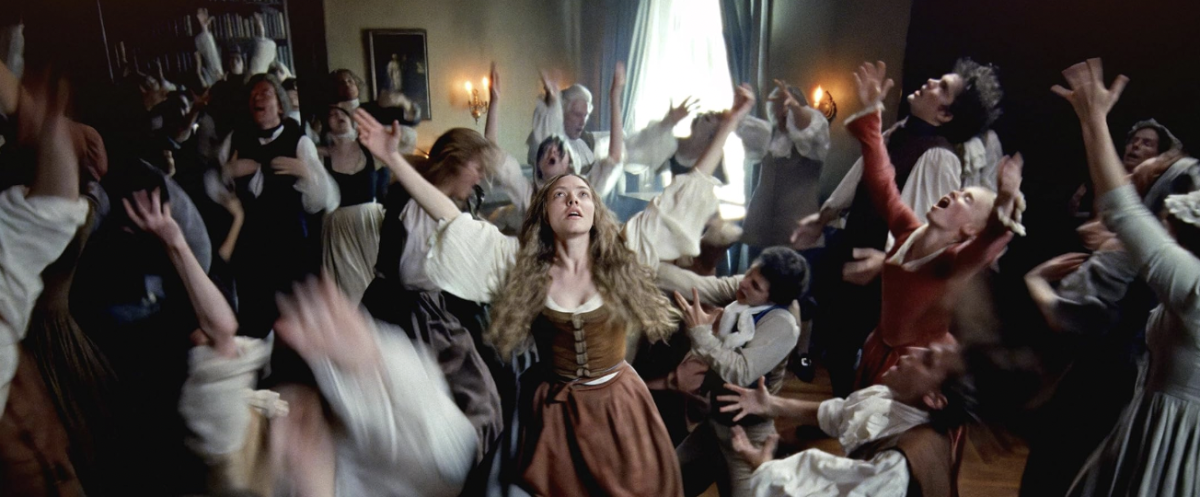

From Shakespeare’s plays to today’s biopics, art has long been a means of exploring historical periods and figures. Mona Fastvold and Brady Corbet’s “The Testament of Ann Lee” sustains this tradition, exploring the life of Ann Lee through the medium of musical film. Yet the film’s scope and subject take a new angle, collapsing the distinction between fact and fiction in establishing the legendary figure of Ann Lee (Amanda Seyfried). The result is a film that is neither truly biographical nor completely fictitious, but instead something entirely new and moving, though it occasionally falters in its musical style.
The film follows Ann from her youth working in a cotton factory in Manchester, England, to her death in New York, tracing the development of the Shaker sect in the latter half of the 1700s and the mythos of Ann as both a radical female preacher and a female iteration of Christ. Ann and her brother William (Lewis Pullman) join a group of Quakers led by Jane (Stacy Martin) and James Wardley (Scott Handy), the precursor to the nascent Shakers, also known as the shaking Quakers, who become notable for their practice of religious cleansing through visceral chanting and dancing. After Ann’s four babies die in early infancy, she commits to abstinence, believing that Adam and Eve’s original sin was fornication and that her babies’ deaths were divine punishment for her sins. Upon sharing this notion of abstinence with the masses, Ann is deemed a female manifestation of Jesus and dubbed ‘Mother Ann.’
As Ann gains prominence in her subversive preaching, the film veers into an exploration of a burgeoning cult of personality, aptly embodied through the film’s musical style. From the opening scene, music and dance are central to the depiction of the sect’s growing religious fervor. The eeriness of the first dance sequence persists in subsequent dances, which contribute to the overarching cultish feel that perfectly fits the Shakers’ obsession with Mother Ann. The film’s most powerful scenes are those in which Mother Ann and William preach through song as the bodies around them convulse in exceptionally choreographed dance. Mother Ann’s followers’ religious zeal is scarily palpable in these moments.
However, the film also stumbles in its musicality. Occasionally, the singing — particularly that of individuals alone, outside of mass — feels awkwardly out of place, momentarily disrupting the otherwise captivating unfolding of the plot. Yet despite causing intermittent lulls in the film’s progression, the music itself is overall very strong. With impressive vocals from both Seyfried and Pullman backed by chaotic choral ensembles and a powerful instrumental mixture of synth and orchestral sounds, the often cacophonic soundtrack captures the rapturous essence of the Shakers’ practices.
The film’s cinematography equally contributes to the stellar characterization of the Shakers, emphasizing Ann’s godly status as she repeatedly sees visions depicting religious imagery and foresees symbolic representations of events or decisions to come. These images flash before the audience’s eyes, allowing a rare entry into Ann’s mind that is otherwise left untouched. Still shots of the Shakers’ furniture and homes highlight the sect’s religious commitment to labor and chasing perfection. The representations of the wilderness in America and the tempestuous sea amplify the film’s overarching eerie beauty.
While these visual elements represent both the real and the miraculous as equally vivid — reinforcing the film’s characteristic, legend-like ambiguity — the film opts to anchor certain plot points in reality to showcase the fraught tension teeming in America upon the Shakers’ arrival. Tackling both the representation of chattel slavery and white settlers’ violence toward Native Americans, the film not only establishes Ann’s radical beliefs but refuses to forfeit reality for the sake of idealism.
Furthermore, the implication of William’s homosexuality offers a level of depth that, while only minimally explored, expounds the complexities of realizing the full and detailed truth of Ann’s life. While sometimes disappointing, the film’s commitment to narrating her life strictly through third-person summary, never daring to delve deeper into Ann’s interiority, lends itself to the mythologizing of her person. Through the combination of this style of narration with Seyfried’s visceral and convincing performance, Ann truly embodies her legendary character.
After the sprawling splendor realized in their preceding movie, “The Brutalist,” I was curious to see how Fastvold and Corbet could build on the scale and existential thematics they broached in “The Brutalist.” With “The Testament of Ann Lee,” Fastvold and Corbet have made clear their excellence in portraying sweeping stories and examining profound questions of creation and power. In this exceptional foray into the genre of the musical historical drama, we are left questioning where the line is between truth and legend.