
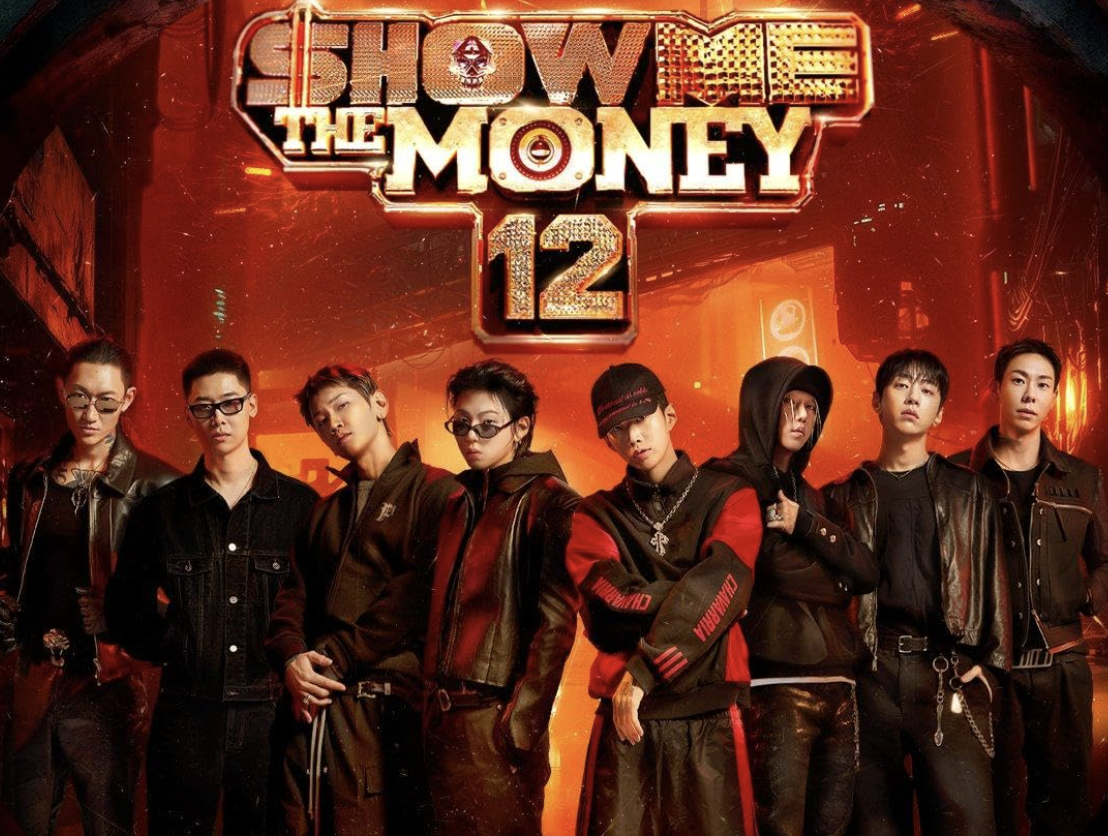
There’s nothing quite as intriguing or baffling as “Show Me the Money.”
I first encountered the show during my first year of high school. Fresh off K-pop, I stumbled upon the show’s seventh season, aptly titled “Show Me the Money 777.” It was the first time I had ever seen Korean rappers in such huge numbers, and I was immediately hooked.
At the most basic level, “Show Me the Money” serves as the connection between the underground Korean rap scene and the mainstream public. In its most recognizable form, the judging panel consists of four teams, each composed of two well-known figures in Korean hip-hop. Through multiple rounds of challenges, including live stage trials, the show attempts to spotlight Korean rap.
In its peak years, most arguably from its fourth to sixth seasons, the show spurred multiple hits, and Korean hip-hop became more prominent in the public eye. However, due to its inherently commercial nature as a reality show backed by a prominent production company, being on “Show Me the Money” became synonymous with selling out.
The production team at Music Network, commonly known as Mnet, edited the show in a way that did not help curb this reputation at all. Known for its “악마 편집,” which is best translated as “evil editing,” the show can be understood as stringing together clips loosely and achronologically to preserve as much drama as possible among its contestants. This smash cut editing style often makes it a fight to get through any sort of reality competition produced by the company, and “Show Me the Money” is no different.
The show’s quality has also declined over the years. While this is a common phenomenon among multi-season shows, the show took an especially considerable nosedive. Its eighth season was no short of a complete mess, complete with accusations of “인맥힙합,” best translated as “nepotism hip-hop,” where already well-connected rappers continued advancing despite poor performances, and the season featured some remarkably questionable performances by other contestants. In fact, there’s a performance that was so iconically catastrophic that if you search any Korean curse word, or even just “그 무대,” an insult that implies “that stage” is damned, it pops up.
Now, after a lackluster 11th season and a four-year hiatus, “Show Me the Money” returned in January 2026 for its 12th season. While there is much to explore about the show and its role within the Korean rap scene, the return of “Show Me the Money” mostly brought back my own questions on what exactly Korean hip-hop is.
Like much of Korean music, Korean hip-hop and rap draws from Western music, particularly from Black hip-hop culture. The beginnings of Korean hip-hop can be traced to American military bases that remained in Korea after the Korean War and carried over hip-hop from the United States in the 1980s. This resulted in a patchwork scene consisting of an incredibly wide variety of genres whose only connection was often the language in which the lyrics were written.
Listening to the contestants of “Show Me the Money 12” and the latest offerings from the Korean rap scene, you see a new, growing prominence of Western influence on the content which is, for lack of a better word, interesting, as it includes guns and drugs, both of which are illegal in Korea. From this observation, there’s a sense that Korean rap is building a hip-hop culture that’s drowning in its Western influence.
Korean hip-hop’s greatest strength, though, is its tendency to experiment and its ability to straddle various genres and blur the lines between them all while respecting the tones, characteristics and history of the Black hip-hop genre they have taken influence from. Alongside K-pop and its own tendency to reach across various genres, fusion has become a key part of modern Korean music. When it doesn’t completely succumb to the generalizations and stereotypes of its influences, this fusion is a wondrous combination of sounds, sentiments and perspective.
In this manner, Korean rap has always felt to me like it is made up of fragments. It is a genre that can effectively twist and combine other genres and influences from across the art form, leading to the creation of genuinely interesting projects. It’s this fragmented coherence that has personally pulled me into the scene, its character reflective of my own scrapbooked identity as an Asian American, forever caught between America and Korea. Yes, there is a need for Korean hip-hop to find its own identity apart from the Black artists that it is influenced by, but there is still genuine respect and beautiful experimentation in Korean hip-hop that is worth watching, even in the messy expanse that is “Show Me the Money.”