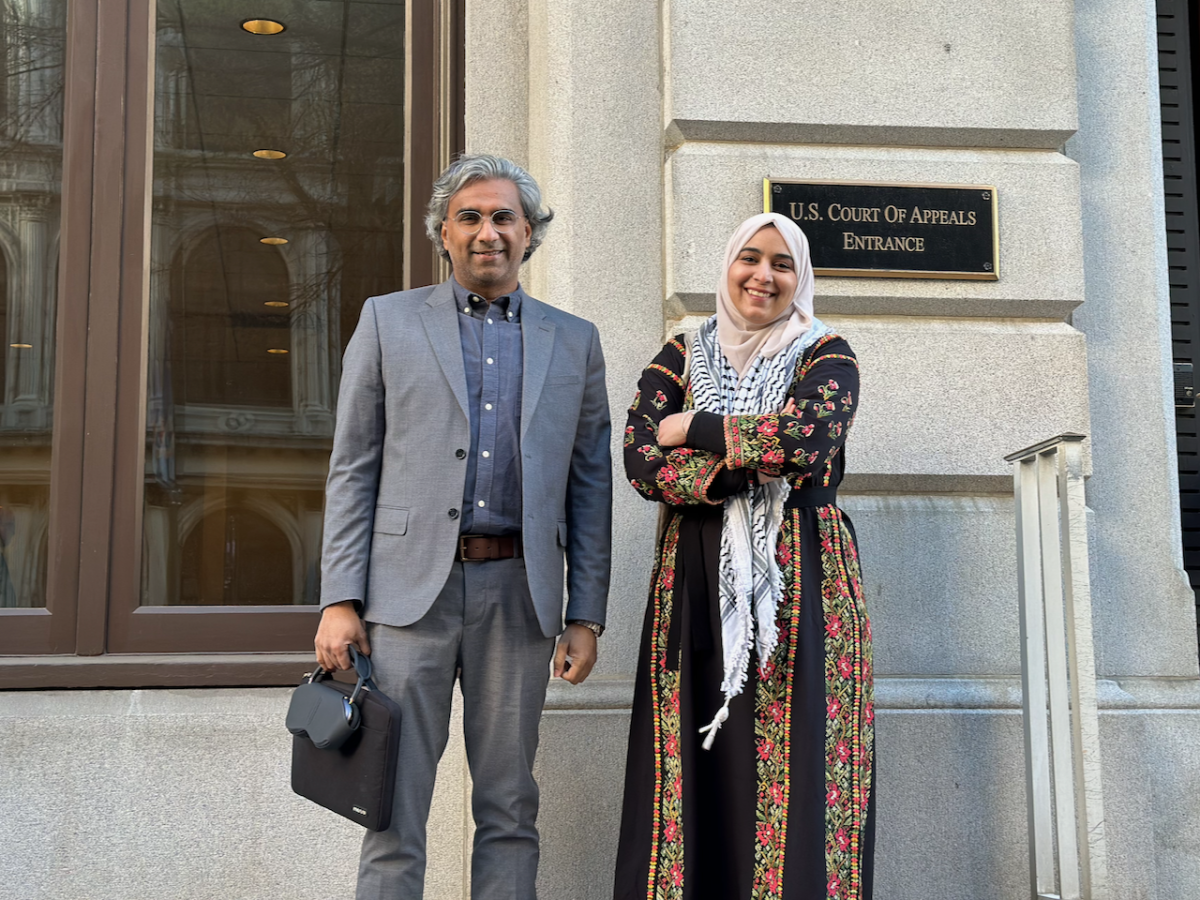
A panel of federal appeals judges appeared skeptical of the government’s claims during a March 17 hearing on whether the Trump administration can redetain Georgetown University postdoctoral researcher Badar Khan Suri.
Following a federal district court’s May 2025 ruling that released Khan Suri from detention, the federal government asked the 4th U.S. Circuit Court of Appeals for an injunction that would allow immigration officials to immediately redetain Khan Suri. A different appeals panel denied immediate redetention July 1 in a 2-1 ruling; Tuesday’s case heard full arguments on the jurisdiction of Khan Suri’s constitutional claims.
During the hearing, the government’s lawyer, Drew Ensign, argued that the district court took an “unlawful detour” by claiming jurisdiction over Khan Suri’s case. Instead, Ensign said, Khan Suri should seek relief through his parallel immigration proceedings, rather than through federal court.
Two of the three judges in Tuesday’s hearing appeared skeptical of Ensign’s argument against constitutional review. The third judge, James Harvie Wilkinson III, questioned why immigration proceedings were not a sufficient path for review.
Only two of the three judges must agree to issue a majority opinion. The panel could take months to issue a decision, according to Khan Suri’s lawyers.
The appeals hearing comes one year after federal immigration officials detained Khan Suri on March 17, 2025, alleging he threatened U.S. foreign policy. In May 2025, a federal district court in Virginia ruled that Khan Suri’s detainment unconstitutionally targeted him for protected speech and familial associations, violating the First Amendment. Immigration officials released him from detention in Texas immediately after the district court ruling.
Khan Suri’s lawyers, both staff attorneys at the American Civil Liberties Union, contended that the government’s argument would allow immigration officials to target pro-Palestinian speech and indefinitely detain immigrants without substantive paths for review. They said the constitutional challenge is essential to grant Khan Suri timely relief.
Noor Zafar, an ACLU senior staff attorney and one of Khan Suri’s lawyers, argued that review solely through the immigration procedures would allow Khan Suri to remain detained as procedures continue, which would not offer sufficient relief.
“That review would come too late to offer relief for Dr. Suri,” Zafar said during the hearing.
In their briefing submitted Dec. 5, Department of Justice (DOJ) lawyers argued that the district court “improperly thwarted” the federal government’s determination that Khan Suri was adverse to U.S. foreign policy goals. The lawyers contended that federal courts cannot interrupt immigration proceedings to hear an “artful claim” contesting the constitutionality of deportation attempts.
During the Tuesday hearing, Wilkinson warned that national immigration proceedings could “get involved in a serious tangle” if petitioners pursued immigration and constitutional cases simultaneously — echoing the DOJ’s oral and written arguments. Wilkinson said the jurisdictional issues “raise the risk of duplication.”
In questioning Ensign, one of the other judges, Pamela Harris, noted that the government’s theory could permit immigration authorities to detain Khan Suri for months or years without redress, since immigrants cannot “get review of detention during detention.”
When denying the government’s injunction request in July, the appeals court said it found the government unlikely to succeed on the merits of its claims that the district court lacked personal or subject-matter jurisdiction. Specifically, the court rejected the Justice Department’s jurisdictional argument that federal district judges could not oversee ongoing immigration cases. In the Tuesday hearing, the judges focused on this latter question.
The government alleged Tuesday that the Immigration and Nationality Act of 1952 (INA), the basis of many deportation claims, bars federal courts from ruling on deportation and detention proceedings. Khan Suri’s lawyers argued that the INA allows constitutional challenges to detention while deportation proceedings are ongoing.
Johnny Sinodis — a partner at Van Der Hout LLP, the law firm representing Khan Suri in his immigration case — said federal courts must retain jurisdiction over cases dealing with constitutional violations because immigration courts are inherently political, noting that their judges report to Pam Bondi, the U.S. attorney general.
“They’re not real courts,” Sinodis said at a press conference after the hearing. “Every immigration judge is an employee of the Department of Justice, answerable to Pam Bondi and Donald Trump. They’re subject to extreme political influence. And I have no doubt that in many instances, if not all, they’re receiving direction on how these cases should be decided and handled.”
Khan Suri’s lawyers said his next immigration hearing is scheduled for June 1, at which they will argue that the First Amendment protects him from deportation. Until that hearing, his legal team will attempt to “uncover additional evidence of government illegality,” Sinodis said.
The case also follows a 3rd Circuit ruling in January that Columbia University student Mahmoud Khalil could only be released by an immigration judge, not a constitutional claim. The 4th Circuit is not bound by other circuits’ rulings, but judges often look to them for parallel reasoning.
Zafar said at the press conference that she is confident there is “strong 4th Circuit precedent” that could yield a ruling in Khan Suri’s favor.
In remarks after the hearing, Khan Suri said his case represents the principles of U.S. democracy.
“The health of a free society depends on protecting the right to question authority and speak uncomfortable truth,” Khan Suri said at a press conference. “The real test of democracy is whether it protects dissent, even when the dissent challenges power.”
This story was updated March 17 to include comment from Khan Suri’s lawyers and additional context.