Each week, members of the Georgetown University community have the opportunity to voice concerns and call for action through this very opinion section of The Hoya.
Contained in each piece is the opportunity to appeal to others, typically calling on the university’s administration to rethink policies ranging from the length of winter break to the guest speakers they invite.
The Editorial Board acknowledges that some calls to action may be less feasible than others and, often, implementing university policy takes time. Yet it does not mean students, faculty and staff should stop making these requests. It certainly should not mean community concerns should rest permanently on the page.
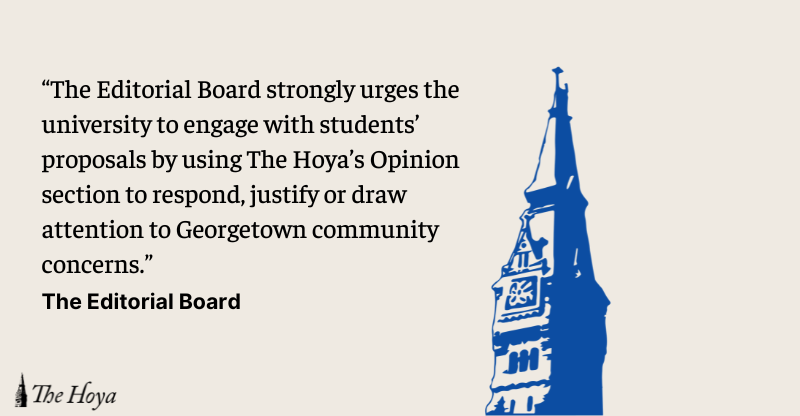
Instead, the Editorial Board strongly urges the university to engage with students’ proposals by using The Hoya’s Opinion section to respond, justify or draw attention to Georgetown community concerns.
The Opinion section of a newspaper is a dialogue and we relish the opportunity to support community members’ voices as they ruminate on campus culture. The issue arises when the conversation stops there.
Last April, Naveen Shah (CAS ’25) and Pratik Jacob (CAS ’25), both of whom had served on the College Academic Council (CAC), expressed their disapproval of moving certain undergraduate programs to the Georgetown University Capitol Campus through a viewpoint in The Hoya. Their primary call to action urged the university to add one student to Georgetown’s board of directors, citing other universities that have done so.
Shah explained how administrators on every level could have benefited from the opportunity to share their thoughts on the matter.
“Our experiences with the CAC demonstrated the value of hearing not only from university administrators but also lower-profile employees tasked with implementation of specific processes, like registration,” Shah told The Hoya. “OpEds would provide a unique format for these figures to share their expertise on a particular issue, working towards a solution.”
Regardless of the feasibility of their initiative, the Editorial Board hoped to receive a direct response to their call, as students invested in this change wanted to understand the administrative perspective.
Asher Maxwell (CAS ’26), whose viewpoint from January 2025 urged the university to end legacy preference in undergraduate admissions, said that the administration would benefit from outlining its explanations for certain decisions.
“When it comes to controversial policies like legacy admissions, where it is easy for students to assume the university’s motivations are corrupt or unsavory, the administration only hurts itself by offering no clear public rationale,” Maxwell told The Hoya.
Importantly, professors and faculty have meaningfully engaged with students through the Opinion section, addressing student institutions such as campus clubs and introducing new initiatives on campus geared towards student health. These diverse calls to action have set a precedent for writing in The Hoya.
However, these pieces fundamentally differ from the ones we are encouraging the administration to write. Rather than submit stand-alone viewpoints, we urge administrators to continue engaging with student and faculty concerns through The Hoya as a public forum.
University administration often communicates with students through mass emails, which serve an important functional purpose. The Editorial Board is not proposing that administrators replace this channel by writing their viewpoints. Instead, we argue that communicating through the university’s newspaper of record serves a distinct function.
Writing and responding to viewpoints allows administrators to engage directly with our concerns in a shared space — one that prioritizes dialogue and explanation over one-way messaging. This means of engagement strengthens the university’s relationship with its students by demonstrating that they take students’ voices seriously enough to merit a public response. Students have suggested this course of action before.
A university spokesperson said Georgetown is committed to engaging with the student body.
“We will continue to communicate and engage with students and the broader Georgetown community about issues of interest through student media and a wide variety of other existing channels including websites, blogs, newsletters, social media, messages to the community and meetings between students and administrators, including town halls, office hours, virtual sessions and informal conversations, as well as engaging with student government and clubs and advisory committees with student representatives,” the spokesperson wrote to The Hoya.
Already, we are beginning to see The Hoya’s Opinion section used as a means for university administrators to respond to students. This week, our section received and published a letter to the editor written by College of Arts & Sciences Dean David M. Edelstein and School of Health Dean Christopher J. King, responding to the portrayal of pre-health advising in a December 2025 article.
This is the perfect example of what the Editorial Board is seeking. Pieces that Georgetown writes, which confront and directly respond to student concerns, will not be perceived as hostile. Rather, students will recognize the university’s efforts to explain the reasoning behind their decisions. By engaging with the student body’s concerns and voices, we can resolve Georgetown’s most pressing issues together.
Hoyas of the past, present and future read viewpoints published in The Hoya. Therefore, any response to a concern raised in these pieces would benefit from being made publicly accessible to these readers and the Georgetown community. As a community, we’re constantly debating how best to build a culture of intellectual curiosity. Discussion, discourse and use of the public forum are the most effective ways to encourage the dialogue that is so necessary for all of Georgetown.
The Hoya’s Editorial Board is composed of six students and is chaired by the senior opinion editors. Editorials reflect only the beliefs of a majority of the board and are not representative of The Hoya or any individual member of the board.