
On Tuesday, March 10, two Georgetown students hosted “Desserts & Dialogue: Real Conversations About Georgetown Life” with professors Alexandra DeCandia and Elizabeth Grimm to talk about navigating careerism, club culture and fitting in at Georgetown.
When I walked into the Copley basement room, I was met with baked goods and a bustling student scene. About 30 undergraduates stood around talking to one another, meeting a friend of a friend and laughing with the two professors. I introduced myself to Professor Grimm, and she immediately asked me what I was interested in and what brought me to the event.
Eventually, all of us made our way to the living room, where we split into two groups to have small discussions led by one of the professors. I nervously anticipated the conversation to be stiff; I had never been to this kind of event, and I wasn’t sure how free the discussion would flow. But, almost immediately, we divulged into life at Georgetown, career pipelines, the value of higher education and what Georgetown can do to encourage more community.
Although they are much more scarce than I would like, this wasn’t the first time I have had the opportunity to forge relationships with faculty members. Every first-year seminar in the College of Arts & Sciences (CAS) is given a stipend to take their students to an off-campus event. My “Equality of Educational Opportunity” class went to the Brown Lecture in Education Research at Howard University, followed by a dinner at Il Canale. That evening is ultimately still one of my favorite Georgetown memories because of how close I grew to my classmates and my seminar professor. For the first time, I felt like I was both academically and personally enriched outside of the classroom.
Georgetown should create more opportunities for students to form stronger bonds with their faculty. Programs like this have existed in the past. The Georgetown “Moveable Feast,” a program that gave small groups of students a stipend to have dinner with professors and academic deans, was launched in 2013, and received praise even years after. Students gushed over the ability to strengthen relationships with professors and teaching assistants outside the confines of classroom material. Georgetown must implement at least a similar institutional policy that reinforces building student-faculty relationships.
But beyond the existence of these structured programs, I call on students and faculty alike to reach out to one another in a personal capacity more frequently. Faculty should be as available as they can to help mentor, be a tool to prepare for life after Georgetown and be a listening ear for the issues their students face. Students should also go out of their way to get to know their professors.
The initiatives need not be formal meals or expensive excursions. When my professors preface their office hours introduction on the first day of class with “come talk with me about homework or about life,” I feel comfortable approaching them. In my first semester of college, I went to my “U.S. Political Systems” professor on three different occasions to talk about the 2024 election and where our class fit into current events; I emailed her 10 months later to ask about community service opportunities. At “Desserts and Dialogue,” Professor Grimm recommended that we simply ask our professors to get lunch in Leo’s, which only costs an extra meal swipe. The point is that, when professors frame themselves as approachable and remind students that they are there for them outside of just coursework, students are inspired to actually reach out.
The issue isn’t that Georgetown faculty are inaccessible or uninterested in their students. In my experience, professors here care about the classes they are teaching and generally make themselves available for office hours. But a gap still exists between knowing a professor in a classroom environment and actually forming a close, mentoring relationship.
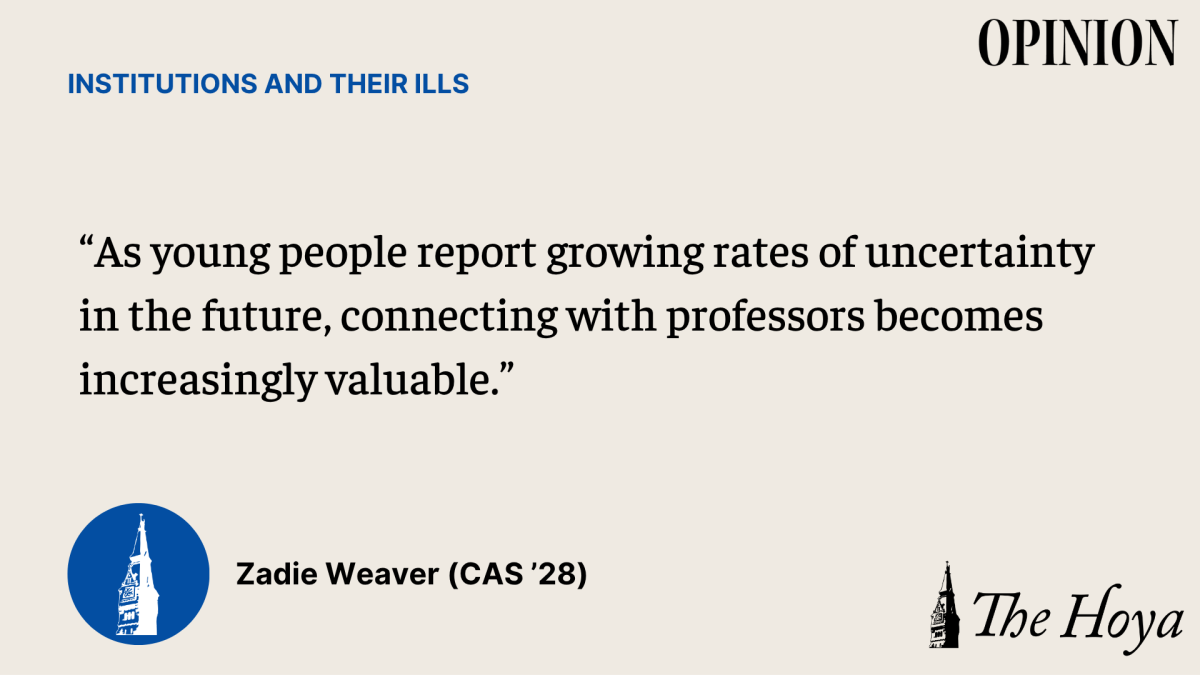
As young people report growing rates of uncertainty in the future, connecting with professors becomes increasingly valuable. Georgetown students’ access to distinguished professors is a tool in navigating careers and lifepaths; many of my professors have been public servants, government employees and business leaders before becoming academics. Those stories and experiences are incredibly useful to any student unsure of what they can do or where they can go.
But, there is also just an intrinsic value in forming stronger relationships and bonds. Outside of career advice, networking opportunities or a higher participation grade, having new conversations with anyone is beneficial. At an academically rigorous school like Georgetown, I sometimes find myself focused on grades, jobs and my social life with other students. This comes at the expense of the rich community in between. In order for Georgetown to truly be committed to a community that lives “generously in service to others,” we need to implement both structural policies like “A Moveable Feast” to bring students and faculty closer, as well as a cultural change where students and faculty undertake the responsibility to form relationships with one another. Relationships are just as important to Georgetown as its academic institutions.
Zadie Weaver is a sophomore in the College of Arts & Sciences. This is her third installment of the column “Institutions and Their Ills.”