
Nearly a year after the massive success of “Wicked,” “Wicked: For Good” returns to complete the tale. Unfortunately, compared to its predecessor, the film is never truly able to fly.
Adapting the second act of the beloved Broadway musical “Wicked,” the film focuses on the aftereffects of Elphaba’s (Cynthia Erivo) vow to reveal The Wizard’s (Jeff Goldblum) deception and free the oppressed animals of Oz. As she clashes with her best friend Glinda (Ariana Grande), now known as the Good Witch, Elphaba reckons with her identity, while struggling to make true change in Oz.
Much like the first film, “Wicked: For Good” significantly elongates its source material, adding nearly an hour and 17 minutes to the musical’s hour-long second act. While most of these additions are small, the biggest and most welcome change is the decision to further develop Glinda’s character.
Writers Winnie Holzman, the original writer of the musical, and screenwriter Dana Fox most prominently add a flashback to Glinda’s childhood. This flashback is quite effective in setting up Glinda’s arc throughout the film, serving to characterize Glinda’s impossible desire to be magical, making her feel inadequate despite the complete adoration and love she receives. Where Grande got the chance to display her comedic ability in “Wicked,” here Grande is able to showcase her dramatic abilities as she deftly captures the heartbreaking tension between Glinda’s public and private personas.
As the film’s central character, Erivo continues to display her powerhouse vocals and natural charisma. Her rendition of “No Good Deed” was, no doubt, one of the film’s strongest moments. The sheer power of her voice beautifully delivers the anger and frustration Elphaba feels. It feels as if all of Elphaba’s pent-up exhaustion and bitterness were released in that moment — a complete catharsis that was only achievable through Erivo’s astonishing vocals.
While still lacking in color, which was one of the main critiques of the duology’s first installment, the film does feature some beautiful set pieces. The Wizard’s lair, shown in its entirety during the song “Wonderful,” features a variety of whimsical inventions that add to the sequence’s oddball energy, falling into place with the song’s quirky and upbeat instrumentals. Additionally, the aftermath of Glinda’s failed wedding is rich with detail, as crushed flowers, knocked chairs and stone vases nearly fill the entire floor. The mess tragically frames Glinda as she heartbreakingly sings “I’m Not That Girl (Reprise).”
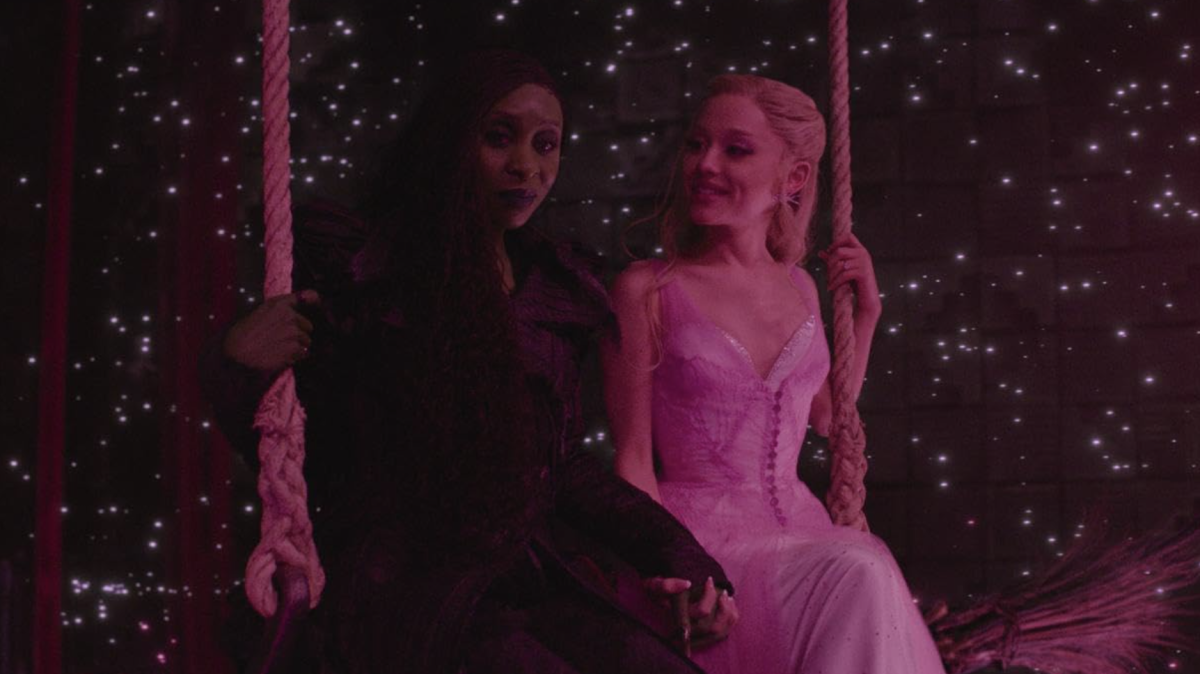
Yet, the film doesn’t quite hit the mark on all its set designs. Arguably, the film’s most important moment, its rendition of “For Good,” sadly falls flat due to the empty background behind Elphaba and Glinda. Although the number is situated in an abandoned castle, the setting is so empty that it distracts from what seems to be the film’s emotional peak. Erivo and Grande were incredible, yet the uninteresting set and dark background felt undeserving of such a beautiful moment.
The film’s greatest weakness is, unfortunately, its own story. “Wicked: For Good” stays relatively close to the original musical’s second act, but the film’s longer runtime lays bare the second act’s weaknesses. For what appears to be a long public battle between Elphaba and Glinda, who becomes the face of the Emerald City, the pair are surprisingly friendly. The pair’s relationship never quite seems to have been impacted greatly by the huge distance between their societal roles. In fact, the biggest conflict between them seems not to be their difference in beliefs, but their struggle over Fiyero (Jonathan Bailey). Yes, the conflict begins with their argument about Elphaba’s sister Nessarose (Marissa Bode), yet the conflict only escalates to a physical fight when it shifts to the subject of Fiyero.
Additionally, the relationship between Fiyero and Elphaba feels surprisingly rushed. The two don’t reunite onscreen until Fiyero’s declaration of loyalty to Elphaba during their confrontation with The Wizard. The lack of any other interaction other than what seems like passing thoughts makes their connection seem unbelievable on the big screen. While the chemistry between Erivo and Bailey helps to bring their love to life, I can’t help but question how it would have appeared without their strong performances.
Many of these issues, though, can be addressed by the nearly year-long gap between the first and second film. The staged musical works despite these issues, as there is only a 15-minute intermission that separates the first and second half of the story. This allows the audience to remain invested in the narrative. With a longer gap, it requires the audience to remember the emotional beats and arcs of other characters in the first film, causing “Wicked: For Good” to feel incomplete despite its commitment to the source material.
The magic of “Wicked” certainly returns with “Wicked: For Good,” yet the film never reaches the first installment’s highs. However, what saves the film from falling is the undeniable appreciation for the original musical that inexplicably fills the film. Sure, “Wicked: For Good” often stays too close to the ground, but it makes an admirable attempt to stay true to the musical’s spirit all the while building on its iconic legacy.