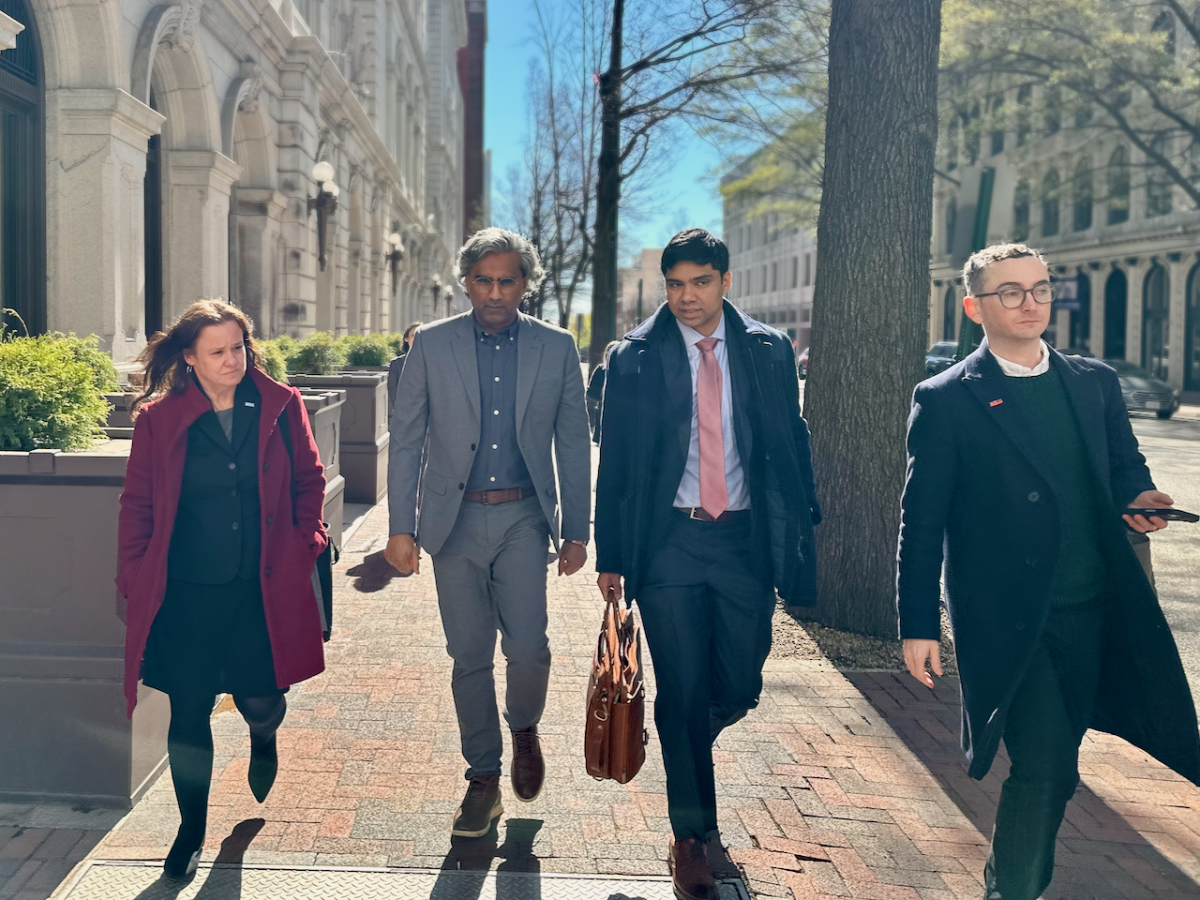
The federal government’s lawyers and Georgetown University researcher Badar Khan Suri’s legal team debated the role of the federal judiciary in immigration cases in front of an appellate court March 17.
Khan Suri is currently a party in two parallel cases: one in federal court and one in immigration court. Suri v. Trump, the federal case, is focused on whether the government unconstitutionally violated Khan Suri’s First Amendment rights when detaining him in March 2025. His immigration case centers on whether the government can remove him from the country.
In May 2025, U.S. District Judge Patricia Tolliver Giles ordered the federal government to release Khan Suri from detention, ruling that his detainment was punitive and retaliation for his speech and familial relationships, violating the First Amendment. Giles also ruled that the jurisdiction for Khan Suri’s habeas corpus petition, which demands the government justify his detention before a federal judge, should be in Virginia because that is where the government arrested Khan Suri.
An appeals panel denied the government’s request for immediate redetention last July in a 2-1 ruling. Tuesday’s hearing heard full arguments on the jurisdiction of Khan Suri’s constitutional claims, which helps determine whether the government can redetain him.
In the simultaneous immigration case, an immigration judge ruled in November that Khan Suri is deportable. His legal team continues to oppose that decision, and his next immigration hearing is scheduled for June 1. If the court does not grant relief, his legal team may petition the Board of Immigration Appeals (BIA), a federal administrative body overseeing immigration court appeals.
Tuesday’s appellate hearing centered on the question of whether an immigrant can petition federal civil courts while their immigration case remains ongoing.
Federal Courts’ Jurisdiction
The government’s lawyers argued that allowing Khan Suri to proceed with his federal case may lead to contradictory rulings between federal and immigration courts. They claimed that if the case were decided solely in immigration court, Khan Suri would still have a means of review through the BIA.
Khan Suri’s lawyers argued that waiting for a BIA review could leave Khan Suri in detention for years, as the BIA oversees removal, not detention. Since removal proceedings can be lengthy, they maintained that a BIA review would be too late to provide Khan Suri with effective relief.
These arguments focused on three related issues: the viability of a habeas corpus petition, the jurisdiction over Khan Suri’s case, and the applicability of parallel case law in other circuit courts.
Khan Suri’s petition for habeas review asks a federal judge to exercise civil jurisdiction over his detention and weigh whether the federal government violated his First Amendment rights. His legal team contends that immigrants can ask the independent judiciary to review the case.
The government, meanwhile, asserts that only immigration judges should oversee habeas petitions.
At the root of the debate is whether the Immigration and Nationality Act of 1952 (INA), the primary law governing immigration in the United States, specifies a jurisdictional distinction between removal and detention, and restricts federal judges’ authority in the latter.
INA § 1252(g) provides that “no court shall have jurisdiction to hear any cause or claim by or on behalf of any alien arising from the decision or action by the Attorney General to commence proceedings, adjudicate cases, or execute removal orders against any alien under this chapter.”
Both legal teams also contested § 1252(b)(9) of the INA, which states that “with respect to review of an order of removal,” judicial review of law and fact, including constitutional claims, “arising from any action taken or proceeding brought to remove an alien from the United States under this subchapter shall be available only in judicial review of a final order under this section.”
Essentially, the statutes aim to assure that an immigration judge and a federal judge are not handing out contradictory rulings on an immigrant’s removal status.
The government argues that the statutes’ phrasing encompasses all parts of immigration proceedings tied to removal — generally including detention. But in July, the 4th Circuit dismissed that reading as “sweeping,” saying the Supreme Court has repeatedly rejected expanding 1252(g) to “habeas challenges to present immigration confinement,” concluding that federal courts have the power to review immigrants’ detention.
Drew Ensign, the government’s lawyer, said Giles acted improperly by assuming jurisdiction over Khan Suri’s case in the May ruling.
“Habeas is the path the petitioner has chosen here, and the district court indulged that unlawful detour by granting habeas relief,” Ensign said in his oral argument Tuesday.
Ensign argued that the word “arising” implies that the law encompasses detention, meaning Khan Suri cannot challenge his detention in federal court, and that the government should be able to redetain him while his immigration case proceeds.
“When an alien challenges his detention on the ground that he should not be removed in the first place, it is in substance a challenge to his removal,” the government’s lawyers wrote in their brief.
James Harvie Wilkinson III, one of the judges deciding the case, said he is worried that giving federal courts too much jurisdiction over immigration cases would make the legal process inefficient.
“The whole immigration process of this country could get involved in a very serious tangle if you say that the immigration proceedings and the habeas proceedings can go forward simultaneously on the same claim,” Wilkinson said during the hearing. “You really are getting into not only delay, but all kinds of contradictory rulings and everything that puts the immigration process in a perfect snarl.”
Khan Suri’s lawyers, meanwhile, argued that removal and detention are separate procedures and that the statutes only explicitly include removal.
Noor Zafar, one of the nonprofit lawyers representing Khan Suri, said that the government cherry-picked language from § 1252 to make its case.
“If you look at that statute as a whole, the jurisdiction-stripping provisions apply only with respect to removal proceedings and issues that arise in those,” Zafar said in her oral argument.
Means for Review
Khan Suri’s lawyers said that the government’s position would leave Khan Suri without means of review, possibly for years, as his immigration case proceeds.
“Together, its arguments mean that someone like Dr. Suri is essentially helpless, at least until the conclusion of executive-run immigration proceedings, to challenge an unconstitutional government attempt to retaliate against and silence them — and that any challenge to that kind of attempt can only occur in a jurisdiction of the government’s choosing,” Khan Suri’s lawyers wrote in their brief.
In response to Ensign’s claim at the hearing that Khan Suri “prefers” judicial review against BIA review, Judge Pamela Harris said his interpretation felt limiting.
“The idea that you can be detained for years, and then, good news, at the end of that yearslong detention period, you can get review of whether for the last several years you’ve been illegally detained — I mean, I feel like that goes beyond sort of ‘personal preference,’” Harris said during the hearing.
Baher Azmy — the legal director for the Center for Constitutional Rights, a nonprofit that is part of the team representing Khan Suri — said the government wants to move the case out of federal court because immigration judges are overseen by President Donald Trump and the executive branch, unlike federal judges.
“The case might have appeared to turn on these seemingly technical questions of jurisdiction, but that really masks the broader danger to our constitutional rights at stake,” Azmy said at a press conference after the hearing. “In these cases, the government, as evidenced by their manipulative behavior in this case, wants to force these kinds of cases through the immigration courts, which are not really independent courts, they’re answerable to the president.”
Johnny Sinodis — a partner at Van Der Hout LLP, the law firm representing Khan Suri in his immigration case — said immigration judges do not have the same mandate as the federal judiciary to weigh constitutional claims.
“They’re only supposed to determine whether someone is removable,” Sinodis said at the press conference. “They disclaim the authority to engage in discovery and to permit people like Dr. Suri from bringing constitutional claims in immigration court.”
The lawyers also sparred Tuesday over the relevance of a 3rd Circuit ruling in January that Columbia University student Mahmoud Khalil could be released only by an immigration judge, not a member of the federal judiciary. The court specifically cited INA §1252(b)(9), holding that immigration courts provide a sufficient avenue for immigrants to seek constitutional relief.
The 4th Circuit is not bound by other circuits’ rulings, but judges often look to them for parallel reasoning and are wary of creating conflicts between circuits — which can prompt Supreme Court cases.
During the Tuesday hearing, Ensign underscored the 3rd Circuit’s reasoning in the Khalil decision and cautioned the judges that ruling for Khan Suri would create such a conflict. Khan Suri’s lawyers contended in a February brief that the Khalil case was wrongly decided and should not bear on the 4th Circuit’s decision.
Virginia’s Relevance
If the 4th Circuit sides with the government on the jurisdiction of the federal judiciary, Khan Suri’s federal case would be dismissed and his legal proceedings would solely play out in immigration court. But if the appeals panel agrees with his lawyers, the judges will confront a second question: Should Khan Suri’s federal case be in Virginia at all?
The issue is that Khan Suri’s lawyers originally filed for relief in Virginia, where he was arrested, after he was transferred to a detention facility in Louisiana and, later, to one in Texas. His legal team has long contended they were unable to contact him and needed immediate judicial action.
Ensign argued that his lawyers knew where he was, so the case should never have been filed in Virginia. Judge DeAndrea G. Benjamin said that since the government rapidly moved Khan Suri after detaining him and did not immediately update the online ICE Locator, which shows where a detained immigrant is being held at a given time, Khan Suri’s lawyers couldn’t have known to file a habeas petition in Texas.
“How was his attorney, filing his habeas petition, supposed to know that, if it was not in the locator?” Benjamin asked Ensign.
Khan Suri’s legal team has relied on a principle known as the “unknown custodian” exception, which allows a detainee’s lawyers to file suit in the jurisdiction where the individual was removed if their physical location is unclear.
The judges appeared particularly unpersuaded by Ensign’s arguments on Tuesday that the exception did not apply, but they will only confront that issue if they side with Khan Suri on the applicability of federal courts.
The 4th Circuit’s ruling, which may not come for several months, could help shape how federal courts broadly understand the process by which immigrants seek judicial review.
Sinodis said the federal judiciary is essential to protecting immigrants’ constitutional rights.
“That’s the very reason Dr. Suri and others like him had to seek relief from district courts, where a real judge could hear actual constitutional claims, because the immigration laws just do not permit that,” Sinodis said. “It’s a game that’s stacked heavily in favor of the executive — that’s being weaponized in ways that we’ve never seen before by this current administration.”