
Each May, Georgetown University celebrates another graduating cohort of global leaders. However, certain students’ ambitions to “change the world” increasingly won’t happen in the United States, as international students are more often choosing to return home after graduation.
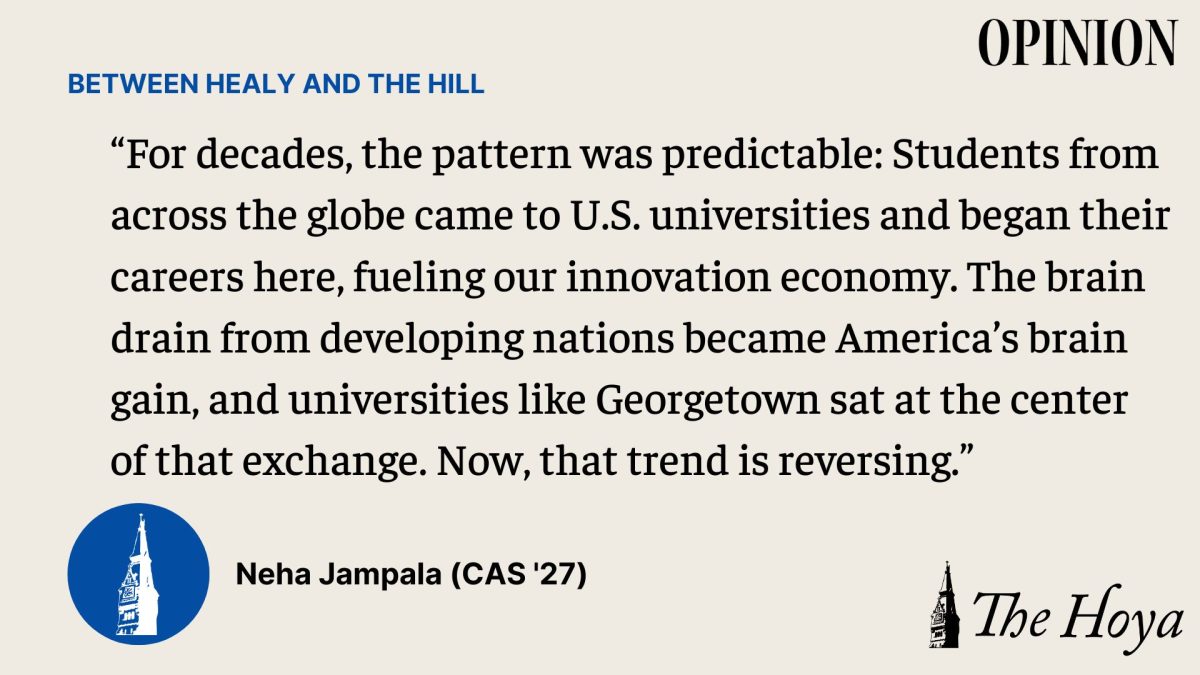
For decades, the pattern was predictable: Students from across the globe came to U.S. universities and began their careers here, fueling our innovation economy. The brain drain from developing nations became America’s brain gain, and universities like Georgetown sat at the center of that exchange. Now, that trend is reversing.
Tightened visa policies, rising anti-immigrant vitriol, ballooning processing backlogs and surging opportunities abroad are reshaping the equation for international students. Georgetown must determine whether this reversal supports our Jesuit mission or exposes a quiet crisis in the United States’ economic competitiveness.
For international students, planning for college is starkly different from it was a decade ago. The H-1B visa lottery, which grants work authorization to a limited number of graduates each year, has only a 29% selection rate in 2025, down from roughly 77% in 2010. If a student isn’t selected, their ability to stay in the United States expires within months. Unless they find another visa, students must decide whether to build a life here with an almost-certain expiration date or explore opportunities back home where they’re not vulnerable to deportation.
Furthermore, the so-called pull factors that lure talented students back to their home countries have strengthened. China’s tech sector is pioneering new models in financial technology and artificial intelligence. India’s startup ecosystem raised over $13.7 billion in venture capital last year. The Gulf states are pouring hundreds of billions into economic diversification that demands the Western-educated talent which Georgetown produces. Returning home isn’t settling anymore; it’s often the more ambitious choice.
These developments represent a change in how international students think about their Georgetown education. They’re not just learning the U.S. policy process; they’re actively mapping what they learn onto systems that exist back home. In classes like “Comparative Political Systems” and “International Financial Cooperation,” I’ve seen international classmates connect U.S. policy tools to challenges in their own countries. Many tell me they’re also building networks — with professors, research partners, mentors — that they plan to maintain when they return. As the alumni network proliferates, the Georgetown degree has become especially portable.
Our university proudly proclaims its commitment to forming “men and women for others” who will serve the world, but the reality is a different story. Georgetown markets itself heavily on proximity to power. The implicit promise is access to American opportunity. When international students can’t access those pathways, or choose not to, something in that value proposition breaks down.
Georgetown has yet to reckon with this tension. Career services track first-destination employment, but there’s little data on where international graduates end up five or ten years after graduation, including their fields of work. We do not measure “global impact” the way we measure average starting salaries or graduate school placement rates. We’ve built an institutional infrastructure around domestic career placement and elite American credentials while espousing an entirely different mission.
The reversal in international student retention is not happening in a vacuum — it reflects a broader policy failure by the federal government. Congress has spent years debating immigration reform while the international student pipeline has quietly been constrained. The H-1B system, designed in 1990 for a workforce of 65,000 people, has not been meaningfully updated even as global competition for talent has intensified. As a result, the United States is increasingly pricing itself out of the global talent market: International enrollment has stagnated while competitor nations surge ahead. Political gridlock and misaligned incentives force a binary immigration outcome, either a pathway to citizenship or temporary status. There’s no room for the kind of fluid global mobility that actually characterizes how elite talent moves in the 21st century.
There’s no clean resolution to this tension. If Georgetown genuinely believes in training leaders to serve the global common good, international students returning home should be celebrated as loudly as those who remain in the United States.
However, if Georgetown also sees itself serving American interests, students and administrators need to advocate loudly for policies that facilitate talent retention rather than force exits. The university should use its voice and its access to push for immigration reform that serves both our mission and our national interest. We can support expanded Optional Practical Training (OPT), the work authorization program for international graduates — particularly in science, technology, engineering and mathematics (STEM) fields — reformed H-1B systems and clearer pathways to permanent residency while also celebrating when graduates choose to return home.
The assumptions that built U.S. higher education’s dominance are being stress-tested. Georgetown can either cling to an old model or lean into a new one: measuring success by global impact rather than domestic retention, advocating for policies that enable circulation rather than extraction and embracing the possibility that the best outcome of a Georgetown education might be brilliant graduates building the future somewhere other than D.C.
The brain drain reversal is happening. It is due time for Georgetown to address it head-on.
Neha Jampala is a junior in the College of Arts & Sciences. This is the third installment of her column “Between Healy and the Hill.”